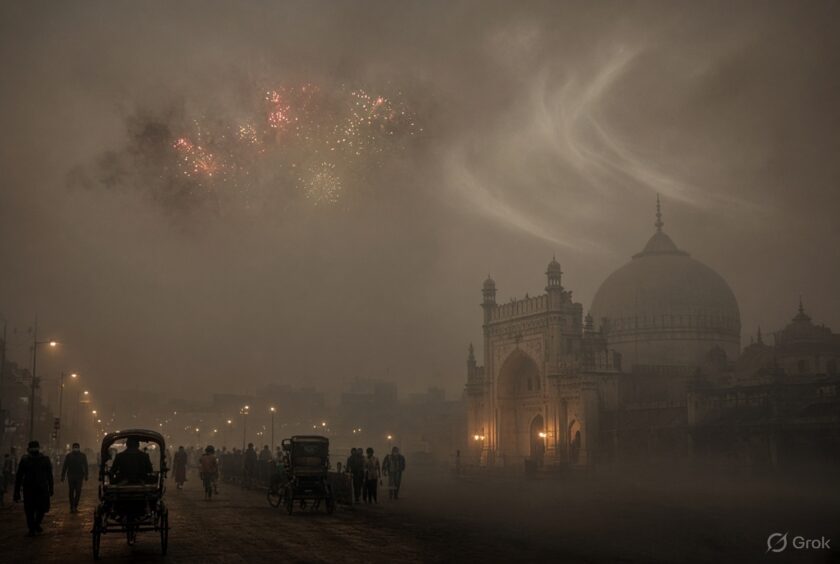
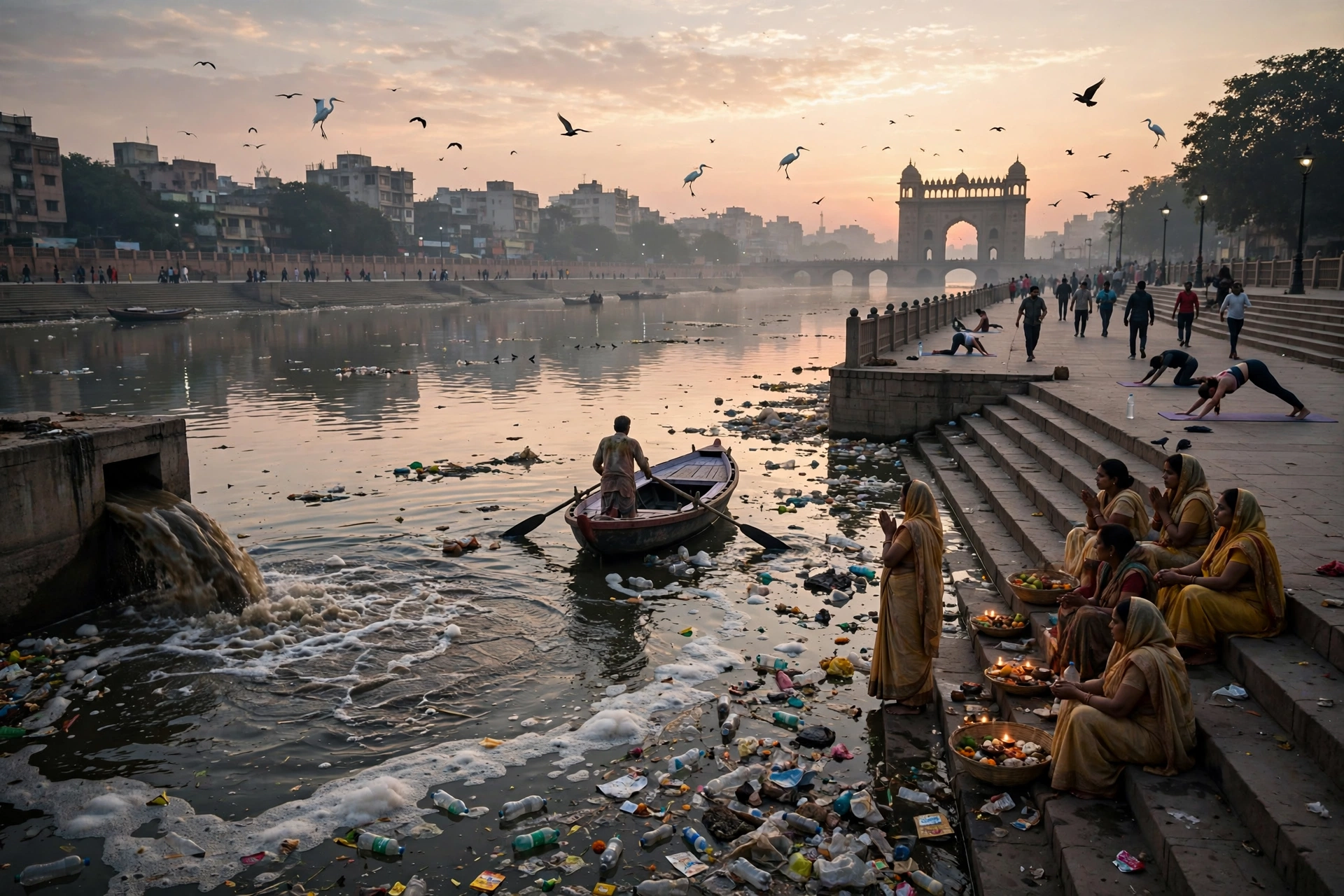
Lucknow: Every morning, Lucknow wakes up next to the Gomti. Office-goers cross its bridges, joggers circle the riverfront promenade, and devotees get ready for the ghats. And yet most people in the city barely notice the river. It’s scenery. With Chhath only days away and the winter flow already thin, that is getting harder to get away with.
The question is a simple and uncomfortable one: is the Gomti getting cleaner, or just better-looking?
What the water says
Post-monsoon assessments don’t offer much comfort. Dissolved oxygen is often far below what a healthy river needs, while BOD and COD stay high. Faecal coliform counts regularly overshoot bathing standards by a wide margin. Recent studies have found dangerously low average dissolved oxygen along stretches inside the city, along with heavy organic pollution. As winter flow drops, the same pollutants get more concentrated, and easier to see and smell.
Upstream of Lucknow, the readings are comparatively better. By the time the river leaves the city, the damage shows. The Gomti takes in Lucknow’s waste far more reliably than it receives Lucknow’s care.
Sewage, the unfinished fight
The city has counted 45 drains flowing into the Gomti. Only some have been fully tapped and routed to treatment plants. About 53 per cent of households are on the sewer network. The rest depend on open drains or septic tanks, and much of that ends up in the river anyway. Treatment capacity is roughly 629–630 MLD, but the city produces more sewage and wastewater than that every day. The big Kukrail drain is only partly tapped, and stretches in Gomti Nagar still discharge untreated or half-treated effluent.
Help is on the way, slowly. A 39 MLD plant at Daulatganj was finished in late 2024. Work to divert more drains to existing plants is continuing, with some projects due in late 2026 and 2027. Bigger proposals under the Namami Gange framework include new plants at Basant Kunj (160 MLD), Wazirganj, Jiamau and Neelmatha. Officials talk about ending untreated discharge by 2044. That’s a long way off, but at least it’s a number. Until then, the river keeps carrying a large share of the city’s raw waste.
A prettier riverfront, not necessarily a cleaner one
The Gomti Riverfront turned an 8-km stretch into walkways, lighting, gazebos and open space, and people love it. Walkers use it in the morning, families in the evening. Plans now include a tourist cruise between Hanuman Setu and the barrage, a nature trail, and, under the wider UPSCR vision, a much longer blue-green corridor with city forests and wellness zones.
Environmental observers keep pointing out the gap. Landscaping the banks does nothing for the water between them. Hard embankments and a squeezed floodplain have changed how the river behaves. The makeover is real, but the ecological recovery is not. From the promenade the river can look tidy while it struggles underneath.
Chhath and the ghats

Chhath is the one time the river gets the city’s full attention. This year the festival runs from 13 to 16 November: Nahay-Khay on the 13th, Kharna on the 14th, and the main Arghya offerings on the 15th and 16th. Chief Minister Yogi Adityanath is scheduled to offer the first evening Arghya on 15 November at the Laxman Mela Ground Chhath Ghat. Ahead of the festival, authorities have stepped up cleaning drives, decorated the ghats, put up lighting, and posted extra personnel and Jal Police. For a few days, the river is a place of devotion and official concern.
After the crowds go home, with winter flow still low, the underlying problems are likely to resurface. The weeks after the festival make the contrast clear: ceremonial care for a few days, neglect for the rest of the year.
Voices from the bank
A boatman who has worked near the riverfront for years doesn’t dress it up: “The banks look better. The water still smells the same in many places. When the flow is low, you can see what is coming in from the drains.” He says the landscaped sections look nothing like the stretches downstream, where untreated inflows are much easier to spot.
A regular morning walker sees it differently. “I come here every day because it is open and green. Ten years ago this place was not like this. But if you go closer to the water or walk beyond the main stretch, you notice the difference. We have a beautiful edge. We still need a living river.”
Before and after at the ghats
On the main riverfront, the change is plain to see. Paved paths, lights, benches and tended lawns have replaced years of neglect. At the traditional Chhath ghats, the heavy pre-festival cleaning and decoration create a short-lived order. Go further along the less-visited banks and the old picture holds: silt, plastic, and drain after drain feeding the river. The unmanaged edges of the “before” have become a selective “after” of landscaped public space. The water itself hasn’t changed the same way.
The river we choose to see
Lucknow has spent money making the Gomti presentable. It has also started the slower, harder job of intercepting sewage and adding treatment capacity. The two efforts haven’t caught up with each other yet. A pretty riverfront can sit beside a polluted river, and as Chhath arrives and the low-flow weeks of early winter follow, that gets harder to ignore.
The Gomti needs more than lighting and walkways. It needs steady flow, drains that are fully intercepted, treatment plants that work, and room to be a river instead of a boxed-in urban channel. Until then, Lucknow will keep living beside a river it would rather not look at too closely, one that grows more photogenic while its health is still unfinished business.










 https://www.youtube.com/watch?si=RtToJsBhYBatUrym&v=mOuYNSdhjHA&feature=youtu.be