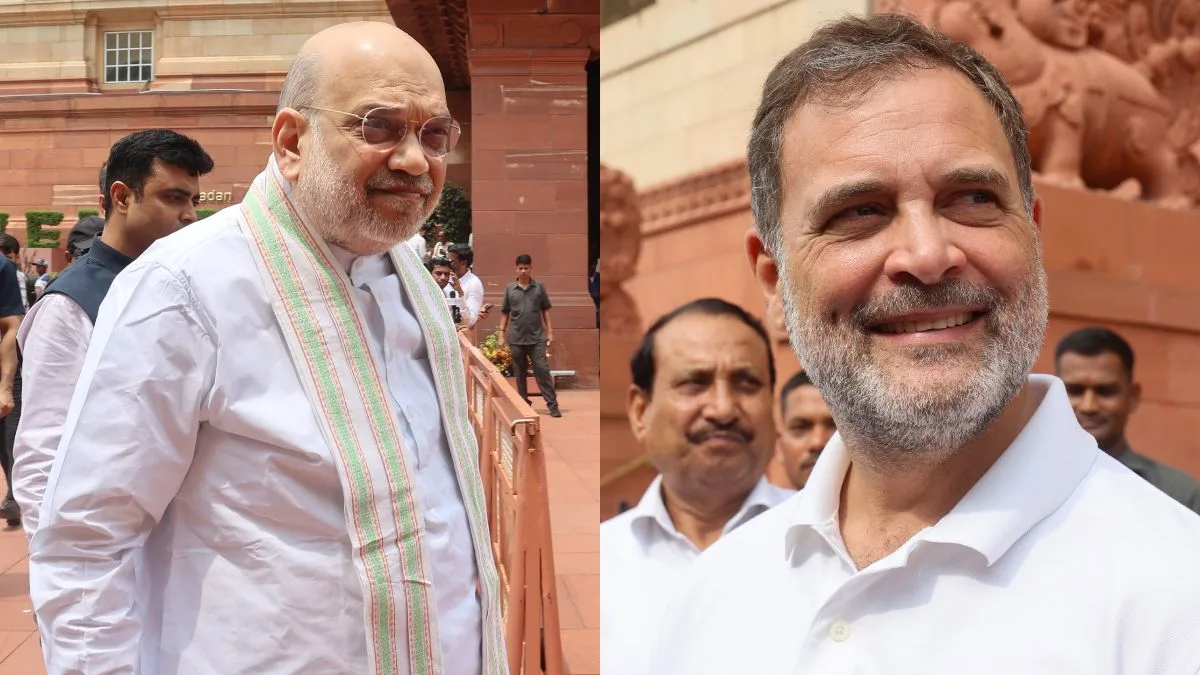
New Delhi: The political confrontation between the Bharatiya Janata Party (BJP) and the Congress has intensified over the Special Intensive Revision (SIR) of electoral rolls, with Union Home Minister Amit Shah challenging the opposition party to examine the reasons behind its repeated electoral defeats rather than blaming the Election Commission of India.
In an article published by Ravivar Delhi on October 18, journalist Vivek Shukla argued that Shah’s remarks had put Congress leaders on the defensive by questioning their allegations against the Election Commission and highlighting the party’s declining electoral fortunes over the decades.

Congress leader Rahul Gandhi has repeatedly alleged that the BJP’s electoral victories are being facilitated by the Election Commission rather than reflecting the popular mandate. Opposition parties have also questioned the functioning of the poll body and demanded accountability over the SIR exercise.
Shah, responding to the criticism, reportedly asked why Congress had been losing elections in several states for decades, well before the current revision of electoral rolls. He argued that the party needed to undertake an honest assessment of its organisational weaknesses, policies and political approach.
Congress questions the purpose of SIR
Congress leaders responded to Shah’s remarks by raising questions about the implementation and effectiveness of the electoral roll revision exercise.
Senior Congress leader Jairam Ramesh sought details on the number of alleged infiltrators identified, removed from electoral rolls or deported from the country. Pawan Khera questioned the deployment of a large police force at Jantar Mantar, while K.C. Venugopal accused Shah of predicting the outcome of future elections, arguing that his remarks raised concerns about the BJP’s influence over the electoral process.
According to Shukla’s analysis, however, these responses did not directly address Shah’s central argument that Congress should examine the reasons behind its prolonged electoral decline.
Shah also accused Rahul Gandhi of seeking to end the SIR process to protect infiltrators, a charge that forms part of the BJP’s broader political attack on the Congress leadership. The article presents the BJP’s position that opposition criticism of the revision exercise is politically motivated, while Congress has questioned the fairness and implications of the process.
Congress’s electoral decline under scrutiny
The article traces Congress’s declining representation in the Lok Sabha since its landslide victory in the 1984 general election, when it won 415 seats. The election took place in the aftermath of the assassination of former Prime Minister Indira Gandhi.
The party failed to secure a parliamentary majority in subsequent general elections. In 1999, under Sonia Gandhi’s leadership, Congress won 114 seats, while its tally fell to 44 in the 2014 general election.
Under Rahul Gandhi’s leadership, the party won 52 seats in 2019 and improved its performance to 99 seats in the 2024 general election. Although the 2024 result marked a recovery compared with 2014 and 2019, Congress remained short of a majority on its own.


Shukla argues that these results weaken the contention that the current SIR exercise alone explains Congress’s electoral difficulties, particularly because the process cited in the article began after the 2024 general election.
Long absence from power in key states
The article also highlights Congress’s prolonged absence from government in several states that were once central to its political influence.
Congress has not had a chief minister in Tamil Nadu since 1967. In West Bengal, the party has remained out of power since the early 1970s. Its decline in Uttar Pradesh has also been pronounced, with its last government led independently in the state dating back to 1989.
The party has similarly struggled to regain power in Gujarat and Odisha, while its influence has weakened in several other regions.
Shah’s reported message was that electoral success requires sustained engagement with voters in villages, towns, agricultural communities and remote areas rather than relying primarily on demonstrations and political campaigns in the national capital.
BJP challenges Congress to reassess its strategy
The article further argues that Congress needs to examine its organisational structure, political messaging and leadership strategy. It portrays Shah’s remarks as an attempt to shift the debate from allegations against the Election Commission to the opposition party’s own record and performance.
The BJP has maintained that its electoral victories reflect public support, while Congress has continued to raise concerns about the electoral process. The competing claims underscore the broader political dispute over electoral transparency, the independence of institutions and the credibility of election outcomes.
Shukla’s analysis concludes that Congress faces a larger strategic challenge than the controversy surrounding SIR alone. Whether the party can rebuild its organisation, reconnect with voters and translate its electoral recovery into a stronger political presence will remain a key question for Indian politics.
The central issue, therefore, is whether Shah’s questions will compel Congress to undertake a deeper review of its electoral strategy or whether the confrontation over the Election Commission will continue to dominate the political debate.












 https://www.youtube.com/watch?si=RtToJsBhYBatUrym&v=mOuYNSdhjHA&feature=youtu.be