New Delhi: Recent protests over the Election Commission and demands concerning Chief Election Commissioner Gyanesh Kumar have highlighted contrasting approaches to crowd management by the Delhi and Mumbai police.
The demonstrations were organised by the same youth-led group in both cities and received support from opposition leaders. However, while the gathering in Mumbai remained largely peaceful, the protests in Delhi witnessed clashes, detentions and allegations of police misconduct, raising questions about how different policing strategies can influence the course of large public demonstrations.

In Mumbai, thousands gathered at Shivaji Park despite the police not granting formal permission for the venue. Authorities barricaded key access points around Shivaji Park and Dadar station and closely monitored the movement of protesters. The police largely avoided direct physical intervention and allowed the gathering to proceed while maintaining a visible presence.
An FIR was subsequently registered by Shivaji Park Police Station against the organisers and several hundred unidentified protesters for alleged unlawful assembly and unauthorised use of loudspeakers. A subsequent march led jointly by Uddhav Thackeray and Raj Thackeray also drew a large crowd, but no major clashes were reported.
The Mumbai approach relied heavily on crowd monitoring, controlled movement and restraint. Police personnel were visibly identifiable, including through name tags, which contributed to greater accountability during the demonstrations.
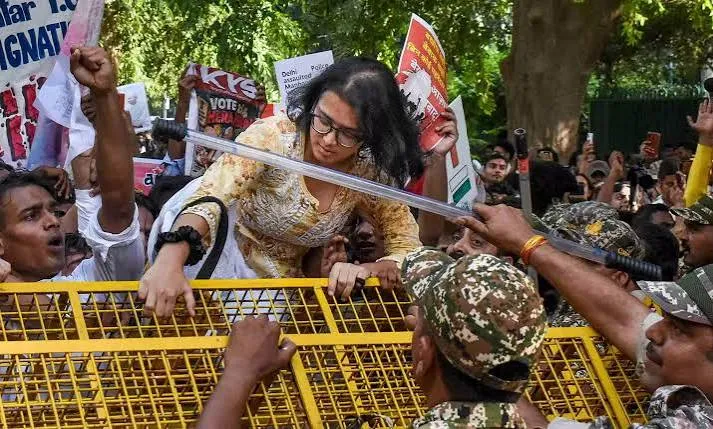
The situation in Delhi was markedly different. Authorities denied formal permission for the protests and imposed restrictions in the New Delhi district. Jantar Mantar was heavily secured, with thousands of personnel deployed, including local police units, reserve forces and the Rapid Action Force.

Police moved to disperse gatherings and detained several protesters and political leaders. Rahul Gandhi and Priyanka Gandhi Vadra were among those stopped while attempting to march, while other political leaders and activists were also detained. More than 100 protesters were reportedly detained during clashes, while over 15 police personnel were injured.
The Delhi protests also resulted in allegations of manhandling of journalists and, separately, sexual harassment allegations against ACP Vivek Bhagat by independent journalists. The matter was transferred to the Delhi Crime Branch for inquiry, according to the source material.
Police registered multiple FIRs in connection with the demonstrations. Delhi Police has also previously cited the presence of individuals with alleged criminal backgrounds or political affiliations at protests, although some of the identification claims reportedly relied on facial-recognition technology whose evidentiary status remains contested.
The contrasting experiences in the two cities have renewed discussion about modern crowd-control practices. Police officials cited in the source material said de-escalation, personnel sensitisation, controlled body language, technology and restraint could help prevent demonstrations from escalating into confrontations.
The developments underline the importance of balancing public order with the right to peaceful assembly. The Delhi-Mumbai experience also demonstrates how policing methods, crowd management and communication can significantly influence the outcome of large public protests.
:::