Lucknow: The Uttar Pradesh government is actively considering major reforms to the Atal Bihari Vajpayee Powerloom Weaver Electricity Flat Rate Scheme to provide greater relief to weavers and strengthen the state’s handloom and powerloom sector.
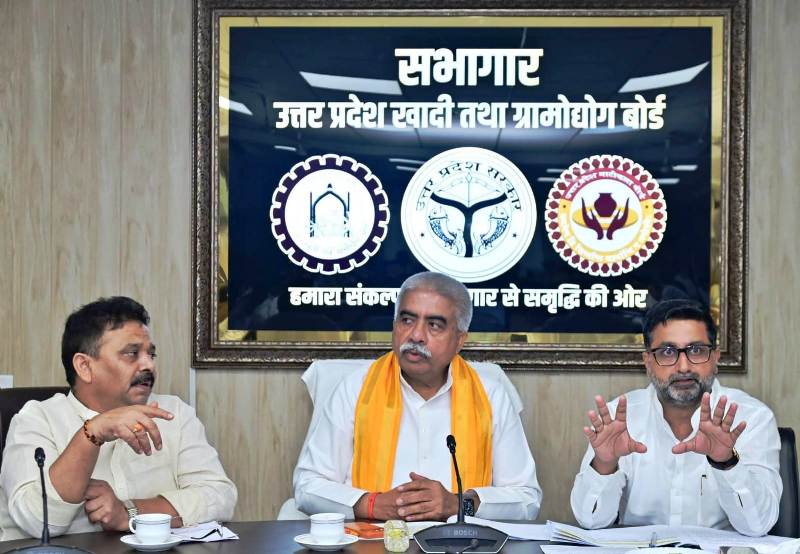
The proposed changes were discussed during a high-level meeting chaired by Khadi and Village Industries, Sericulture, Handloom and Textile Minister Rakesh Sachan at Khadi Bhawan in Lucknow. The meeting was attended by Minister of State (Independent Charge) for Stamp and Registration Ravindra Jaiswal, Minister of State for Minority Welfare, Muslim Waqf and Haj Danish Azad Ansari, senior officials and weaver representatives from across Uttar Pradesh.
Addressing the meeting, Sachan reaffirmed that the Yogi Adityanath government remains committed to safeguarding the interests of weavers and ensuring their economic empowerment. He said the government’s objective is to ensure that the benefits of the electricity flat-rate scheme reach the maximum number of eligible beneficiaries while protecting small weavers from unnecessary financial burdens.
A key proposal discussed during the meeting was expanding the eligibility of the electricity flat-rate scheme from the existing 0–5 kilowatt (kW) category to 0–20 kW, allowing medium-scale powerloom weavers to avail themselves of the subsidised scheme. Officials clarified that the existing benefits available to weavers in the 0–5 kW category would remain unchanged and would not be adversely affected by the proposed expansion.
According to the government, more than 95,000 electricity connections currently fall under the 0–5 kW category, accounting for nearly 94 per cent of all powerloom connections in the state. Weaver representatives welcomed the proposal to extend the scheme up to 20 kW but stressed that small weavers should continue to receive priority and remain in a separate category from larger operators. They also sought additional relief in electricity tariffs.
The financial implications of the proposed expansion were also reviewed. At present, the state government spends nearly ₹600 crore annually to provide subsidised electricity to weavers in the 0–5 kW category. Extending the scheme to cover consumers with loads between 5 and 20 kW is estimated to require an additional ₹189 crore annually, taking the government’s total financial commitment under the scheme to around ₹789 crore per year.

Weaver representatives also highlighted concerns over discrepancies in electricity bills, pending subsidy adjustments and long-standing outstanding dues. They pointed out that despite government subsidies, many electricity bills continue to reflect substantial arrears, causing financial hardship for weavers.
The meeting discussed resolving electricity dues related to the period before April 2023, including pending liabilities arising under the 2006 policy up to March 31, 2023. Proposals included providing relief from interest and delayed payment surcharges, allowing instalment-based repayment of outstanding dues, and introducing a One-Time Settlement (OTS) Scheme to facilitate resolution of old electricity bills.
The government also proposed launching a special district-level campaign in August to address electricity billing grievances. Under the initiative, weavers will be able to submit their electricity bills at local electricity department offices, where officials will verify records, make necessary corrections and forward cases requiring further action to higher authorities. The campaign will also examine pending dues linked to deceased consumers and long-inactive electricity connections.
Concluding the meeting, Rakesh Sachan said the government would carefully examine the suggestions received from weaver representatives, electricity department data and the financial implications before taking a final decision. He assured stakeholders that the government would coordinate with all concerned departments to resolve issues related to electricity bill discrepancies, subsidy adjustments, load enhancement and new electricity connections, while ensuring that policy decisions remain practical and beneficial to the weaving community.
The meeting was attended by Principal Secretary Anil Kumar Sagar, senior officials from the Handloom and Electricity Departments, and representatives of weavers’ organisations from various districts of Uttar Pradesh.







 ---------------------------------------------------------------------------------------------------