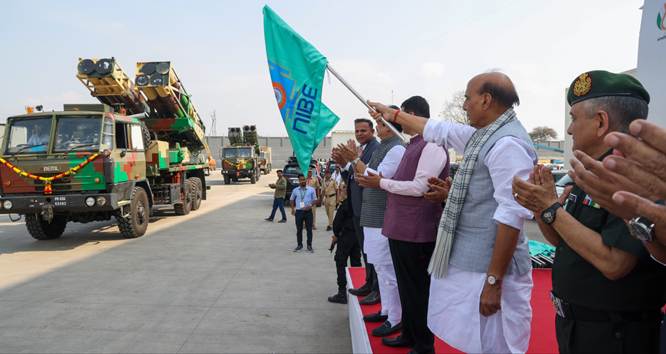
New Delhi: India’s push toward self-reliance in defence manufacturing received a major boost on Friday as Defence Minister Rajnath Singh and Maharashtra Chief Minister Devendra Fadnavis inaugurated a new private-sector Defence Manufacturing Complex in Shirdi, Maharashtra.
Developed by the NIBE Group, the facility is expected to focus on advanced artillery systems, missile and space technologies, rocket systems, energetic materials, and autonomous defence platforms — sectors that are increasingly becoming central to future warfare capabilities.
Speaking at the inauguration, Rajnath Singh underlined the strategic importance of indigenous defence production, saying, “A nation that manufactures its own weaponry writes its own destiny.” He emphasized that self-reliance in defence is no longer just a wartime necessity but a critical pillar for peace, economic resilience, and national development.
A major highlight of the event was the flagging off of India’s first 300-kilometre Universal Rocket Launching System, named Suryastra. The foundation stone for a dedicated missile complex linked to the system was also laid during the ceremony.
The event additionally saw the unveiling of indigenous TNT and RDX plant technologies, along with a renewable compressed biogas initiative. A strategic MoU was exchanged between NIBE Group and BlackSky for collaboration in satellite assembly and related technologies.
Private Sector Emerging as a Key Defence Force
Rajnath Singh noted that India’s defence production ecosystem, once dominated largely by public sector undertakings and ordnance factories, has undergone a major transformation under the Make in India and Aatmanirbhar Bharat initiatives.
According to the Defence Minister, the private sector’s contribution to defence manufacturing has now reached nearly 25–30 percent, with the government aiming to increase that share to 50 percent in the coming years.
He stressed that future conflicts will increasingly be determined by technological superiority, automation, precision systems, and advanced munitions rather than troop strength alone. Referring to recent global conflicts and India’s own operational preparedness, Singh said modern warfare is rapidly evolving and India must stay ahead through innovation and indigenous capability building.
He also highlighted that Indian private companies now possess a growing understanding of next-generation warfare technologies and are actively developing advanced systems for the armed forces.
Push for Munitions and Automation Hub
Calling for coordinated efforts between industry and government, the Defence Minister said India must now aim to become a global hub for munitions and automated defence systems.

He reiterated that the Centre is prepared to support critical technologies through policy reforms, strategic partnerships, liberalised FDI norms, and innovation schemes such as iDEX, ADITI, and the Technology Development Fund.
Singh emphasized that technological advancement should strengthen soldiers rather than replace human decision-making in warfare. “The final decision must always remain in human hands,” he said while discussing the growing role of automation and autonomous systems.
Defence Manufacturing Linked to Economic Strength
The Defence Minister also linked defence preparedness directly to economic growth, stating that national security and economic stability are deeply interconnected in today’s geopolitical landscape.
He warned that global supply chains, trade systems, and even critical minerals are increasingly being weaponised, making domestic manufacturing capabilities essential for strategic independence.
“A strong economy strengthens military capability, while national security creates the environment needed for industrial growth and investment,” Singh said.
Employment and Regional Growth Expected
Officials said the new Shirdi defence complex is expected to create a broader industrial ecosystem involving MSMEs, ancillary industries, suppliers, and technology partners. Along with defence production, the project is likely to generate skilled employment opportunities for local youth and encourage high-technology manufacturing in the region.
Speaking at the event, Devendra Fadnavis praised the Centre’s efforts to strengthen India’s defence preparedness through indigenous manufacturing and highlighted the growing synergy between public and private sectors in the country’s strategic ecosystem.
The inauguration ceremony also featured technology demonstrations, defence capability displays by MSMEs, and interactions between industry leaders, defence stakeholders, and senior officials.
Among those present were Anil Chauhan, Samir V. Kamat, senior Defence Ministry officials, industry representatives, and strategic partners from across the sector.