Lucknow never truly sleeps—it remembers. In the hush between midnight and dawn, when the last tea stall dims its flame and the breeze slips through the arches of Rumi Darwaza, the city exhales its secrets. And on certain nights, when the moon hangs low and full above Bara Imambara, a legend rides again.
They call him the Ghostrider.

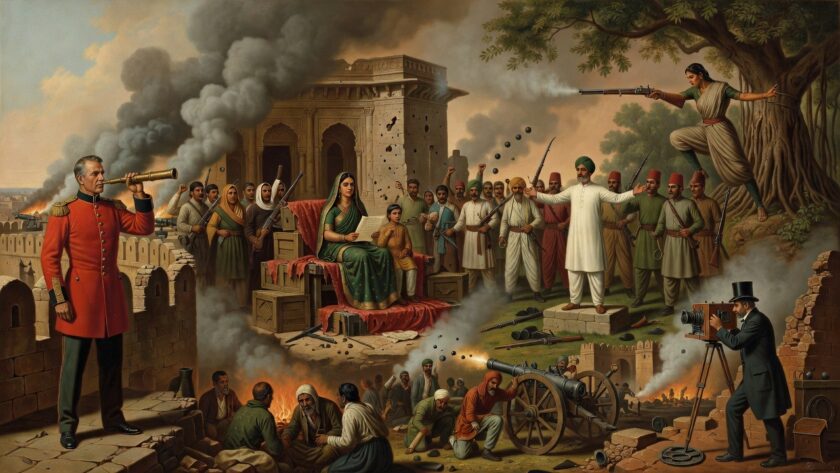
No one agrees on his name. Some say he was a nobleman of the Awadh court, others a rebel general who defied betrayal during the dying days of empire. A few insist his fate was sealed during the Indian Rebellion of 1857—cut down not by enemies, but by treachery. What remains constant is this: he never left.
He rides.
I. The Artist Who Didn’t Believe
Ayaan never believed in ghosts.
He believed in lines, light, and the discipline of observation.
That night, he had set up his easel near Husainabad Clock Tower, chasing the geometry of shadows. The city was quieter than usual. Even the stray dogs seemed to listen.
Then came the sound.
Hooves.
Not loud—measured, deliberate, like a heartbeat echoing through stone.
Ayaan paused mid-stroke. The air tightened. The temperature dropped just enough to raise the hair on his arms. When he looked up, the mist near the road began to gather… and then part.
The rider emerged.
Not as a blur. Not as a trick of light.
But as presence.
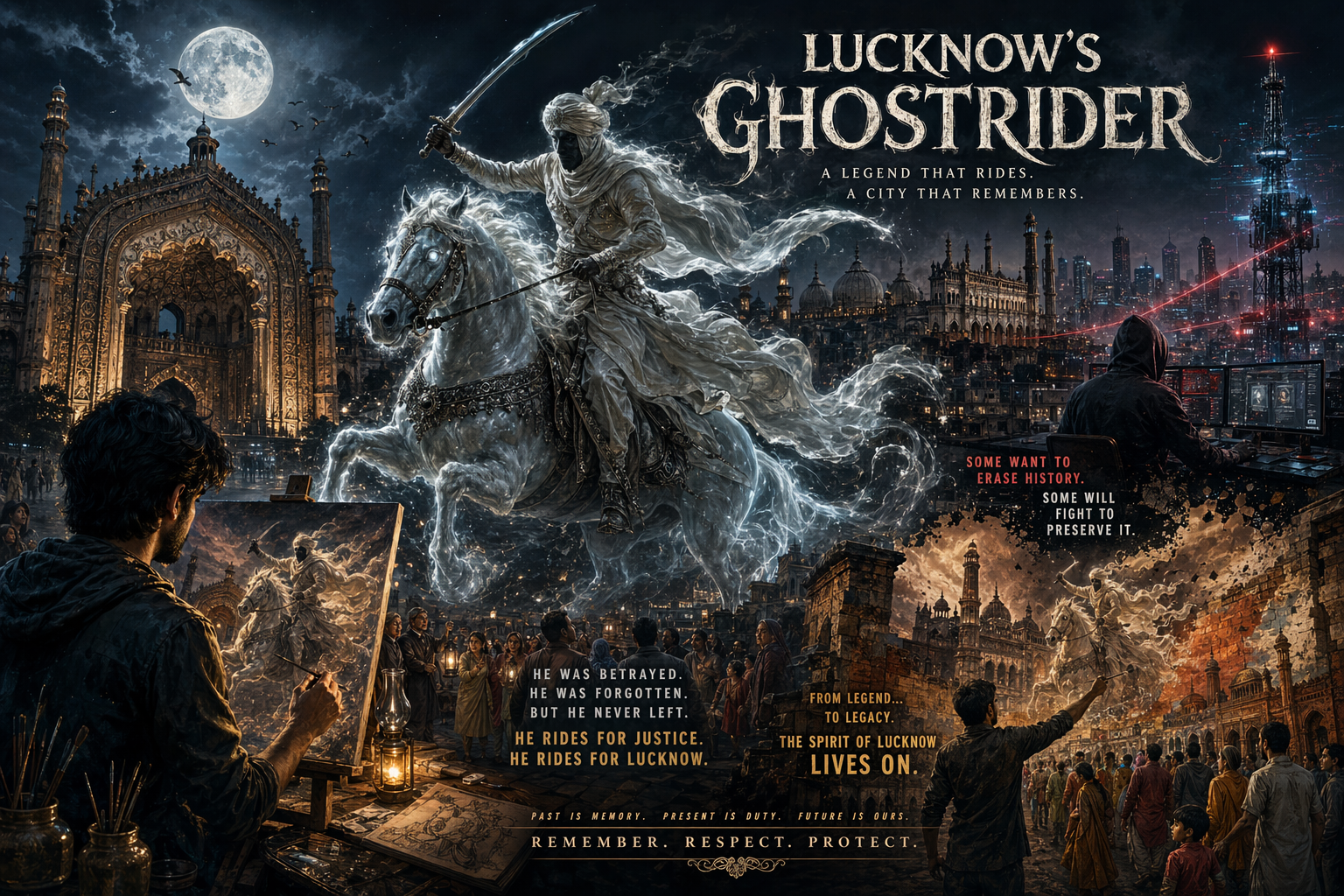
Draped in pale, flowing robes, astride a luminous horse that seemed carved from moonlight itself. No face—only shadow beneath a faintly glowing turban. Yet the eyes… the eyes burned.
Not with rage.
With memory.
II. The Chase Through Time
The Ghostrider didn’t attack.
He turned—and rode.
Something primal snapped inside Ayaan. Curiosity overruled fear. He followed.
Through lanes that should have ended but didn’t. Past walls that seemed to breathe. The city warped around him. Neon signs flickered out. Glass towers dissolved into carved facades. Asphalt softened into dust.
Lucknow was changing.
Or perhaps… revealing itself.
He ran past a transformed Chota Imambara, now glowing with oil lamps instead of electricity. Processions moved silently—figures dressed in another century, unaware of him, yet undeniably real.
The Ghostrider stayed just ahead. Not fleeing.
Leading.
III. The Palace of Betrayal
They stopped at ruins Ayaan had passed a hundred times without noticing. Tonight, it stood whole—a palace reborn in moonlight.
The rider dismounted.
For the first time, he faced Ayaan.
And the city spoke.
Not in words. In fragments.
A courtroom.
A whisper behind silk curtains.
A signed betrayal.
Steel drawn too late.
The nobleman—no, the guardian—had died protecting Lucknow from within, not from without. Betrayed by those he trusted. His death had not just ended a life—it had fractured the city’s memory.
And so he remained.
Not to haunt.
To remind.
IV. The Second Threat
Ayaan staggered back, overwhelmed—until something else cut through the vision.
A hum.
Low. Mechanical. Wrong.
The palace flickered.
For a moment, the illusion broke—and Ayaan saw it: a modern signal tower rising in the distance, pulsing with an unnatural frequency. Data spikes. Surveillance nodes. A digital net tightening over the old city.
Someone wasn’t just forgetting history.
They were erasing it.
The Ghostrider turned toward the disturbance. For the first time, there was urgency in his stillness.

Ayaan understood.
This wasn’t just about the past anymore.
V. Art as Weapon
Back in his world—if it was still his world—Ayaan worked without rest.
He painted not just what he saw, but what he felt. Layers of time. The spectral rider. The living city beneath the modern mask. Hidden signals. Fractured memory.
His art spread.
Murals appeared overnight near Gomti Riverfront—not signed, but unmistakable. People stopped. Looked. Recognized something they couldn’t name.
And then the disruptions began.
The mysterious signal faltered wherever the murals appeared.
Data interference. System glitches. Surveillance blind spots.
Ayaan wasn’t just painting.
He was exposing.
VI. The Final Ride
On the next full moon, the Ghostrider returned.
This time, Ayaan didn’t chase.
He stood ready.
The city pulsed—past and present colliding. The rogue signal tower surged, attempting to overwrite the old network completely.
The rider mounted.
Ayaan lifted his brush.
As the Ghostrider charged toward the tower, Ayaan painted the final piece—a massive, living mural that mapped the true Lucknow across its surface.
History, identity, memory—layered and undeniable.
The moment the rider struck—
Light exploded.
Not destructive.
Restorative.
The signal shattered. The illusion broke. The city stabilized—both its past and present snapping into alignment.
VII. What Remains
At dawn, the rider stood one last time beside Ayaan.
No words. No gesture.
But something had changed.
He was no longer searching.
He was… lighter.
As the first rays of sun touched the domes of Lucknow, the Ghostrider dissolved—not vanished, but diffused into the city itself.
Not gone.
Distributed.
VIII. The Living Legend
Ayaan’s work became a movement.
Not nostalgia—awareness.
People began to see their city differently. Protect it differently.
And sometimes, on nights when the moon is full and the wind carries that familiar rhythm—
hoofbeats… steady, distant… watching—
Lucknow smiles.
Because the Ghostrider no longer rides alone.
The city remembers with him.