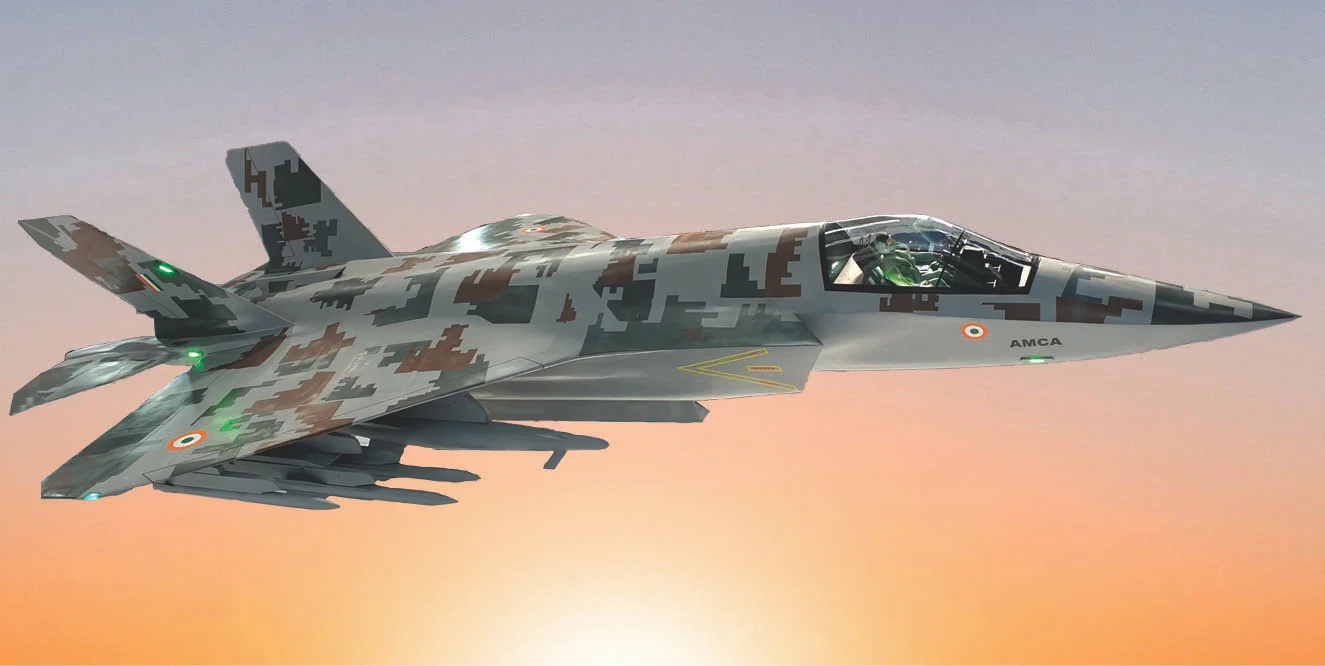
New Delhi: India’s Advanced Medium Combat Aircraft (AMCA) programme is emerging as one of the most cost-efficient fifth-generation fighter development efforts globally, according to officials associated with the Aeronautical Development Agency (ADA).
The programme, designed to deliver India’s indigenous stealth fighter capability, has an allocated research and development (R&D) budget of approximately $1.8 billion (₹15,000 crore), making it significantly lower than comparable international projects.
The Cabinet Committee on Security (CCS) approved the funding in March 2024, formally clearing the programme for prototype development.
Advanced stealth fighter with modern capabilities
The AMCA is being developed as a next-generation stealth multirole combat aircraft featuring advanced capabilities such as a low-observable design, internal weapons bay, supercruise potential, sensor fusion, and a fully network-centric combat architecture.
The Mk1 variant will initially be powered by the GE F414 engine, while plans are underway to evaluate a more powerful 110–120 kN class engine for future iterations under a potential co-development model.
Lower costs compared to global peers
Officials highlight that the AMCA’s budget is significantly lower than similar international fifth-generation fighter programmes:
- The US F-35 programme exceeded an estimated $55 billion in development costs
- China’s J-20 is believed to have cost around $5 billion
- Russia’s Su-57 and Turkey’s KAAN programmes are each estimated to have crossed $10 billion
In comparison, India’s AMCA development cost remains a fraction of these figures, despite similar technological ambitions.
Efficiency-driven development model
According to ADA officials, the programme’s cost efficiency is driven by modern engineering practices, including digital design tools, simulation-based testing, modular architecture, and reuse of proven subsystems from earlier indigenous platforms.

The experience gained from previous aircraft development programmes, including the Light Combat Aircraft (LCA) Tejas, has also contributed to improved design efficiency and reduced development overheads.
Prototype development roadmap
The development plan includes the construction of five flying prototypes, with the first aircraft expected to roll out by late 2028. These prototypes will undergo phased testing to validate performance, stealth characteristics, and combat systems integration.
Strong domestic industrial participation
The Ministry of Defence has also expanded private sector involvement in the programme. Leading Indian defence and engineering firms, including Tata Advanced Systems, Larsen & Toubro, and Bharat Forge, have been shortlisted for prototype-related manufacturing and development roles.
Officials believe this integrated approach—combining design, testing, and production planning from the outset—will help streamline development timelines and improve efficiency.
Building on India’s aerospace progress
The AMCA follows earlier indigenous aviation programmes such as the Tejas series, which itself is regarded as a cost-effective fighter platform. While the Tejas Mk1 and Mk2 programmes required over a billion dollars each in development funding, the AMCA—despite being significantly more advanced—has been planned with a relatively restrained budget.
Strategic significance
Once operational in the mid-2030s, the AMCA is expected to place India among a select group of nations capable of producing indigenous fifth-generation fighter aircraft.
Beyond its technological significance, the programme is also being viewed as a benchmark for cost-efficient advanced defence manufacturing, reflecting India’s growing capability in high-end aerospace engineering and self-reliant military production.