Dhaka: Bangladesh once again finds itself at a critical historical juncture where the lines between democracy, power, and fundamentalism are becoming increasingly blurred. The return of Tarique Rahman—son of former Prime Minister Khaleda Zia and acting chairman of the Bangladesh Nationalist Party (BNP)—after 17 years of self-imposed exile is not merely a political event. It has emerged as a powerful symbol of the deepening instability that has marked Bangladeshi politics since the fall of Sheikh Hasina’s Awami League government.
Tarique Rahman’s homecoming comes at a time when the interim government led by Nobel laureate Muhammad Yunus appears besieged on multiple fronts. Ironically, the very forces that were accommodated—directly or indirectly—in the hope of systemic change are now posing a serious threat to peace, social harmony, and democratic processes. The student-led agitation that followed the collapse of the Awami League government, projected as the “July Revolution,” had raised hopes of a transparent, inclusive, and democratic reset. It was this optimism that prompted student leaders and large sections of civil society to entrust Yunus with leading the interim administration.

However, within months, the illusion of democratic transformation began to unravel. Growing disputes over elections, the absence of a clear roadmap, and the concentration of decision-making power signaled that the struggle was no longer about strengthening democracy, but about capturing power. The political narrative has increasingly shifted from reform to control.
The situation turned even more volatile with the killing of Sharif Osman Hadi, a young leader associated with radical ideology who rose to prominence during the July movement. His murder has intensified tensions, particularly after his brother alleged that elements linked to the interim government orchestrated the killing to delay elections. These accusations have cast serious doubts on the neutrality and moral authority of the Yunus-led administration. If proven true, they would suggest that vested interests within the power structure are deliberately pushing the country toward instability to manipulate the electoral process.
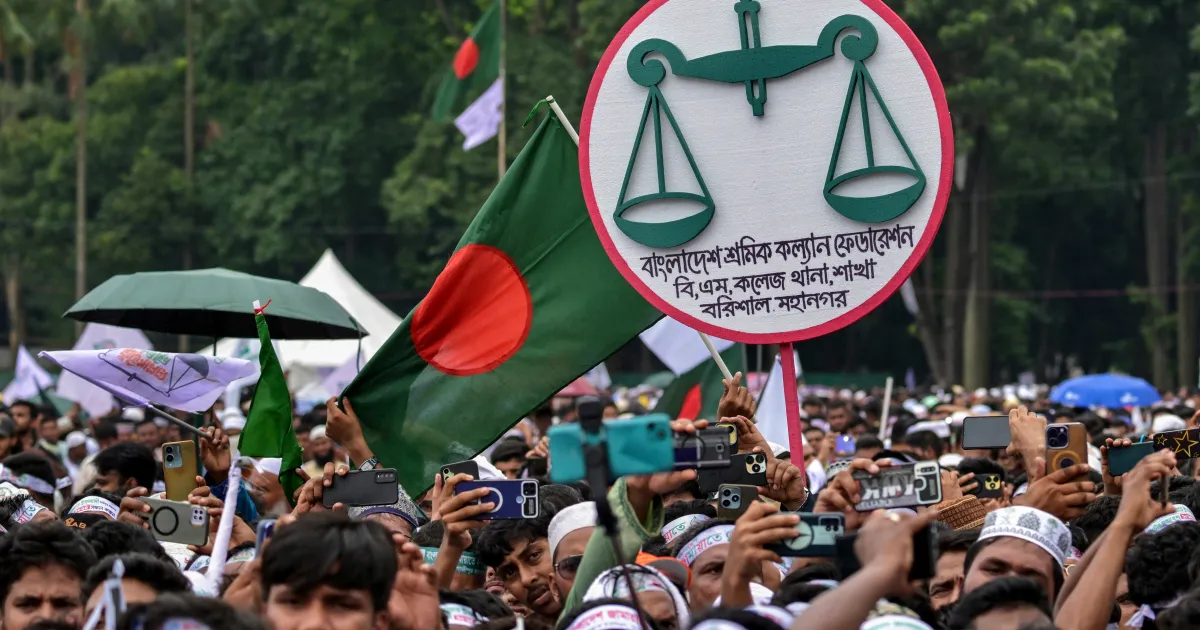
Most alarming is the growing influence of fundamentalist forces. Pressure from groups such as Jamaat-e-Islami on the interim government, escalating street violence, and a spate of attacks on minorities point to a rapid erosion of law and order. The irony is stark: groups once viewed as “democratic allies” against Sheikh Hasina are now hollowing out Bangladesh’s social fabric from within. This mirrors a familiar South Asian pattern—where short-term political gains achieved by accommodating radical elements result in long-term instability and societal fracture.
It is against this backdrop that Tarique Rahman’s return must be assessed. After spending over 17 years in the United Kingdom, his comeback signifies not just the end of exile but a recalibration of Bangladesh’s power balance. Notably, several cases that had kept him away were eased during the interim government’s tenure, paving the way for his return. On the same day he landed in Dhaka, indications emerged that the Awami League could be excluded from upcoming elections—a development that appears more strategic than coincidental.
The BNP currently seems electorally well-positioned, with growing speculation that Tarique Rahman could be Bangladesh’s next prime minister. Yet a fundamental question looms large: can elections held without the Awami League genuinely reflect the will of the people? Democracy is not merely about changing regimes; it is about providing equal opportunity to all major political forces. A systematically excluded party undermines electoral legitimacy and risks deepening polarization.


International scrutiny of the interim government is also intensifying. Human rights organizations have raised persistent concerns over attacks on minorities, curbs on free expression, and deteriorating law and order. Surprisingly, India—a neighbor directly impacted by developments in Bangladesh—has so far offered a muted response. Prime Minister Narendra Modi’s expression of concern over Khaleda Zia’s health and India’s offer of assistance, accepted by the BNP, hints at evolving bilateral equations. However, this engagement is not devoid of strategic calculations.
The continued targeting of Bangladesh’s Hindu community has moved beyond an internal security issue to become a matter of regional concern. The recent lynching of a Hindu citizen, Amrit Mondal, underscores how emboldened religious violence has become. Attacks on temples, forced displacement, and an atmosphere of fear are severely damaging Bangladesh’s democratic credentials. For India, this can no longer be ignored. As a responsible regional power, New Delhi faces mounting pressure to send a firm diplomatic message, raise the issue on international platforms, and assert that minority protection is a non-negotiable pillar of democracy.
With elections approaching, communal violence must be treated as a central issue. Free and fair elections are impossible in an environment of fear and insecurity. If Bangladesh truly seeks democratic restoration, it must form a government that guarantees the rights and dignity of all minorities. Without safeguarding Hindu and other religious communities, neither political stability nor regional peace is achievable.
Bangladesh’s current turmoil cannot be attributed solely to internal dynamics. External influences, including the historical role of Pakistan and its links with radical networks, cannot be ruled out. This makes Muhammad Yunus’s responsibility even greater—to steer the interim government toward fairness, transparency, and democratic norms. Yet developments so far suggest limited success in containing the crisis.
Some observers see cautious hope in Tarique Rahman’s statements, believing that a BNP-led government might balance radical pressures and restore democratic institutions. However, the expectation that democracy can be revived with the support—or tolerance—of fundamentalist forces is inherently contradictory.
Ultimately, Bangladesh faces a defining choice: to move toward an inclusive, multi-party, constitutional democracy or sink deeper into the quagmire of power struggles and extremism. The answer will not rest with a single leader or party, but with the collective political wisdom exercised in the coming months. Without free elections, rule of law, and minority protection, Tarique Rahman’s return may yet be recorded as another missed opportunity in Bangladesh’s turbulent political history.












 https://www.youtube.com/watch?si=RtToJsBhYBatUrym&v=mOuYNSdhjHA&feature=youtu.be