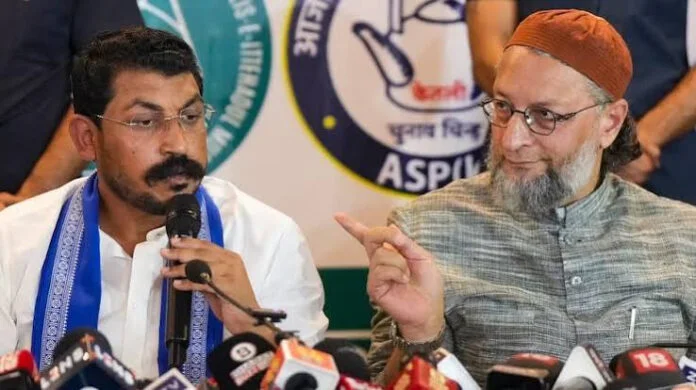
Lucknow: Uttar Pradesh politics witnessed a new political development ahead of the 2027 Assembly elections, with All India Majlis-e-Ittehadul Muslimeen (AIMIM) chief Asaduddin Owaisi and Azad Samaj Party (Kanshi Ram) president Chandrashekhar Azad announcing an alliance called the Social Transformation Front (SPM) on Thursday.
At a joint press conference in Lucknow, Owaisi declared Chandrashekhar Azad as the alliance’s chief ministerial candidate. The two leaders said the front would seek to bring Dalits, Muslims, backward communities and other disadvantaged sections onto a common political platform.
The alliance could introduce new electoral equations for the Samajwadi Party (SP) and the Bahujan Samaj Party (BSP), both of which have traditionally drawn support from sections of these communities.
Owaisi said the Social Transformation Front would emerge as a strong alternative in Uttar Pradesh and work to prevent the BJP from returning to power for a third consecutive term. He expressed confidence in the partnership and said both parties were committed to making it successful.
Chandrashekhar Azad described the alliance as more than a conventional third front, calling it a platform for social change. He appealed to backward, deprived, exploited and weaker sections to join the initiative.
He also criticised successive governments for failing to address the concerns of marginalised communities, stressing the need to eliminate caste discrimination, violence and social inequality.
Seat-sharing remains unclear
The alliance has yet to announce the number of constituencies it intends to contest or the seat-sharing arrangement between the two parties.
Earlier media reports had suggested that the front could contest around 150 Assembly seats. However, some reports following Thursday’s announcement have indicated that it may consider fielding candidates across all 403 constituencies. The final strategy is yet to be formally clarified.
Challenge for Akhilesh Yadav and Mayawati
The alliance’s political significance lies largely in its attempt to consolidate Dalit and Muslim voters, two important electoral groups in Uttar Pradesh.
The Samajwadi Party has traditionally enjoyed considerable support among Muslim voters, while the BSP under Mayawati has built its political base primarily around Dalit communities.
Owaisi’s AIMIM has focused on Muslim political representation, while Chandrashekhar Azad has emerged as a prominent voice on Dalit and Bahujan issues. Their partnership could therefore put pressure on both the SP and BSP, particularly in constituencies where these communities have a significant electoral presence.
For the BSP, the emergence of Chandrashekhar as a potential alternative could pose a challenge, particularly among younger Dalit voters and sections seeking greater political representation.
The BSP’s vote share in Uttar Pradesh fell to around 9.4 per cent in the 2024 Lok Sabha elections, highlighting the party’s struggle to regain its earlier electoral strength. However, it remains uncertain whether voters who have moved away from the BSP will shift their support to Chandrashekhar’s alliance.

Owaisi faces a test among Muslim voters
Owaisi will also have to establish the AIMIM’s independent appeal among Muslim voters in Uttar Pradesh. In recent elections, a significant section of Muslim voters has supported opposition parties considered best placed to defeat the BJP.
The SP-Congress alliance received substantial Muslim support in the 2024 Lok Sabha elections. The Social Transformation Front will now have to demonstrate whether it can attract a meaningful share of this electorate.
Its success will depend on its ability to build a strong organisational network beyond its leadership and mobilise voters at the grassroots level.
Could the alliance indirectly benefit the BJP?
Another question surrounding the new front is whether it could indirectly benefit the BJP by splitting opposition votes.
If the alliance contests constituencies where the SP or BSP is the principal challenger to the BJP, a division of votes could alter the electoral outcome. However, the front could also attract voters who have remained politically unrepresented or dissatisfied with existing parties.
Its actual impact will depend on constituency-level support, candidate selection and the strength of its campaign. It would therefore be premature to conclude that the alliance will automatically benefit the BJP.
What previous election results indicate
The 2017 and 2022 Assembly elections offer an indication of the challenges facing opposition parties in Uttar Pradesh.
In 2017, the BJP won 312 seats, while the Samajwadi Party secured 47. In 2022, the BJP retained power with 255 seats, while the SP improved its tally to 111.
These results underline the importance of alliances, caste equations, candidate selection and the consolidation of opposition votes in determining electoral outcomes.
With the formation of the Social Transformation Front, the 2027 Assembly contest could see another political player seeking to influence the state’s electoral arithmetic. Whether Owaisi and Chandrashekhar Azad can convert their partnership into a credible electoral force will become clearer as their organisational structure, seat-sharing formula and campaign strategy take shape.










 https://www.youtube.com/watch?si=RtToJsBhYBatUrym&v=mOuYNSdhjHA&feature=youtu.be