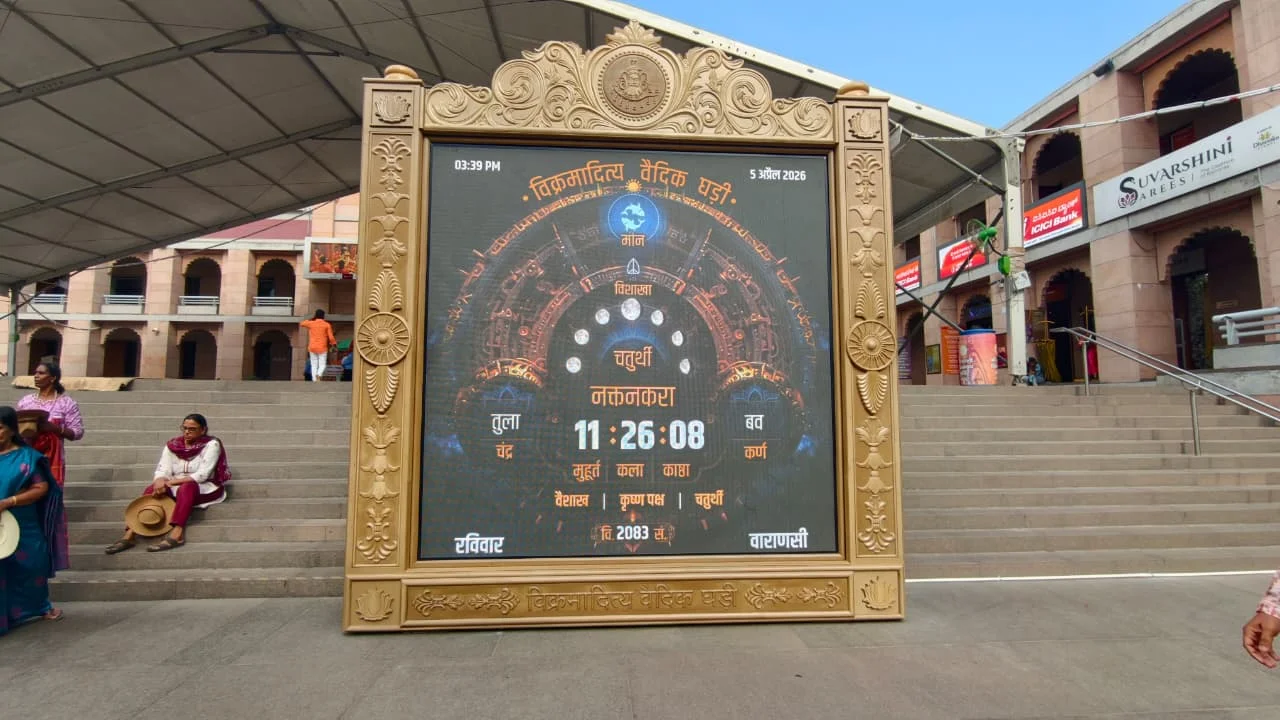
Varanasi: In a significant step towards reviving India’s ancient knowledge systems, a Vikramaditya Vedic Clock has been installed at the sacred precincts of Kashi Vishwanath Dham in Varanasi. Following its earlier installation in Ujjain—the city of Mahakal—this marks the second such clock in the country, symbolising a unique confluence of traditional Indian timekeeping and contemporary technology.
The clock began functioning from Brahma Muhurta on Sunday, offering time calculations based on ancient Vedic principles. Unlike conventional clocks, it operates on a sunrise-based system, recalibrating time according to the exact moment of sunrise at a given location.

A Fusion of Science and Tradition
Officials at the temple administration described the installation as a remarkable example of “Sanatan science,” presenting a holistic approach to time that goes beyond standard hours and minutes. The clock integrates multiple elements of Indian chronology, including Vedic time, Indian Standard Time, Panchang, Vikram Samvat, planetary positions, lunar phases, and Bhadra timings.
The initiative gained momentum when Mohan Yadav presented the Vedic clock as a ceremonial offering to Yogi Adityanath at the temple on April 3.
According to temple CEO Vishwabhushan Mishra, the clock has been installed in the temple courtyard and will be maintained by the temple trust. “This system combines all components of Vedic time calculation into one integrated format. It aligns with sunrise and synchronises with Indian Standard Time,” he said.
Understanding Vedic Time
The Vikramaditya Vedic Clock introduces a distinct structure of time measurement:
- 1 day = 30 Muhurats (each ~48 minutes)
- 1 Muhurat = 30 Kalas (~96 seconds each)
- 1 Kala = 30 Kashthas (~3.2 seconds each)
This framework calculates time from one sunrise to the next, offering a dynamic and location-sensitive understanding of the day.

Educational and Cultural Significance
Scholars associated with Banaras Hindu University highlighted the educational importance of the installation. Professor Ramnarayan Dwivedi noted that the project involved guidance from Kashi-based scholars and aims to familiarise younger generations with India’s traditional systems of timekeeping.
“This is not just a clock—it is a living Panchang. It will help people understand the cyclical nature of time and the scientific foundations of ancient Indian chronology,” he said.
Digital Integration
Complementing the physical installation, a Vikramaditya Vedic Clock mobile application has also been launched. The app offers features such as:
- A 30-hour Vedic time display
- Panchang and Vikram Samvat calendar (extending up to 5,800 years)
- Muhurat-based alerts indicating auspicious and inauspicious timings
- Real-time weather updates including temperature, humidity, and wind
- Availability in over 180 languages
A Step Towards Cultural Revival
The installation of the Vedic clock in Kashi underscores a broader effort to reconnect with India’s intellectual heritage while making it accessible in modern formats. By combining traditional astronomical calculations with digital tools, the initiative seeks to inspire curiosity and deeper understanding among the youth.
With its presence in both Ujjain and Varanasi, the Vikramaditya Vedic Clock stands as a symbolic bridge between India’s ancient wisdom and its technological future.


 ---------------------------------------------------------------------------------------------------