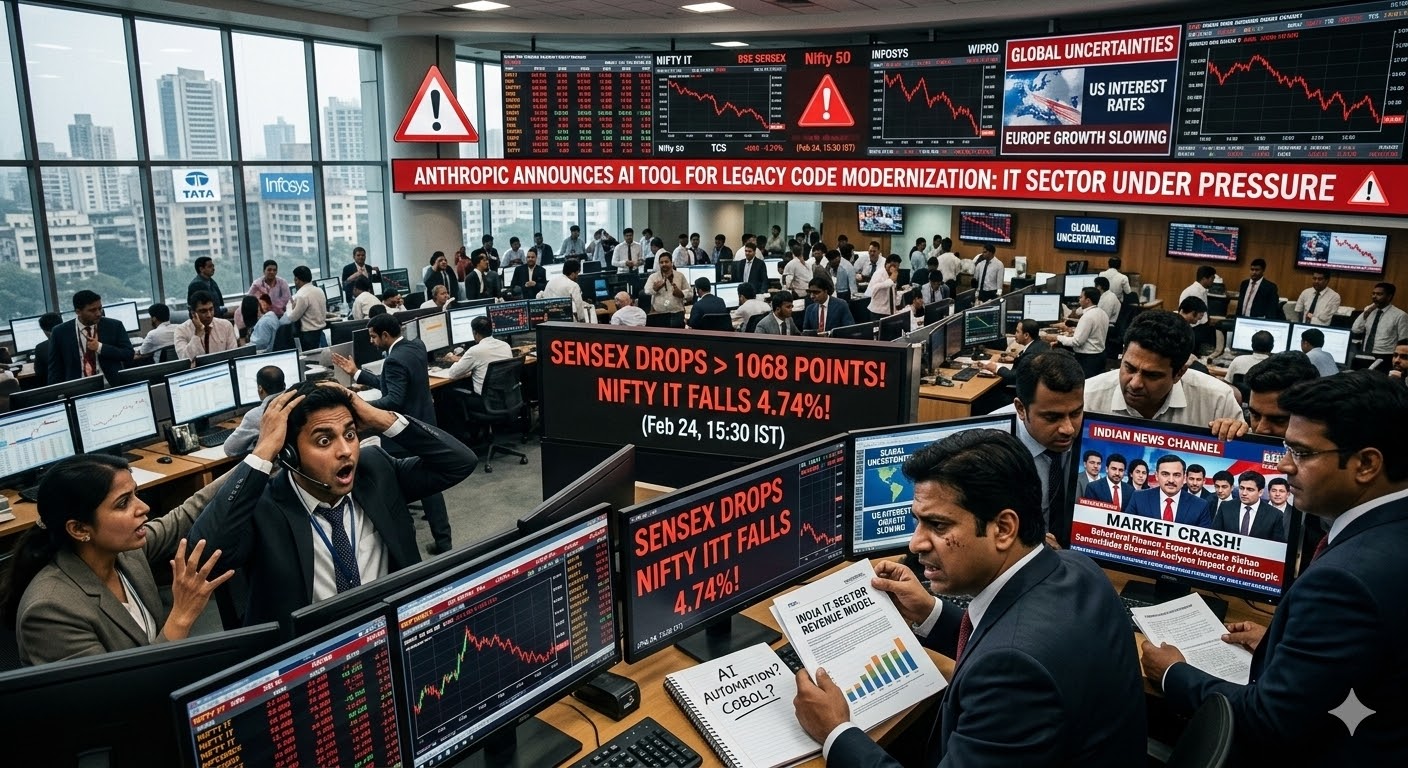
Mumbai: A recent announcement by the AI company Anthropic triggered sharp volatility in the stock market, highlighting how technological developments and investor psychology increasingly influence global financial markets. The incident, which occurred on February 24, led to significant declines in Indian equity indices, particularly in the IT sector.
During the afternoon trading session, Anthropic revealed a new tool for its AI model designed to modernize legacy programming systems, including converting older COBOL code into modern languages. The development raised concerns among investors that automation through AI could reduce demand for traditional software services provided by IT companies.

The market reacted swiftly. The Nifty IT Index fell nearly 4.74 percent, while the benchmark BSE Sensex dropped more than 1,068 points to close at 82,225.92. Meanwhile, the Nifty 50 Index declined over 288 points, ending the session at 25,424.65.
Financial analyst Advocate Kishan Sanmukhdas Bhavnani from Gondia, Maharashtra, noted that market reactions are rarely driven solely by economic fundamentals such as GDP growth, inflation, or interest rates. Instead, modern capital markets are increasingly shaped by expectations and information signals. According to behavioral finance principles, investor decisions are influenced not only by rational calculations but also by psychological cues.
For decades, India’s IT industry has played a major role in global outsourcing, earning steady revenue from maintaining and modernizing legacy systems used in banking, telecommunications, insurance, and government networks. The possibility that AI tools could automate such processes raised fears about the long-term revenue models of IT service providers.
However, experts caution that AI-driven code modernization may not completely replace traditional IT services. Activities such as testing, system integration, cybersecurity, and long-term maintenance will continue to require human expertise. Many Indian IT firms are already integrating AI into their service offerings, potentially turning disruption into opportunity.

Global uncertainties also contributed to the market’s reaction, including concerns over interest rate policies in the United States, slowing growth in Europe, and weaker export demand across Asia. When markets are already in a fragile mood, even a single technological announcement can trigger large-scale selling.
Analysts say the event reflects the dynamics of herd behavior in financial markets. When major institutional investors begin selling shares, algorithmic trading systems and retail investors often follow, accelerating the downturn.
The episode also echoes lessons from the Dot‑com Bubble of the early 2000s, when technology announcements frequently caused extreme market swings. While today’s AI boom is backed by stronger technological foundations, experts warn that maintaining balance between valuations and real earnings remains crucial.
Ultimately, the February 24 market drop demonstrates how technological innovation, investor sentiment, and global economic uncertainties interact in shaping modern financial markets. Analysts emphasize that while AI may disrupt traditional industries, it also has the potential to create new opportunities. Long-term investors are therefore advised to focus on fundamentals and long-term trends rather than reacting solely to short-term market fluctuations.