Mumbai/ New Delhi: Over the past decade—and especially in the last few years—India’s media landscape has undergone a profound transformation. A growing number of journalists, commentators, entertainers, and independent storytellers are shifting away from traditional newsrooms and television studios to build their presence on digital platforms, most notably YouTube. What once functioned as a supplementary video platform has now evolved into a powerful alternative to mainstream media, rivaling television news channels, entertainment networks, and even print publications.
This shift reflects deeper structural changes in how audiences consume information and entertainment. Factors such as increasing internet penetration, affordable smartphones, digital literacy, and the rise of the creator economy have dramatically altered media consumption habits, particularly among younger Indians. As a result, YouTube has emerged not only as a content platform but also as a parallel media ecosystem that offers independence, reach, and economic opportunity.
India today stands as YouTube’s largest market globally. As of 2025, the platform hosts between 460 and 500 million monthly active users in the country, and industry projections suggest that this number could approach 859 million by 2029. This massive user base has turned YouTube into one of the most influential digital spaces for information, commentary, and entertainment.
The platform’s influence is particularly visible in the sphere of news consumption. According to the Reuters Institute Digital News Report 2025, India leads the world in the use of YouTube for news, with approximately 55 percent of respondents saying they rely on the platform for news updates and analysis. Other surveys suggest that nearly 87 percent of Indian adults watch YouTube daily for a mix of news and entertainment content, often spending more than 70 minutes per session. In comparison, only around 39 percent of viewers now primarily rely on television news channels—a figure that reflects a significant decline in the influence of traditional broadcast media.
One major driver behind this shift is the credibility crisis confronting sections of mainstream media. Critics often argue that television news debates have become overly sensational, politically polarized, and driven by ratings rather than substantive journalism. Concerns about editorial independence and media ownership have also contributed to growing public skepticism.
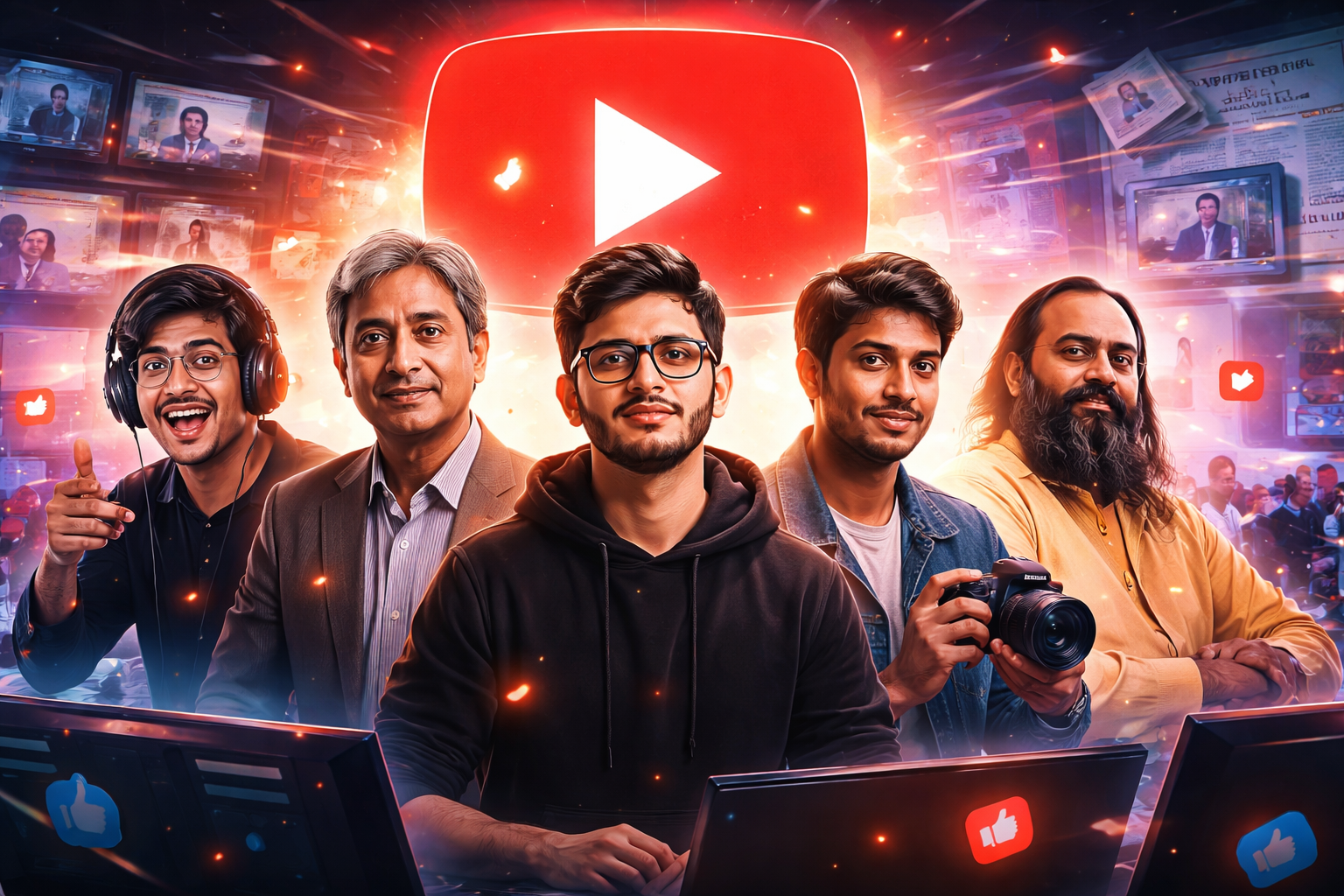
In this environment, many respected journalists have chosen to leave traditional television roles and build independent digital platforms. Prominent examples include Ravish Kumar, formerly associated with NDTV, and Abhisar Sharma, both of whom have developed successful YouTube channels after exiting mainstream television. Their content often features in-depth commentary on politics, social issues, and media ethics, presented without the time constraints and editorial pressures typical of television broadcasting.
Independent digital creators have also gained massive followings by offering detailed explanations and fact-based discussions on complex topics. Among them is Dhruv Rathee, whose analytical videos on politics, economics, climate change, and social issues attract millions of viewers. Rathee’s channel exemplifies the appetite among younger audiences for long-form, research-driven content that goes beyond the quick soundbites commonly associated with TV debates.
Entertainment content has followed a similar trajectory. While major television networks such as Sony Entertainment Television, Zee TV, and Colors TV maintain enormous subscriber bases on their official YouTube channels, individual creators frequently outperform traditional programming in engagement levels and viewer loyalty.
India’s top YouTube personalities have built audiences that rival or surpass those of mainstream television shows. Creators such as KL BRO Biju Rithvik, Acharya Prashant, Techno Gamerz, CarryMinati, and Mr. Indian Hacker command tens of millions of subscribers. Their content ranges from gaming and comedy to spirituality, science experiments, and lifestyle storytelling.
These creators resonate with audiences partly because they communicate in relatable language and often produce content in regional languages or colloquial Hindi. This localization has allowed YouTube to penetrate smaller towns and semi-urban regions, areas that traditional national television networks sometimes overlook.

Another factor accelerating YouTube’s influence is the explosion of short-form video content. YouTube Shorts, along with competing formats such as Instagram Reels, has rapidly become one of the most popular forms of digital entertainment in India. Research conducted by Ipsos in collaboration with Meta Platforms found that nearly 97 percent of Indian consumers watch short-form videos daily, compared to roughly 83 percent who watch television.
At the same time, long-form content on YouTube continues to grow, especially as smart televisions and connected TV devices become more common in urban households. In many premium homes, YouTube viewing through smart TVs now exceeds 40 percent usage, effectively turning the platform into a direct competitor to traditional television broadcasting.
Economic incentives have also encouraged professionals to migrate toward digital platforms. India’s creator economy—valued at approximately $1.45 billion in 2025—is expanding rapidly, with annual growth estimated at more than 20 percent. The ecosystem now includes over two million monetized creators whose content influences an estimated $350 billion in consumer spending.
Unlike traditional media jobs, where salaries often stagnate and editorial structures limit creative freedom, YouTube offers multiple revenue streams. Creators can earn through advertising revenue, Super Chats during livestreams, channel memberships, brand collaborations, affiliate marketing, and merchandise sales. This diversified income structure provides financial independence and allows individuals to build personal media brands.
The platform’s recommendation algorithm also plays a critical role. By prioritizing viewer engagement and niche interests, YouTube allows creators to rapidly build audiences around specialized topics. A single viral video can attract millions of views within hours, something rarely possible in the rigid scheduling framework of television broadcasting.
Nevertheless, the rise of YouTube as a media powerhouse is not without challenges. The sheer volume of uploaded content makes discoverability difficult for new creators, while misinformation and unverified claims occasionally circulate within the ecosystem. Governments and regulatory bodies are increasingly debating the need for clearer rules governing digital creators and influencers.
Despite these concerns, YouTube remains one of the most open and participatory media spaces available today. For journalists, entertainers, educators, and activists alike, the platform offers an opportunity to bypass traditional gatekeepers and communicate directly with audiences.
Ultimately, the migration of new-age media professionals to YouTube reflects a broader democratization of media production and distribution. With nothing more than a smartphone, editing software, and internet connectivity, creators can reach millions of viewers, influence public debate, and build sustainable careers.
As digital platforms continue to dominate advertising revenue and audience attention, YouTube’s role will only expand. In many ways, it is no longer simply competing with mainstream media—it is redefining what mainstream media itself looks like in the digital age.