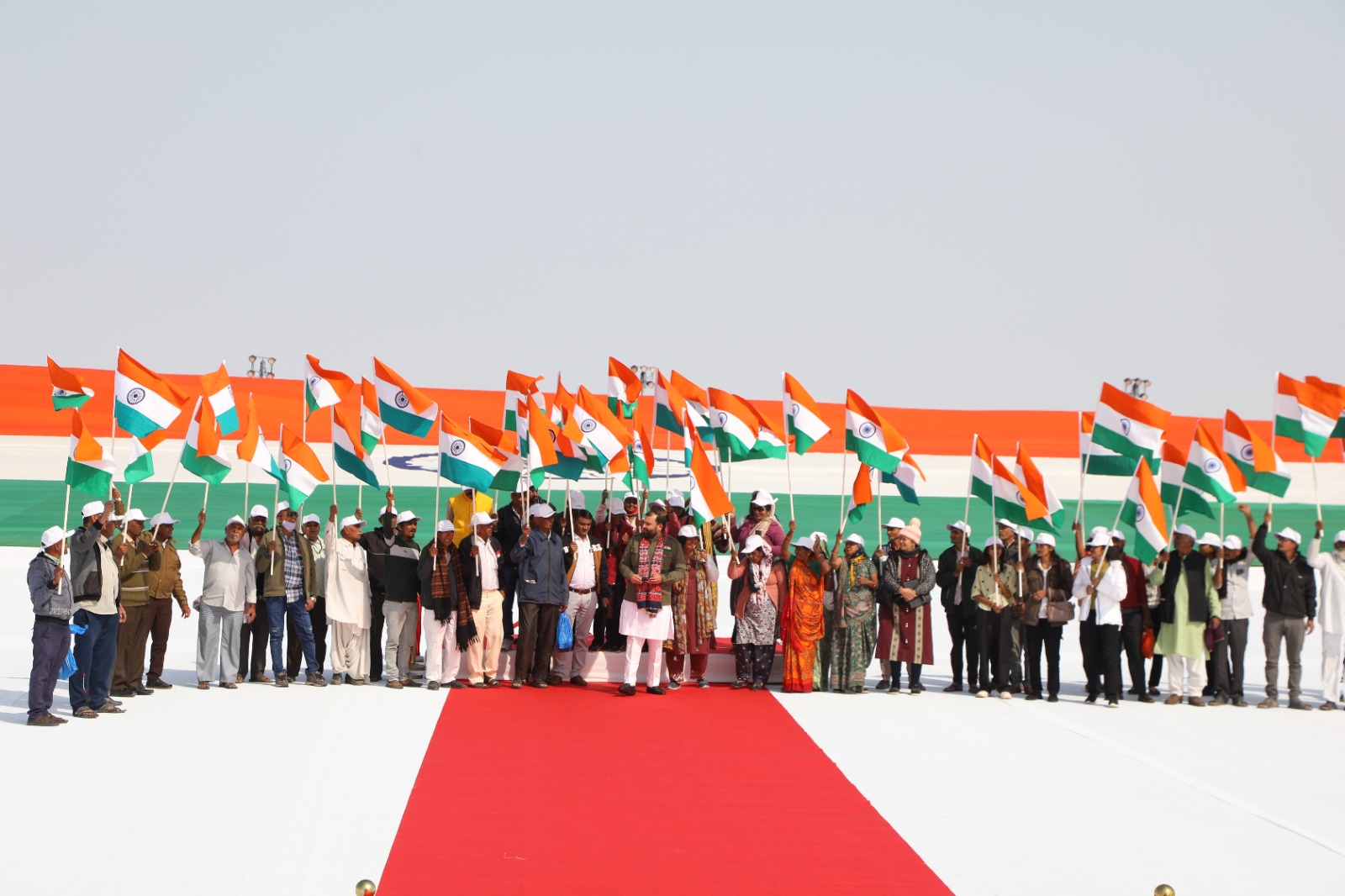
Bhuj: A historic display of patriotism and indigenous pride unfolded at the Great Rann of Kutch on India’s 77th Republic Day, as the world’s largest Khadi-made national flag was unfurled with full military honours in the border district of Bhuj, Gujarat.
The monumental Tricolour was displayed at Dhordo, transforming the vast white salt desert into a powerful symbol of national unity, self-reliance, and India’s cultural heritage. The event was organised by the Khadi and Village Industries Commission (KVIC) under the Ministry of Micro, Small and Medium Enterprises, Government of India.
On this occasion, soldiers of the Indian Army and the Border Security Force (BSF) saluted the massive Khadi Tricolour with full ceremonial honours. Millions of Khadi artisans from across the country also paid tribute by saluting the flag through video messages, creating a unique national record of collective participation.
The programme coincided with the 25th anniversary of the 2001 Bhuj earthquake, offering a poignant moment of remembrance for those affected by the devastating tragedy. The event highlighted Kutch’s remarkable journey of resilience, reconstruction, and planned development over the past quarter-century.
KVIC Chairman Manoj Kumar, the chief guest at the event, said that the unfurling of the world’s largest Khadi Tricolour at the Rann of Kutch was a moment of immense pride for the nation. He dedicated the event to the brave soldiers of “Operation Sindoor” and credited Prime Minister Narendra Modi’s visionary leadership for revitalising the Khadi movement and enabling the systematic redevelopment of Kutch after the 2001 earthquake.
During the ceremony, the KVIC Chairman honoured the wife of martyr Sergeant Murlidhar, Rajkumari, paying tribute to her sacrifice and the supreme dedication of the armed forces. As part of the Gramodyog Vikas Yojana, modern tools and toolkits were distributed to Gujarat’s artisans in line with the Prime Minister’s vision of Aatmanirbhar Bharat.

The event witnessed the presence of senior officials and personnel from the Indian Army and BSF, representatives of the Gujarat government, KVIC officials, local public representatives, and Khadi artisans.
It was noted that the new, resilient, and well-planned Bhuj stands as a testament to sustained development and visionary leadership following the 2001 earthquake. The Chairman also highlighted the significance of Smriti Van, describing it as a living memorial that transforms collective grief into strength, remembrance into resolve, and disaster into inspiration for nation-building.
Highlighting the growth of the Khadi and village industries sector, the KVIC Chairman said that over the past 11 years, major reforms in production, design, marketing, and technology have resulted in unprecedented progress. The sector’s turnover has crossed ₹1.70 lakh crore, generating employment for over two crore people nationwide. Artisans’ earnings have seen a significant rise, reflecting enhanced dignity, confidence, and improved livelihoods.
The monumental Khadi Tricolour, created during the “Azadi Ka Amrit Mahotsav” celebrations, measures 225 feet in length and 150 feet in width, weighs approximately 1,400 kilograms, and covers an area of 33,750 square feet. Made from hand-spun and handwoven Khadi cotton, it required nearly 3,500 hours of work by 70 artisans over 49 days. The Ashoka Chakra alone has a diameter of 30 feet.
The display of this iconic Tricolour at the Great Rann of Kutch served as an inspiring reminder of India’s rich Khadi legacy and its enduring role in shaping a self-reliant and confident nation.