By Dr Atul Malikram, Political Strategist
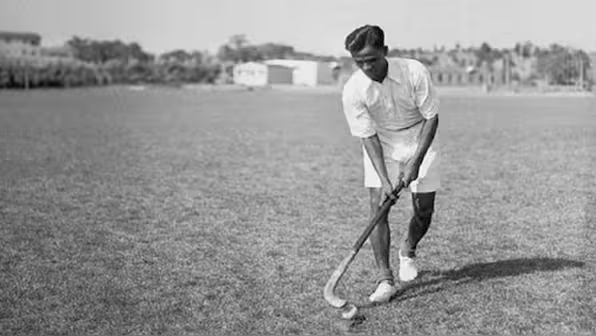
New Delhi: The debate over conferring India’s highest civilian honour, the Bharat Ratna, on hockey legend Major Dhyan Chand has resurfaced with renewed intensity. Political strategist Dr Atul Malikram has questioned why the man who led India to global glory during colonial rule is yet to receive the nation’s supreme civilian recognition.
It is often recalled that after India’s spectacular victory at the 1936 Berlin Olympics, German dictator Adolf Hitler was so impressed by Dhyan Chand’s brilliance that he reportedly offered him a high-ranking position and a prosperous life in Germany. Dhyan Chand is said to have politely declined the offer. At a time when India was still under British rule, that decision symbolised not just personal integrity but national self-respect.
Dhyan Chand’s legacy in Indian sports history transcends medals and records. He was not merely a great hockey player; he embodied the spirit of a nation yearning for dignity. Winning three Olympic gold medals in 1928, 1932 and 1936, he helped establish India as a dominant force in world hockey—long before the advent of modern sports infrastructure, corporate sponsorships or high-performance systems.
Dr Malikram argues that the question is no longer about an individual award but about the country’s moral compass. “We speak of ‘Amrit Kaal,’ of an आत्मनिर्भर भारत (self-reliant India), and aspire to be a global leader. But does a nation’s greatness lie only in its future ambitions, or also in how it honours its past heroes?” he asks.
The 1936 Berlin Olympics were not just another sporting event. They were a grand spectacle staged by Nazi Germany to project power and supremacy. Against this backdrop, a team from colonised India triumphed with skill and grace. When Dhyan Chand’s stick weaved its magic, it was not merely a ball that found the net—it was India’s confidence piercing through the shadows of subjugation. The victory demonstrated that while a nation could be politically enslaved, its talent and pride could never be shackled.
Yet, decades after Independence, Dhyan Chand remains without the Bharat Ratna. The issue often draws comparisons with Sachin Tendulkar, who was awarded the honour in 2014 for his immense contribution to Indian cricket. Malikram clarifies that Tendulkar’s recognition was fully justified, but questions whether earlier sporting icons have received equitable consideration.

“Hockey was the sport that first gave India a global identity,” he notes. “Have we, over time, allowed popularity metrics, television ratings and commercial appeal to overshadow historical contribution?”
It is true that Dhyan Chand has been commemorated in several ways. His birthday, August 29, is celebrated as National Sports Day. Stadiums bear his name. Postage stamps and statues honour his memory. Yet the Bharat Ratna—the highest civilian recognition—remains absent from that list.
According to Malikram, the Bharat Ratna is not merely an award to an individual but a tribute to an era. Honouring Dhyan Chand would symbolise respect for a generation that upheld India’s pride in the most challenging circumstances. It would send a message that the nation values substance over spectacle and remembers those who built its foundations long before the age of mass media.
He also views the move as an affirmation of sporting equality. Recognising Dhyan Chand would reinforce the idea that every athlete who has raised the tricolour—whether in the glare of cameras or in the quiet pages of history—holds equal importance in the national narrative.
India today celebrates milestones in space exploration, technology and diplomacy. As the country strengthens its global standing, Malikram suggests that it must also demonstrate sensitivity towards its historical icons. He expresses hope that the Government of India, which in recent years has conferred the Bharat Ratna across regions and disciplines, will consider Dhyan Chand in the same spirit.
Awarding the Bharat Ratna to Major Dhyan Chand, he concludes, would not be an act of charity but a correction of historical oversight. “The day his name is added to the Bharat Ratna list,” Malikram says, “that list will feel complete. It will prove that India may sometimes take time, but it never forgets its true heroes.”