New Delhi: Rising geopolitical tensions in West Asia are once again highlighting India’s vulnerability to global conflicts, particularly through energy markets, trade routes, and financial systems. Analysts warn that escalating hostilities involving the United States, Iran, and Israel are creating a “war-fear scenario” that could influence India’s economic stability and growth trajectory.
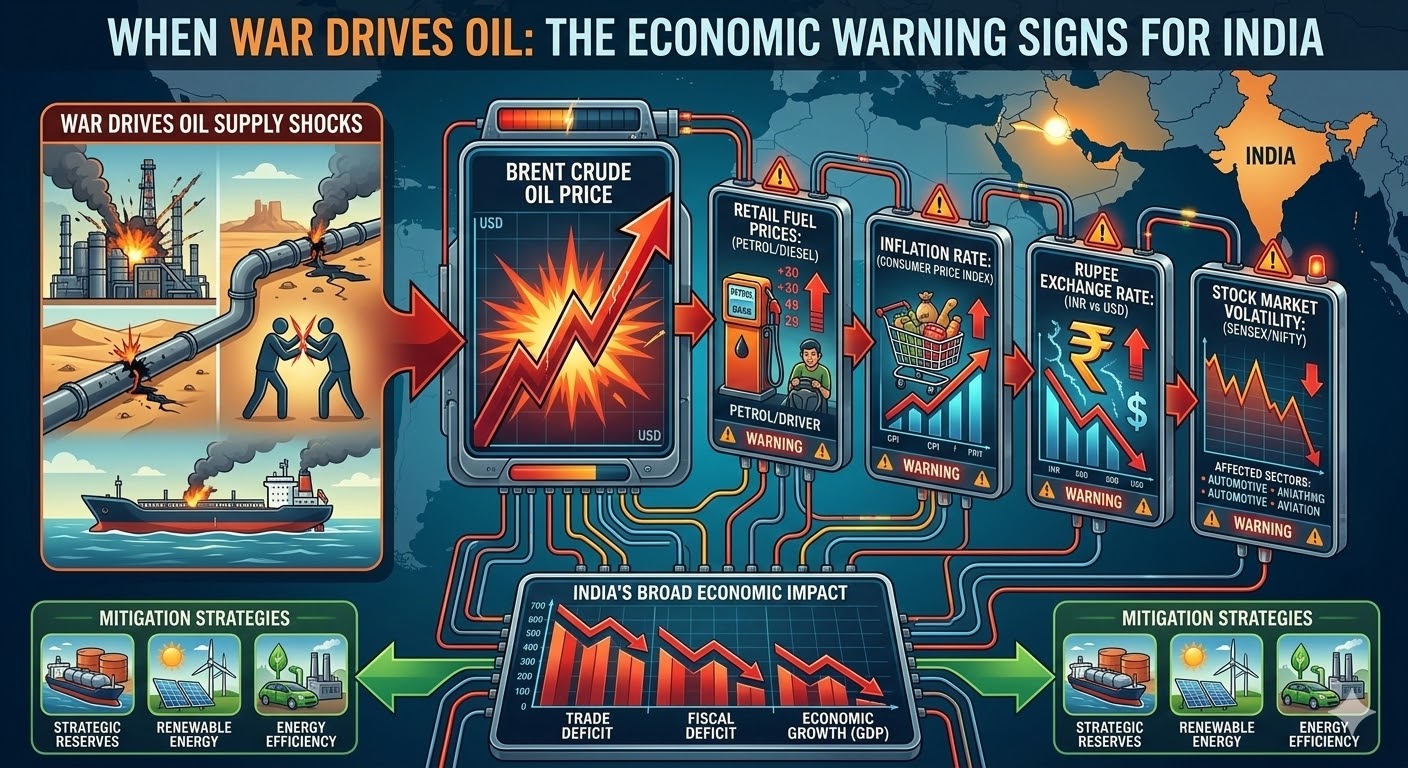
Economists say the idea of a “war-fear syndrome” in India is no longer merely a psychological perception but an economic reality. Whenever tensions escalate in the Middle East, financial markets in India react almost instantly. The latest confrontation in March 2026 pushed Brent crude prices above $82 per barrel, while reports of congestion and uncertainty around the Strait of Hormuz, a vital oil transit route, triggered concern across global energy markets.
For India, the impact is immediate. The country’s $4.5 trillion economy, which recently appeared stable with controlled inflation and strong growth, now faces the risk of external shocks. Investors often respond to such uncertainty by reducing exposure to emerging markets, placing pressure on the Indian rupee and financial markets. For ordinary citizens, the impact becomes visible at petrol pumps and grocery stores, where rising fuel costs often translate into higher prices for daily necessities.
Historically, such vulnerabilities have repeatedly surfaced during global crises. The 1991 Gulf War, when Iraq invaded Kuwait, severely strained India’s foreign exchange reserves and forced the country to initiate economic liberalisation. Earlier, the 1973 Yom Kippur War triggered the first global oil shock when oil-producing countries used energy supplies as a geopolitical tool. More recently, the Russia-Ukraine war in 2022 pushed crude oil prices close to $120 per barrel, driving inflation in India above seven percent and prompting tighter monetary policies.
Each crisis has followed a similar pattern: a distant conflict disrupts global supply chains, energy prices surge, and India’s economic momentum slows. Experts argue that India’s dependence on imported energy, fertilisers, and critical supply chains continues to expose the economy to such external shocks.
The current tensions in West Asia illustrate the same risk. Nearly 17 percent of India’s exports are linked to the region, and millions of Indian expatriates working there send remittances that support families and contribute significantly to India’s foreign exchange inflows. If instability continues, oil prices could rise above $100 per barrel, widening India’s current account deficit and placing pressure on economic growth.
Higher oil prices also increase logistics costs and insurance premiums for shipping and trade. Businesses operating on thin margins may struggle to absorb these increases, leading to slower economic activity. Financial markets tend to react quickly, with investors moving capital toward safer assets, reducing liquidity in emerging markets like India.
Energy security remains the most vulnerable link in this chain. India imports nearly 88 percent of its crude oil requirements, with a large portion transported through the Strait of Hormuz. Although India maintains strategic petroleum reserves, these stocks can only provide temporary relief during prolonged disruptions. If energy supply routes are affected, industries, transportation systems, and agricultural production could face rising costs.
The consequences often extend beyond the energy sector. When fuel prices increase, transportation costs rise, manufacturing expenses grow, and eventually food and consumer goods become more expensive. Economists describe this chain reaction as an “energy shock” that can transform into an inflationary surge.

Currency fluctuations further complicate the situation. A significant increase in oil prices raises India’s import bill, putting pressure on the rupee. A weaker currency makes external borrowing more expensive for companies and increases the cost of servicing foreign debt. In response, the central bank may have to tighten monetary policy through higher interest rates, which can slow investment and economic expansion.
Financial markets often reflect this anxiety even before broader economic effects are visible. Rising geopolitical uncertainty tends to trigger foreign portfolio outflows from equity markets. Stock indices fall, companies struggle to raise capital, and investment sentiment weakens. While India’s market capitalisation has expanded rapidly in recent years, analysts say oil-driven shocks can still push the country behind other emerging economies in terms of investor confidence.
Foreign direct investment decisions are also influenced by geopolitical risk. Global fund managers often reassess investment strategies during conflicts, raising risk premiums for developing economies. A single geopolitical flashpoint can translate into sharp declines in stock markets and increased volatility.
Despite these challenges, policymakers believe crises can also create opportunities for structural reform. Experts argue that India must accelerate efforts to diversify its energy sources and strengthen strategic reserves. Expanding renewable energy capacity, investing in green hydrogen, and securing long-term energy partnerships with multiple suppliers are seen as crucial steps toward reducing vulnerability.
Diplomatic balance will also remain important. Maintaining strong relations with multiple global powers and energy-producing regions allows India to protect its economic interests during geopolitical disruptions.
At the same time, strengthening domestic manufacturing and improving supply chain resilience could reduce the impact of global shocks. Financial discipline, technological innovation, and infrastructure investment are seen as essential for ensuring that India’s growth story remains stable despite external turbulence.
Ultimately, analysts say the “war-fear scenario” confronting India is both a warning and an opportunity. It highlights the risks of excessive dependence on volatile global systems while also encouraging strategic planning and policy reforms.
Whether India remains vulnerable to each new geopolitical crisis or emerges more resilient will depend largely on how effectively the country transforms these recurring shocks into long-term economic reforms.