Rajasthan Government and Piramal Foundation Spotlight Community-Led Initiatives
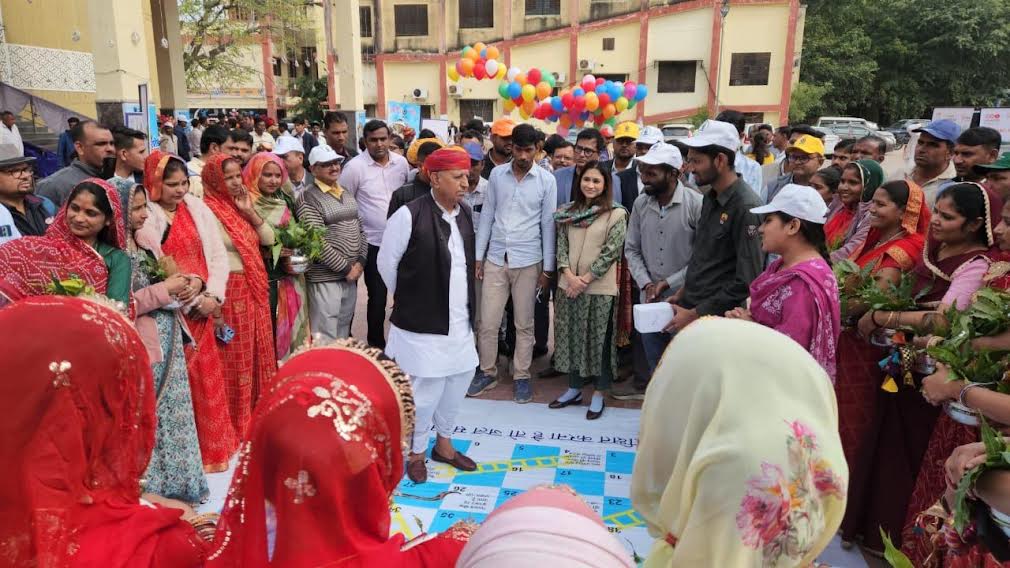
Ajmer, Rajasthan | The Rajasthan Government on Saturday hosted the Watershed Festival at the JLN Medical College Auditorium in Ajmer, bringing together officials, community leaders, development experts and civil society organisations to celebrate the district’s progress under the Mukhyamantri Jal Swavlamban Abhiyan (MJSA) and the Pradhan Mantri Krishi Sinchai Yojana (PMKSY). The event put strong emphasis on community-owned water conservation, reinforcing the idea that long-term water security can be achieved only when citizens actively participate in managing and rejuvenating local water bodies.
Teams from five districts shared their experiences, highlighting key on-ground changes, the role of local institutions, and the impact of watershed interventions on rural livelihoods. Representatives from Panchayati Raj institutions, community groups and local leadership presented case studies demonstrating how improved water management has reshaped agriculture, enhanced groundwater levels and reduced water scarcity in several villages.
The event was attended by Member of Parliament Bhagirath Choudhary, MLA Vasudev Devnani, and senior district officials from Ajmer.
Piramal Foundation Plays Lead Role in Programme Facilitation
As a key partner to the Watershed and Soil Conservation Department, Piramal Foundation played a central role in organising and facilitating the festival. The discussions focused on machine-led rejuvenation of water bodies and the need for community-driven solutions to ensure sustainability of such interventions.
A short film jointly created by Piramal Foundation and A.T.E. Chandra Foundation (ATECF) was screened at the event. The film demonstrated how desilting of ponds can significantly enhance water storage capacity and showcased how MJSA enables such rejuvenation efforts. It also explained the role of Fifteenth Finance Commission (FFC) funds in supporting these activities and presented a simple, low-cost, community-led model that empowers villagers to take responsibility for the upkeep of local water sources.
1,200 Water Bodies Revived; 18 Lakh Beneficiaries Across 12 Districts
Over the past three years, ATE Chandra Foundation and its partner organisations have facilitated the revival of nearly 1,200 water bodies across 12 districts of Rajasthan. The recent phase, implemented with support from FFC funds and Piramal Foundation, contributed to a significant increase in water storage capacity—estimated at 1,200 crore litres, equivalent to more than 12 lakh water tankers.
This initiative has benefitted nearly 18 lakh people in 1,800 villages, with around 14% of interventions concentrated in aspirational districts and blocks identified by NITI Aayog.
According to WRIS data, Rajasthan has approximately 82,000 water bodies, of which nearly 49,000 are suitable for rejuvenation. If the Rejuvenation of Water Bodies (RWB) model is scaled under MJSA, it could strengthen water security in around 26,000 villages, create a storage potential of 33,210 crore litres, improve groundwater recharge and save nearly ₹9,963 crore in tanker-related costs.
Leaders Emphasise Collective Responsibility and Scalable Models
Speaking on the occasion, Sangeeta Mamgain, Head of the School of Climate & Sustainability at Piramal Foundation, said:

“For the past 17 years, Piramal Foundation has worked closely with the Rajasthan Government to enhance school leadership and learning outcomes. Building on this experience, we are now aligning the Gandhi Fellowship model with natural resource management. Through MJSA in Ajmer, we have partnered with the Watershed Development and Soil Conservation Directorate to support machine-led rejuvenation of water bodies and build climate resilience.”
Amrita Kasturi Rangan, COO of A.T.E. Chandra Foundation, highlighted the importance of collaboration:
“Rajasthan deeply understands the value of water. When government departments and foundations work together, the impact multiplies. The last few years have shown that when people, institutions and systems join hands, water bodies can be revived quickly and effectively. The Watershed Festival is a celebration of this collective effort.”
IAS Muhammad Junaid P.P., Director of the Watershed Development & Soil Conservation Department, reaffirmed the government’s commitment:
“The first phase of MJSA has shown promising results, but the journey ahead is long. By working with social organisations and CSR partners, we aim to introduce the most effective and innovative measures for the next phase. A clear shared roadmap will ensure lasting engagement and sustainable benefits for Rajasthan’s villages.”
A Platform for Learning, Recognition and Future Action
The Watershed Festival served as a collaborative platform to bring together community members, government teams and partner organisations. It showcased impactful local initiatives, encouraged cross-learning and underscored the collective mission of building a water-secure Rajasthan.
With strong community participation, robust government programmes and the support of philanthropy-driven partnerships, Rajasthan is steadily moving closer to establishing a sustainable, climate-resilient water ecosystem for the future.