Lucknow: The two-day national seminar on the theme ‘River Rejuvenation and Indian Knowledge System: Science, Society, and Sustainability’ organized by the Department of Environmental Science, Babasaheb Bhimrao Ambedkar University (BBAU), concluded on November 13. The seminar was held under the guidance of the Vice-Chancellor, Prof. Raj Kumar Mittal, and jointly organized by the Department of Environmental Science, BBAU, the State Mission for Clean Ganga, Uttar Pradesh and the Shiksha Sanskriti Utthan Nyas, New Delhi. During the valedictory session, the key dignitaries present included Sanjay Swami, National Convener, Environmental Education, Shiksha Sanskriti Utthan Nyas, Suresh Kumar Gupta, National Treasurer, Shiksha Sanskriti Utthan Nyas and Prof. Venkatesh Dutta, Head of the Department of Environment Science, BBAU. At the beginning, Prof. Dutta welcomed all the guests and participants. The anchoring was done by Dr. Sufia Ahmad and Dr. Leena Sharad Shimpi.
Sanjay Swami emphasized the urgent need for river rejuvenation, stating that rivers form the foundation of human life. Rivers not only provide water but also play a crucial role in maintaining ecological balance, agriculture, industry, and biodiversity. If rivers continue to be polluted, it will have a direct impact on human health, life, and the future. Therefore, it is our collective responsibility to keep rivers clean and safe. He further highlighted that individuals can make a significant contribution by making small behavioral changes in daily life. If every person fulfills this responsibility, river conservation will not just remain an initiative but will turn into a people’s movement. Through such collective awareness and efforts, we can ensure clean, free-flowing, and life-giving rivers for future generations.
Suresh Kumar Gupta, while expressing his views, said that the Ganga River has been considered sacred for centuries because it contains unique types of bacteria that naturally keep the water clean, lively, and disease-free. This is why the water of the Ganga does not spoil easily and holds immense religious, cultural, and scientific significance. Unfortunately, due to human negligence and unbalanced development, excessive dumping of garbage, industrial waste, and sewage into the river has caused rising pollution levels. Consequently, the very bacteria that once purified the Ganga’s waters are now dying. If this situation persists and corrective action is not taken in time, the consequences will be disastrous. Therefore, it is essential that we all work together to restore the Ganga to its pure and free-flowing state.
Prof. Venkatesh Dutta shared that Babasaheb Bhimrao Ambedkar University has been actively collaborating with various institutions and organizations for the conservation and rejuvenation of rivers. He mentioned that earlier, the university had organized a cleanliness drive and a yoga series along the banks of the Gomti River to raise public awareness about river cleanliness and conservation. Such initiatives not only enhance environmental awareness but also instill a sense of responsibility among citizens. When students and local people participate in these campaigns, they develop a deeper understanding of the importance of rivers and water sources. These programs also promote community unity, environmental education, and public participation. Prof. Dutta added that such collective efforts are not only essential for keeping rivers clean but also serve as a crucial step toward sustainable development, ensuring clean water and a healthy environment for future generations.
On this occasion, Prof. Dutta also presented a detailed report of the two-day seminar along with the principles formulated after the conclusion of the seminar. During the valedictory session, various experts shared their views on multiple topics. Dr. Bijoy Thomas from the Indian Institute of Science Education and Research (IISER), Pune, spoke on ‘Linking Knowledge and Practice for Effective Water Management’ and Prof. Philippe Cullet from National Law University, Delhi, presented his views on ‘Rejuvenation through Rights: Potential and Limitations of the River Rights Discourse.’

Three technical sessions were also organized for the participants on the second day. The first session, chaired by Prof. Prabhat Kumar Singh from IIT ,BHU, Varanasi, was held on ‘River Rejuvenation Models and Case Studies.’ Under this session, Dr. Jayashree Vaidyanathan from the Center for Earth Research and Environment Management, Bangalore, presented on ‘River Nila: The Living Legacy — Tradition, Transformation, and Revival of Bharathapuzha (Nila) of Kerala’ and Dr. Neha from Baroda Council, Gujarat, spoke on ‘Safeguarding Ephemeral River Systems: Lessons from the Case of Vishwamitri River, Vadodara, India.’ Dr. Tagore Seetharam, Nodal Officer, Namami Gange Programme, Madhya Pradesh, presented on ‘Integrated Ecohydrological Framework for Urban River Rejuvenation:
A Case Study of the Ganga Basin Tributary — Kanh River, Indore, India’ and Dr. Naveen Kumar Singh from Indira Gandhi National Tribal University, Amarkantak, shared his research on ‘Plant-based Management of Pollution in the Ganga River.’ The second technical session, chaired by Prof. T. Sekar from Indira Gandhi National Tribal University, Amarkantak; Ms. Rajni Pandey from Bankers Institute of Rural Development (NABARD), Prof. Venkatesh Dutta, HOD, Environmental Science, BBAU and Mr. Mithilesh Mishra, focused on ‘River Restoration using Nature-based Solutions (NbS) – A Pragmatic Approach.’ The third technical session, chaired by Prof. Philippe Cullet, National Law University, Delhi, was held on ‘Linking Knowledge and Practice.’ Under this theme, Mr. Ravindra Swaroop Sinha from the Groundwater Action Group presented his insights on ‘Critical Role of Groundwater Resources in River Restoration.’ Participants also presented posters on various related topics during the seminar.
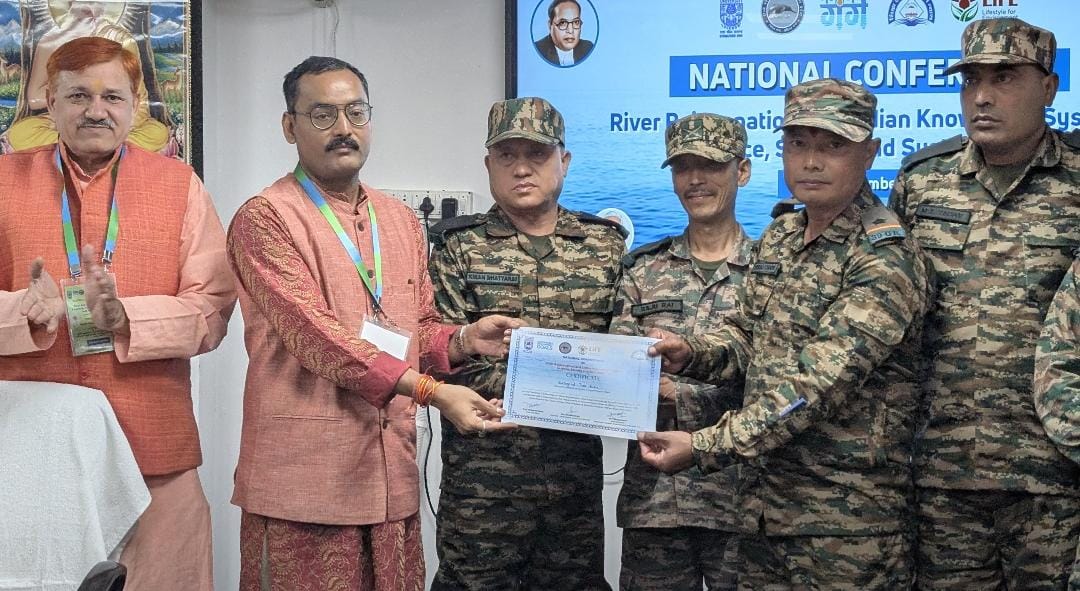
During the valedictory session, the winners of the poster presentation competition were felicitated with certificates of appreciation. The guests were honored with mementos and shawls by the organizing committee as a token of gratitude. The program concluded with a formal vote of thanks proposed by Prof. Venkatesh Dutta.
Throughout the event, heads of various faculties and departments, faculty members, non-teaching staff, officers from different districts, participants, and students were present.