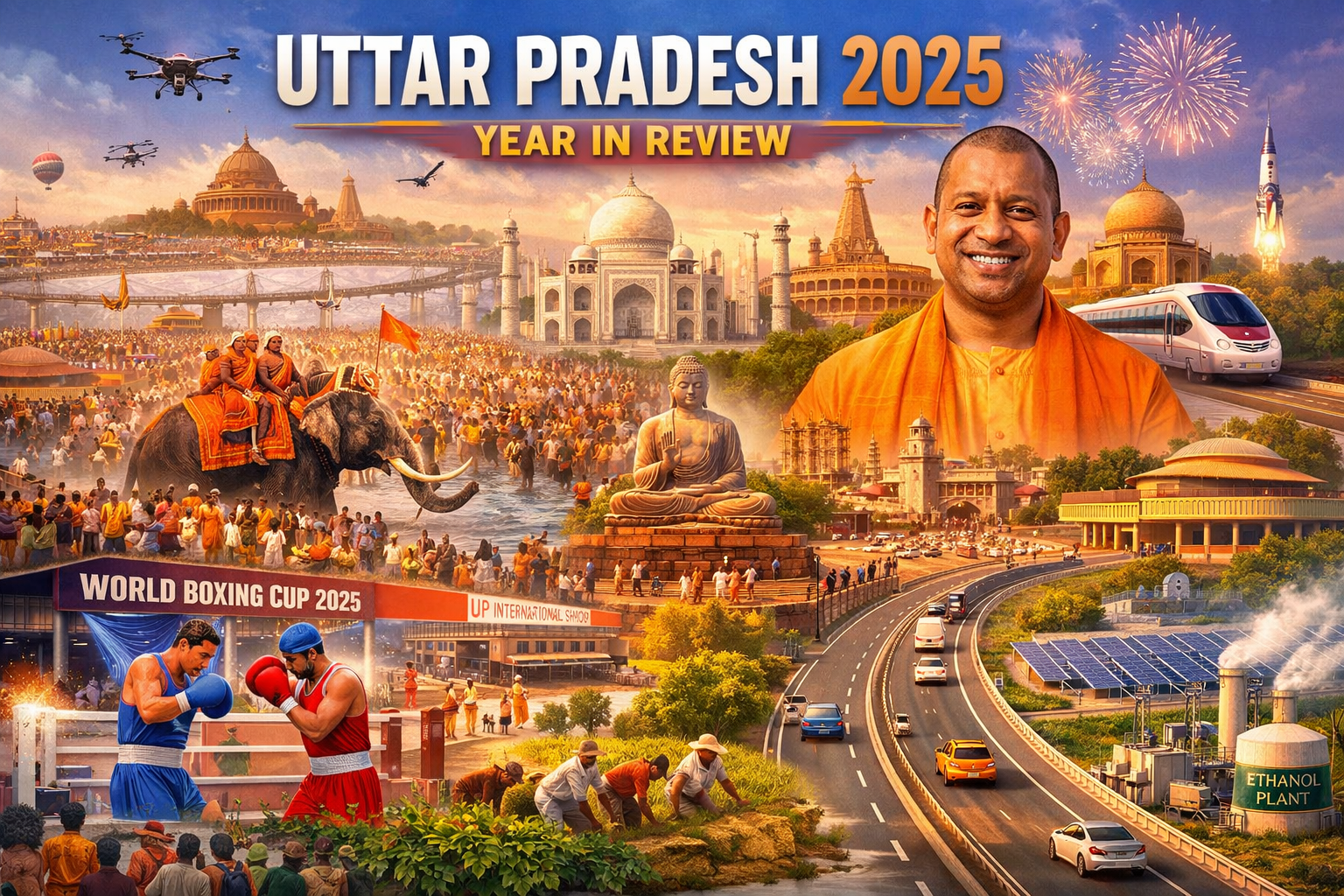
Lucknow: In 2025, Uttar Pradesh—India’s most populous and historically complex state—stood at the centre of a remarkable transformation. Long viewed through the prism of political volatility and developmental challenges, the state instead offered a year defined by spiritual magnificence, economic momentum, infrastructural ambition and a calendar packed with cultural, sporting and business milestones. From the sacred banks of the Sangam in Prayagraj to the buzzing trade floors of Greater Noida, Uttar Pradesh emerged not just as a participant but as a pace-setter in India’s growth story.
At the heart of this extraordinary year was the Mahakumbh Mela in Prayagraj, a once-in-144-years spiritual congregation that became a global spectacle of faith and organisation. But 2025 was far more than a single mega event. Tourism scaled new heights, investments flowed in, youth engagement expanded through sports and innovation, and governance reforms under Chief Minister Yogi Adityanath reshaped perceptions of the state. Together, these currents propelled Uttar Pradesh to an estimated Gross State Domestic Product (GSDP) of ₹35–36 lakh crore, cementing its position as India’s second-largest state economy and a key engine of national growth.
Mahakumbh 2025: Faith Meets the Future
The Mahakumbh Mela, held from January 13 to February 26, was the defining moment of the year—and perhaps of the decade. Hosted in Prayagraj, the sacred confluence of the Ganga, Yamuna and mythical Saraswati, the event drew an unprecedented 66 crore devotees, making it the largest peaceful human gathering in recorded history.
This Maha Kumbh, occurring after 144 years, was not merely a religious congregation; it was an exercise in governance, logistics and technological innovation on a scale rarely seen. Spread across more than 4,000 hectares, a temporary city rose along the riverbanks, complete with pontoon bridges, hospitals, fire stations, police posts and a sanitation network that included over 1.5 lakh toilets.
Technology played a crucial role. Artificial intelligence-assisted crowd management systems, drone surveillance, underwater drones for river safety, and thousands of CCTV cameras ensured real-time monitoring. Digital dashboards tracked sanitation and healthcare delivery, while Ayush wellness centres complemented modern medical facilities.
The sacred bathing days—Paush Purnima, Makar Sankranti, Mauni Amavasya, Basant Panchami and Maha Shivratri—witnessed massive footfalls, with shahi snans by various akharas forming the spiritual core of the festival. Visits by national and international dignitaries, including Prime Minister Narendra Modi, added to its global visibility.
While a crowd-related incident on Mauni Amavasya tested preparedness, swift administrative response and adaptive measures prevented escalation. By the end of the Mela, the consensus was clear: Uttar Pradesh had demonstrated organisational capabilities on par with the world’s largest global events.
Economically, the Mahakumbh proved transformative. Hospitality, transport, retail, handicrafts and local services experienced an unprecedented boom. Artisans, boatmen, small traders and performers found new markets, while global media coverage projected Uttar Pradesh’s spiritual and cultural capital to the world.
Tourism Boom: The Rise of India’s Most Visited State
Building on the Mahakumbh’s momentum, 2025 saw Uttar Pradesh cement its position as India’s top domestic tourism destination. The state recorded over 137 crore domestic tourist visits during the year, along with approximately 3.66 lakh foreign tourists, placing it among the top four states in international arrivals.
Ayodhya, rejuvenated after the Ram Temple inauguration, witnessed a steady stream of pilgrims throughout the year. Varanasi continued to blend spirituality with urban renewal, while Mathura-Vrindavan remained a magnet for devotees, especially during Krishna Janmashtami. The Buddhist circuit—Sarnath, Kushinagar and Shravasti—attracted visitors from Southeast Asia, East Asia and beyond.
Policy support played a key role. Under the Tourism Policy 2022, investment proposals worth over ₹37,600 crore were received, with significant allocations for ghats, heritage circuits, accommodation and visitor facilities. Improved air connectivity, new airports, expressways, homestay schemes and last-mile transport strengthened the tourism ecosystem.
Eco-tourism also gained ground, particularly in the Terai region, where wildlife tourism and community participation helped balance conservation with livelihoods. World Tourism Day celebrations and sustainability-focused initiatives highlighted a shift toward responsible tourism.
Beyond numbers, tourism became a powerful employment generator, supporting the state’s long-term ambition of becoming a $1 trillion economy.
Culture Beyond the Kumbh: A Calendar of Celebrations
While the Mahakumbh dominated headlines, Uttar Pradesh’s cultural life in 2025 was rich and diverse. The Taj Mahotsav in Agra revived Mughal-era splendour through crafts, cuisine, music and performances, drawing tourists beyond the monument itself.
In Mathura and Vrindavan, Krishna Janmashtami unfolded with elaborate raslilas, temple rituals and processions that brought together millions of devotees. Kanpur’s Bithoor Mahotsav celebrated shared cultural heritage with Maharashtra, while the India-Nepal Literature Festival in Vrindavan fostered cross-border intellectual exchange.

Traditional fairs such as the Kailash Fair and Ram Barat added colour to the cultural landscape, while Buddha Purnima celebrations in Sarnath attracted monks and pilgrims from across the world. Together, these events reinforced Uttar Pradesh’s role as a living repository of India’s plural traditions.
Sports, Youth and New Aspirations
Sports emerged as a major pillar of youth engagement in 2025. Greater Noida made history by hosting the World Boxing Cup from November 13 to 24—the first time India staged the prestigious event. Featuring over 450 boxers from more than 80 countries, the tournament placed Uttar Pradesh firmly on the global sports map.
At the grassroots level, MLA Sports Competitions promoted participation across age groups and disciplines. The government’s plan to establish sports colleges in every division and playgrounds in all gram panchayats reflected a long-term vision of nurturing talent.
Inclusivity was another highlight. Events like the Unity Cup wheelchair basketball championship showcased adaptive sports, while school and college-level competitions broadened access. Parallelly, Techkriti at IIT Kanpur—Asia’s largest inter-college tech and entrepreneurship festival—underscored the state’s growing innovation ecosystem.
Economy and Business: Momentum on Multiple Fronts
The economic narrative of Uttar Pradesh in 2025 was one of acceleration. The Uttar Pradesh International Trade Show in Greater Noida brought together global exhibitors, exporters and policymakers, spotlighting the state’s manufacturing and MSME strength. The Global Capability Centers Conclave attracted technology majors, signalling growing confidence in UP as a services and innovation hub.
Healthcare collaboration advanced through Medical Expo India in Lucknow, while focused workshops engaged industry stakeholders on the $1 trillion economy roadmap. FDI inflows rose, particularly in electronics manufacturing, defence corridors and renewable energy.
Agriculture recorded robust growth, with the state emerging as a leader in ethanol production and solar installations. The One District One Product (ODOP) scheme continued to empower artisans and small enterprises, linking local skills with global markets.
Large-scale groundbreaking ceremonies launched thousands of infrastructure and industrial projects, translating policy intent into on-ground employment and revenue generation.
Infrastructure, Health and Governance Gains
Infrastructure development remained a visible marker of change. New expressways, upgraded highways, logistics parks and expanded railway lines improved connectivity across regions. Airports in Ayodhya and Bareilly earned national rankings, while freight corridors strengthened supply chains.
Healthcare outcomes also improved. Filariasis prevalence fell below 1% in most blocks, reflecting sustained public health efforts. Startup growth placed Uttar Pradesh among the top three states nationally, with several unicorns emerging from sectors such as fintech, agritech and logistics.
Women’s safety initiatives under Mission Shakti were expanded, and sector-specific policies in footwear, textiles and digital agriculture reflected a governance approach focused on both growth and inclusion.
Challenges and the Road Ahead
Progress was not without challenges. Crowd management issues during peak religious events and isolated crime incidents tested administrative agility. Yet, swift responses and course corrections ensured that these did not derail the broader momentum.
As 2025 draws to a close, Uttar Pradesh stands transformed—more confident, more connected and more consequential to India’s future. From the spiritual unity of the Mahakumbh to the hum of factories, festivals and sports arenas, the year showcased what coordinated governance and long-term vision can achieve.
For its 25 crore citizens, 2025 was not just a year of events—it was a statement of intent. As Uttar Pradesh marches toward a $1 trillion economy and aligns with the national vision of a Viksit Bharat by 2047, the foundations laid this year are set to shape its trajectory for decades to come.