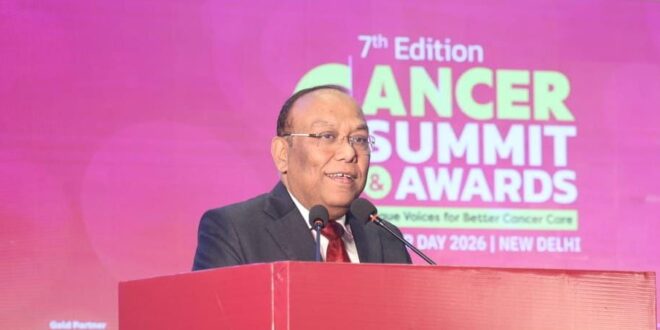
Lucknow: On the eve of World Cancer Day, Uttar Pradesh reaffirmed its strong commitment to strengthening cancer care and improving public health at the 7th Cancer Summit and Awards 2026, organised by the Integrated Health and Building (IHW) Council in New Delhi. Representing the state government, Amit Kumar Ghosh, Additional Chief Secretary, Medical Health & Family Welfare and Medical Education, Government of Uttar Pradesh, attended the event as the Chief Guest.
Appreciating the IHW Council’s sustained efforts in patient advocacy and evidence-based dialogue, Ghosh said such platforms are crucial for translating policy intent into on-ground action. He described the central health budget crossing ₹1 lakh crore for the first time as a “landmark moment,” stating that it positions healthcare as a key driver of economic growth, social equity and the India@2047 vision.
Highlighting Uttar Pradesh’s evolving healthcare strategy, Ghosh said the state is moving away from episodic cancer treatment towards a system-driven, preventive and technology-enabled cancer care model that reaches every district. “We have rapidly expanded government medical colleges and cancer institutions, strengthened population-based screening, and are establishing dedicated cancer day-care centres across the state to bring treatment closer to people’s homes,” he said. Through Ayushman Bharat, digital health initiatives and robust public–private partnerships, the state aims to ensure timely diagnosis, affordable treatment and dignified, patient-centric cancer care for all, regardless of location or income.
Emphasising the scale of transformation, Ghosh noted that the number of medical colleges in Uttar Pradesh has increased from 9 to 43, significantly strengthening oncology services while boosting research capacity and medical training. The state is further reinforcing its cancer ecosystem through institutions such as the JK Singhania Cancer Institute and the Kalyan Singh Super Specialty Cancer Institute in Lucknow. Population-based screening programmes are also gaining momentum, enabling early detection and better outcomes.
He informed that 67 cancer day-care centres are being set up across Uttar Pradesh in collaboration with mentoring institutions. In addition, the state plans to integrate private day-care centres with government facilities to ensure easier access to chemotherapy and follow-up care. Ghosh described Ayushman Bharat (PMJAY) as a game changer in reducing the financial burden on cancer patients and said proposals are underway to further strengthen cancer care packages to enhance access in both public and private hospitals.
Stressing the importance of prevention and technology, Ghosh spoke about tobacco control measures and the focused rollout of HPV vaccination among adolescent girls to reduce the future cancer burden. He also underlined the role of advanced diagnostics, liquid biopsy, artificial intelligence and personalised medicine, adding that “innovation must always be balanced with affordability and equity.”
Calling for deeper collaboration, Ghosh said that reaching the last-mile patient requires strong public–private partnerships. He proposed organising a National Cancer Dialogue in Lucknow within the next two months, in collaboration with policymakers, doctors and the IHW Council, to share Uttar Pradesh’s cancer control roadmap and best practices with other states.
The summit concluded with a collective call to make cancer care across India more accessible, affordable and patient-centric. Discussions underscored the need for sustained investment, prevention and early detection, technology-driven services and stronger public–private partnerships. The 7th Cancer Summit and Awards 2026 provided a vital platform to enhance collaboration among government, healthcare professionals, industry, civil society and patient groups in the fight against cancer.