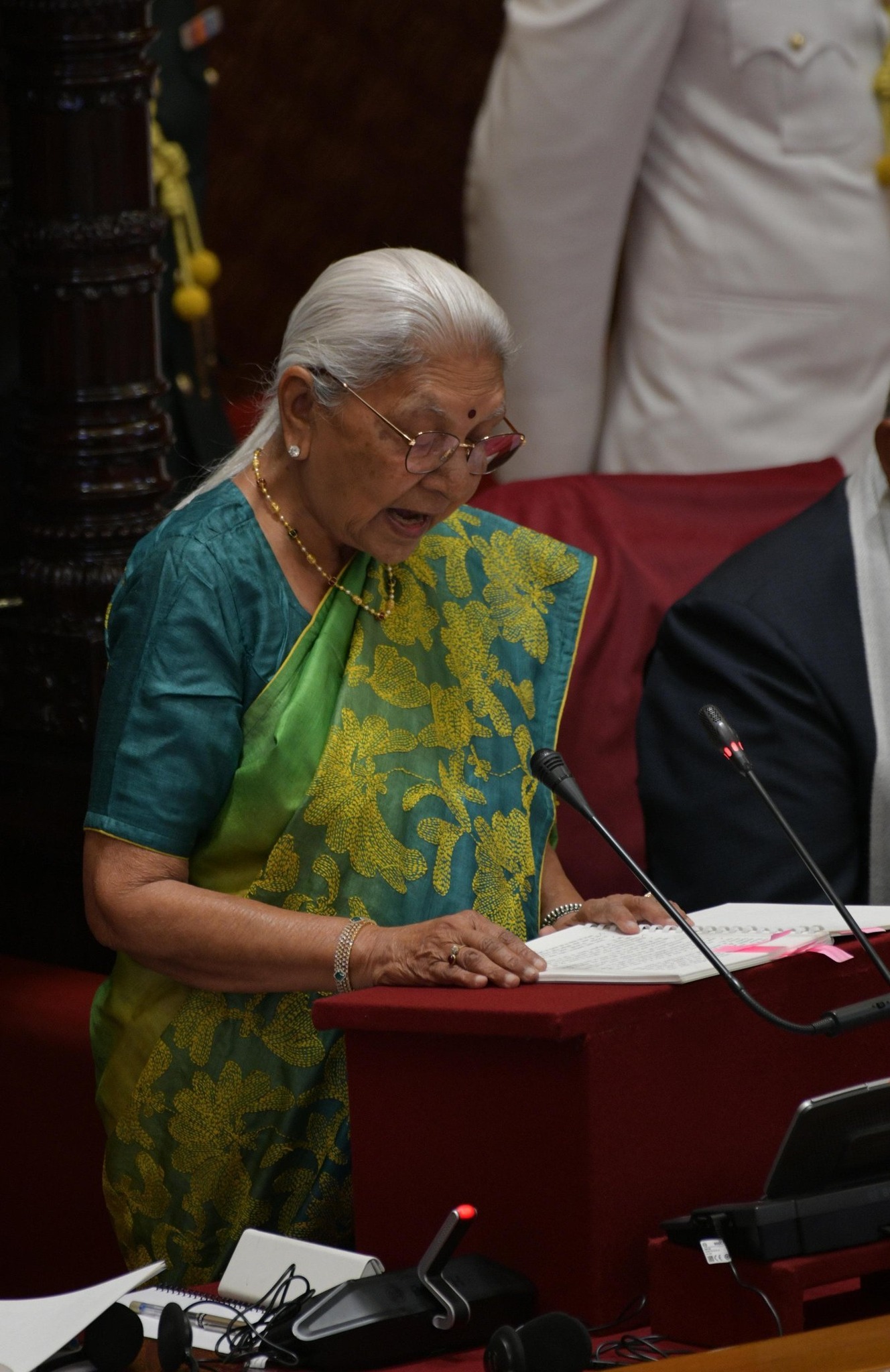
Lucknow: Addressing the joint sitting of the Legislature, Governor Anandiben Patel presented a comprehensive and fact-based picture of Uttar Pradesh’s development. From power supply to the agriculture-based economy, sugarcane payments, animal husbandry, environmental conservation, mining reforms, public transport, social security, women’s empowerment, urban housing and labour welfare, she systematically outlined the government’s policies and their tangible outcomes.
Highlighting sweeping reforms in the power sector, the Governor said that Uttar Pradesh has witnessed a historic transformation in electricity supply. At present, uninterrupted power is being ensured for 24 hours in urban headquarters, 21 hours in tehsil headquarters and 19 hours in rural areas.
Under the Intensive Distribution Scheme, 5.983 lakh smart/electric meters have been installed so far, while 3.745 lakh old meters have been replaced with prepaid meters. The Governor also clarified that there has been no increase in electricity tariffs over the past six years, providing sustained relief to consumers and strengthening trust in the power sector.
Presenting a detailed account of historic progress in agriculture, the Governor said, “Uttar Pradesh is today moving swiftly ahead on all three fronts-production, productivity and the agricultural economy. Food grain production, which stood at 55.746 lakh metric tonnes in 2016-17, rose to 67.080 lakh metric tonnes in 2023-24 and further to 73.740 million metric tonnes in 2024-25. The agriculture sector’s contribution to Gross State Domestic Product (GSDP) has also seen a significant jump-from ₹2.96 lakh crore in 2016-17 to ₹6.95 lakh crore at present-reflecting a 135 percent increase and an annual growth rate of nearly 18%.”
“The state has also scaled new heights in horticulture. Cultivated area has increased from 2.14 million hectares to 2.6 million hectares, while production has risen from 38 million metric tonnes to 60 million metric tonnes. Exports of horticultural products have grown remarkably from ₹400 crore to ₹1,700 crore. These achievements have directly benefited farmers, with income from fruits and vegetables increasing from ₹41,000 crore to ₹1.25 lakh crore”, she added.
Referring to achievements related to the sugar industry and sugarcane farmers, the Governor said, “Uttar Pradesh has set unprecedented records in sugarcane payment. Since 2017, more than ₹3,04,321 crore has been paid to farmers, ₹90,802 crore more than the total payment of ₹2,13,519 crore made between 1995 and 2017.
After 2017, the establishment of three new sugar mills at Pipraich, Munderwa, and Ramala has increased the state’s crushing capacity by 1.25 lakh quintals per day. In the interest of farmers, sugarcane prices have been increased by ₹30 per quintal, while productivity has risen from 72.38 metric tonnes per hectare to nearly 84 metric tonnes per hectare. Through self-help groups, 59.75 crore plant saplings were distributed and financial assistance of ₹76.88 crore was provided. As a result of these coordinated efforts, more than 10 lakh people associated directly and indirectly with the sugar industry and sugarcane sector have gained employment opportunities.”
Highlighting animal husbandry and rural economic strengthening, the Governor said that cow welfare in Uttar Pradesh has been developed not merely as protection, but as a strong and sustainable livelihood model. A total of 1,238,547 destitute cattle are being cared for in 7,497 cow shelters across the state. Under the “Mukhyamantri Sahbhagita Yojana” and the “Nutrition Mission”, 1,81,418 cattle have been handed over to cow rearers, providing sustainable livelihoods to 1,13,631 families. To make cattle rearing economically viable, assistance at the rate of ₹50 per animal per day is being transferred directly through DBT, under this, more than ₹1,484 crore has been paid so far in the financial year 2025-26. These integrated efforts have provided a solid foundation to the rural economy and positioned animal husbandry as an effective instrument of self-reliance.

The Governor highlighted notable achievements in forests and environmental conservation, stating that since 2017, a total of 242.13 crore saplings have been planted, increasing the state’s forest cover to 9.96%. Treating environmental protection not merely as a government initiative but as a movement driven by public participation has established Uttar Pradesh as an effective and exemplary model in this field. Integrated efforts in plantation, protection, and conservation have enabled tangible progress toward sustainable development and ecological balance.
Referring to extensive reforms in the mining sector, the Governor said, “Since 2017, the state has earned mining revenue of ₹28,920 crore, compared to just ₹7,712 crore during 2012-17. Technology-enabled monitoring, e-tendering and transparent auction systems have not only significantly increased revenue but also ensured effective control over illegal mining.”
Highlighting the achievements of the Uttar Pradesh State Road Transport Corporation, the Governor said that its 13,621 buses operated for 10.337 billion kilometres, providing safe and accessible transport services to 371 million passengers. As a result of efficient management, the corporation earned revenue of ₹3,810.63 crore, reflecting the strength and financial stability of the state’s public transport system.
Underscoring progress in social security and public welfare, the Governor said, “That self-help groups have emerged as a powerful vehicle for social inclusion and women’s empowerment in the state. More than 64% of SHG members belong to Other Backward Classes (OBCs), while over 45,611 women from Scheduled Castes and Scheduled Tribes are also actively associated. Through SHGs, more than ₹109 crore has been transferred directly to beneficiaries, significantly strengthening women’s economic independence, social participation and the rural economy.”
The Governor said, “Keeping the spirit of social justice at the core, the government has ensured 23% reservation for Scheduled Castes and Scheduled Tribes under the Baba Saheb Ambedkar Employment Promotion Scheme, with a provision of subsidy up to ₹70,000 for these categories and persons with disabilities. For the general category, the subsidy is 25% per unit or a maximum of ₹50,000. This targeted financial assistance has provided economic support to eligible beneficiaries and played a crucial role in ensuring that schemes deliver real benefits. These reforms clearly reflect the government’s commitment to inclusive development and equal opportunity.”
On progress in urban development and housing, the Governor said that under the Pradhan Mantri Awas Yojana (Rural), 3.637 million houses have been constructed- 99.49% of the target and the highest in the country. Similarly, under the Chief Minister Awas Yojana (Rural), construction of 367,000 houses has been fully completed so far. This achievement marks a major step toward providing dignified housing to the poor.
Referring to labour and worker welfare schemes, the Governor said that unprecedented efforts have been made to bring workers from the unorganized sector under the social security net. More than 85.1 lakh workers have been registered on the e-Shram portal so far, reflecting the state’s extensive outreach. Under the Pradhan Mantri Shram Yogi Maandhan Yojana, 701,484 workers have been linked to pension security, providing financial support for their future and reinforcing Uttar Pradesh’s strong identity as a worker-friendly state.