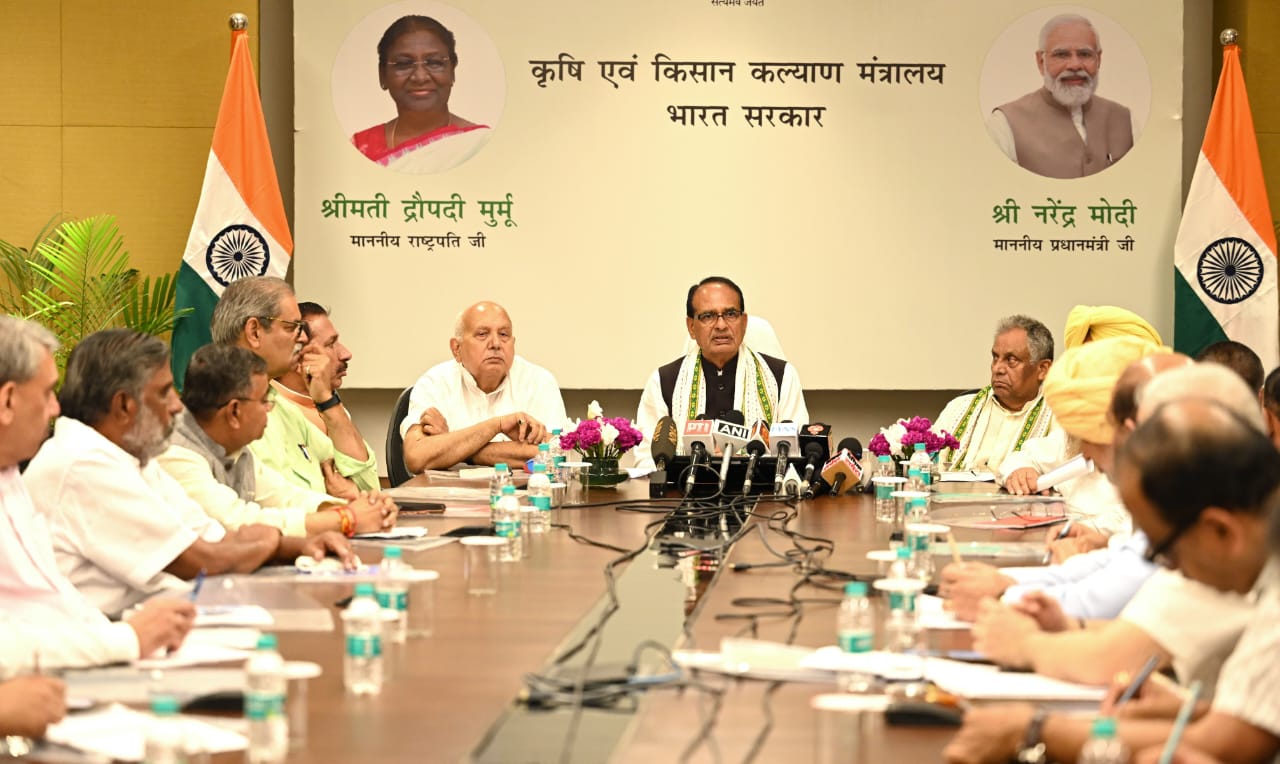
Lucknow : Uttar Pradesh Agriculture Minister Surya Pratap Shahi participated in the inaugural session of the National Agriculture Conference 2025, organised by the Ministry of Agriculture and Farmers Welfare, Government of India, at the Bharat Ratna C. Subramaniam Auditorium, NASC Complex, Pusa, New Delhi.
Addressing the gathering, Minister Shahi presented details of various initiatives and schemes being implemented by the Uttar Pradesh government for farmers’ welfare. He highlighted that the state has made remarkable progress in agriculture during the current government’s tenure. Uttar Pradesh recorded a foodgrain production of 725.12 lakh metric tonnes in 2024-25, compared to 557.46 lakh metric tonnes in 2016-17. Similarly, the state achieved 35.18 lakh MT in pulse production (up from 23.95 lakh MT) and 29.20 lakh MT in oilseed production (up from 12.04 lakh MT).
The state has set a target of 293.36 lakh MT for Kharif 2025, marking an increase of 30 lakh MT over the previous year. Uttar Pradesh currently ranks first in the country in the production of wheat, rice, mangoes, potatoes, vegetables, and milk. It holds the second position in the production of millet and lentils, third in mustard, and fourth in overall pulse production.
Given the declining soil fertility in many areas, Shahi emphasised the need to expand the cultivation of maize, millet, sorghum, urad, moong, arhar, and other coarse grains. He set a target to raise the productivity of Kharif foodgrains from 12.30 quintals per hectare to 13.55 quintals per hectare. He also stressed timely availability of quality seeds, fertilizers, and water based on agro-climatic zones, as well as the promotion of seed treatment, line sowing, Direct Seeding of Rice (DSR), crop rotation, intercropping in sugarcane, and diversification of farmland.
To help the nation become self-reliant in pulses and oilseeds, the UP government has distributed over 4.63 lakh free minikits to farmers since 2017-18. High-quality seeds are being supplied at subsidised rates through POS machines. The state currently has a robust stock of fertilizers: 14.55 lakh MT of urea, 2.58 lakh MT of DAP, 2.65 lakh MT of NPK, and 2.87 lakh MT of SSP. He urged farmers to use fertilizers in a balanced manner and encouraged the use of biopesticides, bio-agents, and increasing organic carbon in soil.
Shahi shared that under the PM-Kisan Samman Nidhi scheme, ₹85,000 crore has been transferred to 2.86 crore farmers in Uttar Pradesh. Under the PM-KUSUM scheme, the state has targeted installation of 45,000 solar pumps by 2025-26 to promote clean energy in agriculture.
He further informed that 72 lakh farmers have benefited under the Pradhan Mantri Fasal Bima Yojana, with insurance payouts totaling ₹5,500 crore. Through e-lottery, the government has distributed 2.36 lakh agricultural implements, established 6,000 farm machinery banks, and created 8,000 custom hiring centers.
Uttar Pradesh has successfully met its targets under the Digital Crop Survey and Farmer Registry initiatives.
During the session, Minister Shahi submitted several key recommendations to the Union Agriculture Minister:

-
Under the PM Crop Insurance Scheme, crop damage due to waterlogging in paddy fields should be included as a localised disaster.
-
The window for reporting individual losses should be extended from 72 hours to 120 hours.
-
Compensation for crop loss should be ensured within two months of harvest, and the portal should be updated accordingly.
He also sought changes in fund allocation under the Rashtriya Krishi Vikas Yojana (RKVY):
-
The second installment of funds should not be withheld until 75% of the first installment is spent, as it hampers timely implementation.
-
A pending ₹172 crore under RKVY and Krishonnati Yojana from the previous year should be released for immediate expenditure.
-
The first installment for 2025-26 under the Krishonnati Yojana should be issued at the earliest.
The conference marked a significant platform for deliberations on future strategies to strengthen Indian agriculture and ensure inclusive growth for farmers across the country.