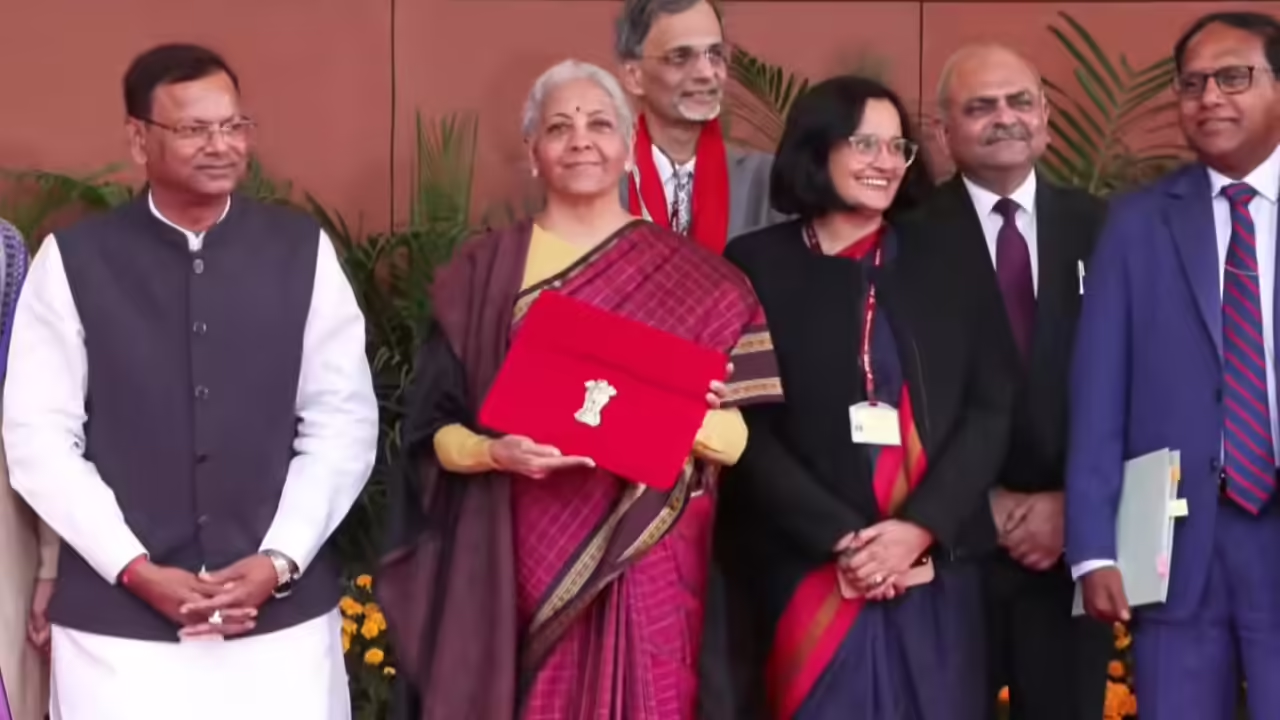
New Delhi: The Union Budget 2026–27 has outlined a comprehensive and inclusive roadmap to fulfil the third Kartavya of Sabka Saath, Sabka Vikas, aimed at ensuring equitable access to resources, amenities and opportunities for every family, community, region and sector. Presenting the Budget in Parliament, Union Finance and Corporate Affairs Minister Nirmala Sitharaman said this Kartavya aligns closely with the government’s long-term vision of a Viksit Bharat.
The Finance Minister said achieving this goal requires targeted interventions focused on increasing farmers’ income, empowering Divyangjan and vulnerable sections, and accelerating development in the Purvodaya states and the North-East region.
Targeted Inclusion and Regional Focus
Laying out the framework for inclusive development, Smt. Sitharaman highlighted four priority areas:
-
Enhancing farmers’ incomes through productivity improvement and entrepreneurship, with special attention to small and marginal farmers.
-
Empowering Divyangjan with livelihood opportunities, skills training and access to high-quality assistive devices.
-
Strengthening access to mental health and trauma care for vulnerable populations.
-
Accelerating development and employment generation in the Purvodaya states and the North-East.
Boost to Farmers’ Income and Rural Economy
Under the objective of increasing farmers’ incomes, the Budget announced provisions for the integrated development of 500 reservoirs and Amrit Sarovars, strengthening the fisheries value chain in coastal regions, and improving market linkages through start-ups, women-led groups and Fish Farmer Producer Organisations.
Animal husbandry has been identified as a key growth driver for rural and peri-urban employment. The government will support entrepreneurship in the sector through a credit-linked subsidy programme, scaling up and modernisation of livestock enterprises, development of integrated dairy, poultry and livestock value chains, and promotion of Livestock Farmer Producer Organisations.

Focus on High-Value Agriculture
The Budget placed strong emphasis on high-value agriculture, particularly crops with strong domestic and global demand. Support will be extended to coconut, sandalwood, cocoa and cashew cultivation in coastal regions, agar trees in the North-East, and nuts such as almonds, walnuts and pine nuts in hilly areas.
Announcing a Coconut Promotion Scheme, the Finance Minister noted that India is the world’s largest coconut producer, with nearly 30 million people, including about 10 million farmers, dependent on coconut-based livelihoods. The scheme aims to enhance productivity and competitiveness by replacing old and non-productive trees with improved varieties in major coconut-growing states.
A dedicated programme for Indian cashew and cocoa has also been proposed to make India self-reliant in raw material production and processing, boost export competitiveness, and position Indian cashew and cocoa as premium global brands by 2030.
To revive the traditional Indian sandalwood ecosystem, the Union Government will partner with states to promote focused cultivation and post-harvest processing. Additionally, a special programme has been announced to rejuvenate old orchards and expand high-density cultivation of walnuts, almonds and pine nuts, with a strong emphasis on value addition and youth engagement.
Bharat-VISTAAR: AI for Inclusive Agriculture
Further strengthening farmer support, the Finance Minister announced the launch of Bharat-VISTAAR (Virtually Integrated System to Access Agricultural Resources). Envisioned as a multilingual, AI-based advisory platform, Bharat-VISTAAR will integrate AgriStack portals and ICAR’s agricultural practice packages with advanced AI systems.
The platform is expected to enhance farm productivity, enable better decision-making by farmers, and reduce risks through customised, region-specific advisory services.
Inclusive Growth as a Cornerstone
Through a blend of agricultural reforms, technology-led interventions and region-specific development strategies, the Union Budget 2026–27 underscores the government’s commitment to inclusive growth. By focusing on farmers, vulnerable groups, Divyangjan and lagging regions, the third Kartavya of Sabka Saath, Sabka Vikas is positioned as a central pillar in India’s journey towards becoming a developed nation by 2047.