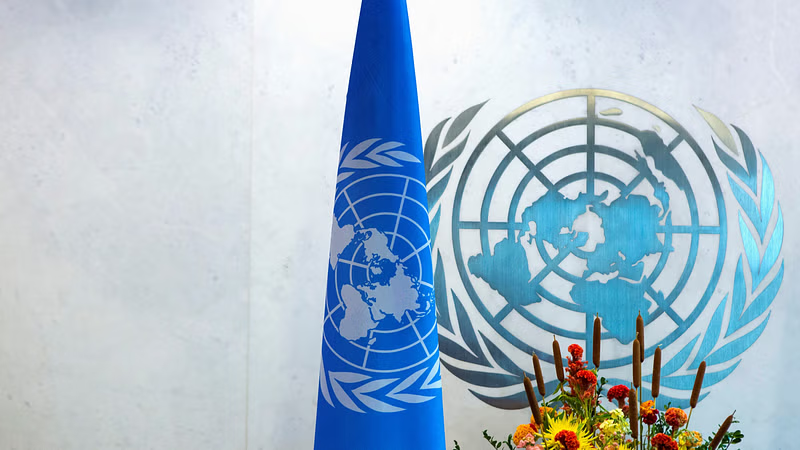
United Nations: The President of the United Nations Security Council (UNSC), Evangelos Sekeris, on Thursday expressed deep concern over the growing tensions between nuclear-armed neighbours India and Pakistan and said the Council might meet “sooner rather than later” to address the escalating situation.
Speaking at a press briefing on Greece’s chairmanship of the UNSC for May, Sekeris, who also serves as Greece’s Permanent Representative to the UN, responded to a question from PTI, stating, “Obviously, if a meeting request is made, then I believe that it should happen since it may also be a chance to voice opinions and assist to ease some tensions. We shall see.”
The comments follow increasing hostilities between India and Pakistan, triggered most recently by a deadly terrorist attack in Pahalgam, Jammu and Kashmir. The UNSC had condemned the attack in a statement last week, calling it “heinous” and stressing the need to bring the perpetrators to justice.
Sekeris affirmed the Council’s united stance against terrorism: “We vehemently denounce any act of terrorism as a matter of principle, and we did just that in response to the Pahalgam terrorist attack that claimed innocent lives.” He also added that both India and Pakistan are significantly large nations, and the need for de-escalation and dialogue is critical to prevent further deterioration of the situation.
India has long accused Pakistan of backing cross-border terrorism, while Pakistan continues to allege provocation and aggression from New Delhi. In a recent phone conversation with US Secretary of State Marco Rubio, Pakistan’s Prime Minister Shehbaz Sharif reiterated those accusations, calling for international mediation.
Meanwhile, Indian External Affairs Minister S. Jaishankar recently discussed the attack with his Greek counterpart George Gerapetritis, reinforcing the shared stance against cross-border terrorism. Jaishankar stated, “Our Strategic Partnership reflects the depth of our ties,” while acknowledging Greece’s vocal support on the issue.

Sekeris highlighted Greece’s cordial bilateral relations with both India and Pakistan, stressing that the Council’s role is not antagonistic but cooperative. “We are on the Council together with Pakistan, and we will work together. If a request is made to convene a meeting, we are ready to guide the discussion in accordance with our responsibilities as president,” he said.
He also confirmed that internal discussions were ongoing within the Council and that bigger member states were already in contact with both sides to promote peace. “We are paying attention, keeping a careful eye on the situation, and we will take appropriate action,” he said. “There is no doubt that it will occur.”
On the possibility of a high-level UN mediation, Secretary-General António Guterres has extended his good offices to both nations. However, his spokesperson, Stéphane Dujarric, clarified that any potential visit or mediation would depend on consent from both governments. “As in any instance of high tensions, both parties must accept his good offices,” Dujarric said.
As tensions simmer and diplomatic channels remain active, the international community watches closely. The potential UNSC meeting could serve as a crucial platform to de-escalate the situation and reiterate the global consensus against terrorism and for peaceful resolution.