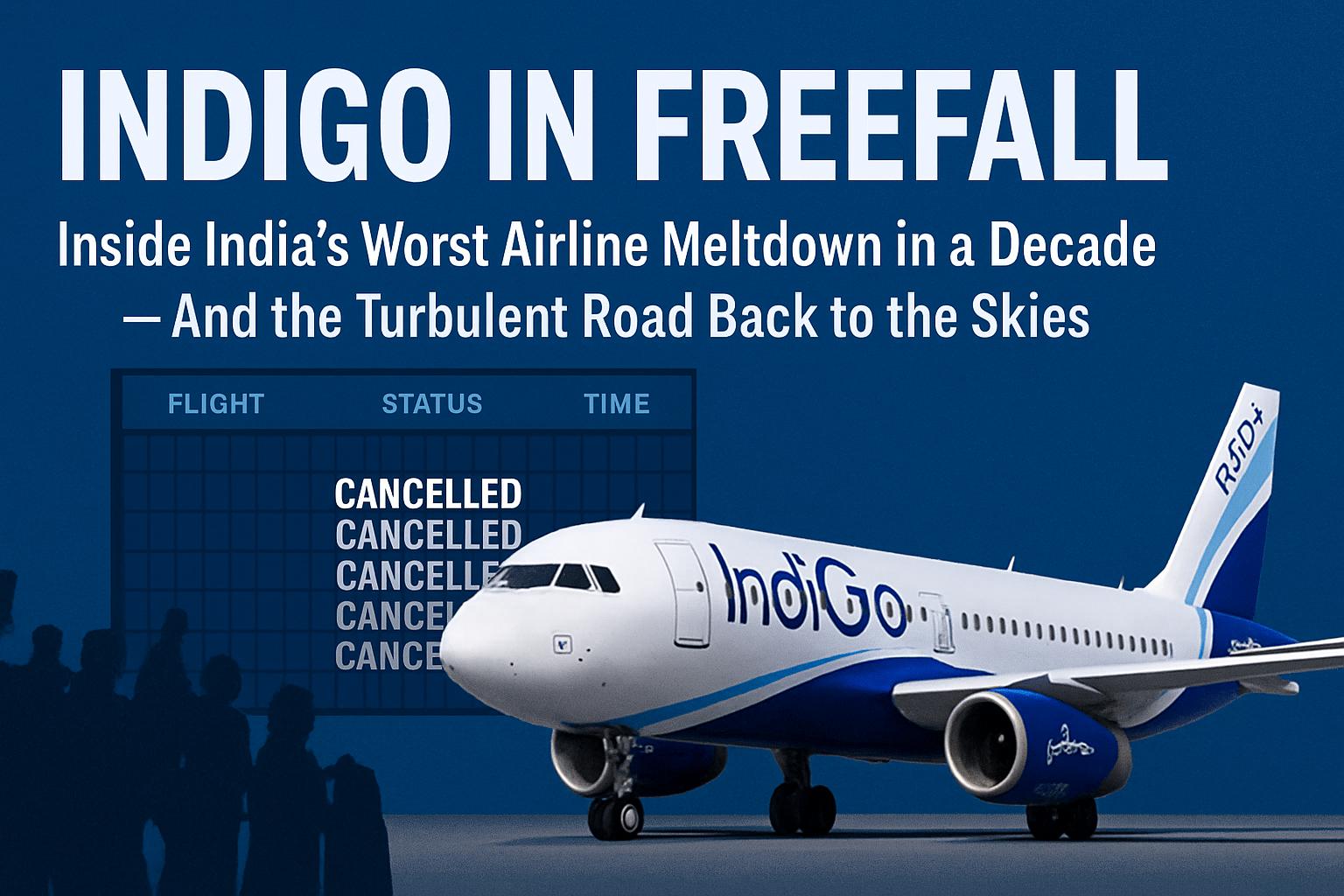
New Delhi: In what aviation veterans describe as India’s worst airline crisis in over ten years, budget carrier IndiGo has spent the past week clawing its way out of a catastrophic operational collapse that grounded more than a thousand flights in a single day and left tens of thousands of passengers stranded at airports from Delhi to Srinagar. Triggered by a severe pilot shortage and compounded by newly enforced flight duty regulations, IndiGo’s meltdown exposed deep fissures in the country’s aviation ecosystem—dominant market share, aggressive expansion, and an over-lean revenue model stretched far beyond its limits.
As of December 7, IndiGo has restored 1,650 flights—a major rebound from the paltry 700 that operated on crisis day—yet 650 flights remain canceled, signalling that while aircraft are back in the air, the crisis is far from fully resolved.
How the Crisis Erupted: A Perfect Storm of Regulations, Rosters, and Rapid Growth
The turbulence began earlier this week when IndiGo, which commands over 60% of India’s domestic aviation market, failed to roster enough pilots ahead of full enforcement of the revamped Flight Duty Time Limitations (FDTL) on November 1. The DGCA-mandated rules, backed by a Supreme Court directive, restrict weekly rest periods and night-duty hours to curb pilot fatigue—safety measures long demanded by crew unions.
While peers like Air India and Akasa Air navigated the transition with relative ease, IndiGo’s skeleton staffing model—denounced by the Federation of Indian Pilots as an “unorthodox and prolonged cost-cutting experiment”—buckled under the pressure. The repercussions were immediate and dramatic.
Friday: The Day Indian Aviation Froze
Friday marked the system’s complete unraveling:
- 1,000+ flights canceled in 24 hours
- All departures from Delhi’s IGI Airport scrapped
- Thousands stranded across Mumbai, Bengaluru, Hyderabad, Pune, and Kolkata
- Chants of “IndiGo, shame!” echoing through terminals
- Piles of unclaimed baggage forming labyrinths across baggage halls
- Mass protests in Srinagar and Jammu during peak holiday season
Aveen Balakrishnan, flying to Bengaluru from Ahmedabad, endured a 20-hour ordeal. “We were herded like cattle, left without updates or food vouchers,” she told reporters—one of hundreds of similar testimonies.
By the time the weekend arrived, the shockwaves had affected weddings, medical travel, business shipments, school events, and even participants heading for the Smart India Hackathon.
Planes Flying Again: What Has Improved as of December 7
Surging Operations
- 1,650 flights flown today
- OTP climbs to 75% (up from a dismal 30%)
- 137 of 138 destinations reconnected
- 95% network stability claimed by IndiGo
- Full normalization expected by December 10
Airport Snapshot
- Kolkata: 53 departures & 23 arrivals canceled
- Amritsar: 13 flights canceled
- Hyderabad: 115 total flights canceled
- Bengaluru: 124 canceled
- Mumbai: 112 canceled
- Delhi: 109 canceled
The worst disruption zones are slowly stabilizing, though “residual turbulence” continues, especially during peak hours.
Social Media Mood: A Mix of Relief and Resentment
On X, posts under #IndiGoCrisis reveal a public torn between hope and fury.
Travelers describe:
- Operations “nearing normalcy”
- Concerns about Monday and Tuesday schedules
- Emotional posts about missed weddings, interviews, funerals
- Viral videos of passengers confronting staff
Refunds, Waivers & Baggage: What IndiGo Has Completed So Far
IndiGo has met the Centre’s deadline to clear all refunds by Sunday 8 PM.
Financial Relief
- ₹610 crore refunded to passengers
- Cancellation/rescheduling fees fully waived through December 15
- Thousands of hotel rooms and ground transport arranged
Baggage Update
- 3,000+ bags delivered
- Complete clearance expected within 48 hours
Travel platforms like ixigo have waived convenience fees to support disrupted passengers, though indirect bookings still face delays.
Government Intervention: Caps, Crackdowns and Committees
Civil Aviation Minister Ram Mohan Naidu Kinjarapu moved fast and hard:
Immediate Actions
- Fare caps imposed:
- ₹7,500 for short-haul
- ₹18,000 for long-haul
- Directed IndiGo to finish all refunds by Sunday night
- Ordered complete compliance reports from the airline
Transport Relief
Indian Railways ran 89 special “Train on Demand” services, connecting cities like Delhi, Lucknow, Bengaluru, and Mumbai.

Regulatory Hammer
- DGCA issued a show-cause notice to CEO Pieter Elbers
- Possible penalties include fines or suspension
- Parliamentary Committee to summon IndiGo leadership, DGCA, and the ministry
- High-level probe committee already at work
Opposition leaders like Rajeev Shukla and P. Chidambaram blasted the situation as a failure symptomatic of India’s fragile aviation duopoly: IndiGo and Air India controlling the skies.
IndiGo’s Response: Apologies, Explanations, and Internal Damage Control
CEO Pieter Elbers released a video apology, calling the chaos a result of “unforeseen operational challenges”—ranging from FDTL changes to winter fog and tech outages.
He promised:
- Stabilization by Dec 10–15
- Full restoration by February 10, 2026
Internally, the Board activated a Crisis Management Group (CMG), led by Chairman Vikram Singh Mehta and including heavyweight directors like Amitabh Kant and Mike Whitaker.
Why IndiGo Cracked: The Structural Weakness Behind a Gigantic Fleet
When an airline grows too fast, the cracks show first in its crew rosters.
IndiGo’s numbers at the end of 2025:
- 437 aircraft
- 2,300 daily flights
- 31.1 million passengers in Q3 FY24
- Cash reserves: ₹43,781 crore
But the airline’s rapid scaling didn’t match its pilot hiring pipeline.
The FDTL enforcement simply exposed the gap.
Aviation analyst Kapil Kaul called it “a wake-up call for sustainable growth in an oligopolistic market.”
Air India’s Resurgence: A Subplot Worth Watching
As IndiGo spiraled, Air India and Air India Express not only matched fare caps but also stepped up with change-fee waivers and added capacity. The Tata-owned group has been on a massive rebuilding path—new aircraft orders, international routes, and a rebranding blitz.
This crisis may give Air India a significant market share boost, especially among business travelers shaken by IndiGo’s instability.
What Comes Next: Immediate Predictions
Short-Term (next 72 hours)
- Expect minor delays but fewer mass cancellations
- OTP could breach 80% by December 10
- Full refunds for any additional cancellations
Medium-Term (next 4–6 weeks)
- DGCA may recommend:
- Penalties
- Oversight of IndiGo rostering
- Possibly leadership changes
Long-Term (2026)
- A rebalanced aviation market
- Air India and Akasa Air poised to expand
- Pressure on IndiGo to invest in:
- Crew welfare
- Contingency planning
- Training capacity
A Crisis That Redefined Indian Aviation
This week’s meltdown wasn’t merely an operational failure; it was a revelation.
A reminder that dominance is fragile, and that even India’s largest airline can be brought to a standstill by regulatory changes it should have anticipated years ago.
IndiGo’s planes are flying again.
The crowds are thinning.
The boards are turning green.
But trust—once shaken—will take far longer to regain. As the DGCA’s probe deepens and competition sharpens its wings, the skies IndiGo once ruled uncontested may soon become more turbulent, more competitive, and more demanding of accountability than ever before.