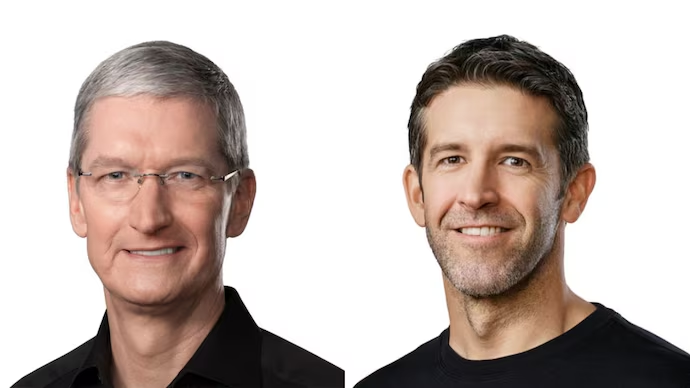
Washington: Apple may be on the verge of one of the most significant leadership transitions in its modern history. After more than a decade at the helm, CEO Tim Cook is reportedly considering stepping back from day-to-day responsibilities later this year, potentially setting the stage for a carefully managed succession at the world’s most valuable company.
While Apple has made no official announcement, multiple reports and internal signals suggest that discussions around leadership continuity are already well underway. If confirmed, Cook’s transition would mark the end of an era that transformed Apple from a successful tech company into a global economic powerhouse.
Tim Cook’s Era: Stability, Scale, and Unprecedented Growth
Tim Cook took over as Apple’s CEO in 2011, following the passing of co-founder Steve Jobs. At the time, Apple was valued at approximately $350 billion and faced intense scrutiny about whether it could maintain its momentum without its visionary founder.
Fourteen years later, Cook leaves behind a vastly different company. Under his leadership, Apple crossed the $4 trillion market capitalisation mark, expanded its services business into a major revenue pillar, and built one of the most resilient global supply chains in corporate history. Products such as the Apple Watch, AirPods, and Apple Silicon chips emerged during his tenure, reshaping entire categories.
Cook’s leadership style focused less on showmanship and more on execution, operational discipline, and long-term planning. That approach delivered consistent growth and stability, even during global disruptions such as the COVID-19 pandemic and ongoing geopolitical supply chain challenges.
A Gradual Step Back, Not a Sudden Exit
According to reports, Cook has informed senior Apple executives that he intends to reduce his workload. This discussion comes ahead of Apple’s annual shareholder meeting scheduled for February 2026. At 65, Cook is said to be exploring a transition away from daily operational responsibilities rather than an abrupt departure.
Industry observers believe Cook may remain involved with Apple as chairman, a role that would allow him to guide long-term strategy while handing over execution to a new CEO. Such an arrangement would mirror leadership transitions seen at other major corporations and would align with Apple’s preference for stability.
Importantly, Apple is known for methodical succession planning. Any leadership change would likely be announced well in advance, ensuring continuity for investors, employees, and partners.
Succession Planning Already in Motion
Apple has historically favoured internal leadership transitions, and current indications suggest the same approach this time. Rather than looking outside the company, Apple appears focused on grooming candidates who already understand its culture, values, and complex ecosystem.
Among the names frequently discussed, one executive stands out: John Ternus, Apple’s Senior Vice President of Hardware Engineering.
Why John Ternus Is the Top Contender
John Ternus joined Apple in 2001 and has steadily risen through the ranks. Today, he oversees some of Apple’s most critical product lines, including the iPhone, iPad, and Mac. His role places him at the intersection of product vision, engineering execution, and manufacturing realities.
At 50 years old, Ternus is roughly the same age Tim Cook was when he assumed the CEO role. Internally, he is regarded as a calm, methodical leader with a deep understanding of Apple’s hardware roadmap and supply chain dynamics — an area that remains central to Apple’s business model.

Ternus has also become increasingly visible in recent years, representing Apple at major product launches and technical briefings. This growing public presence has fueled speculation that Apple is intentionally positioning him as a future leader.
A CEO with a strong hardware background would mark a shift from Cook’s operations-first leadership style, but it would not be unprecedented in Apple’s history. Given Apple’s increasing focus on custom silicon, devices, and tightly integrated hardware-software experiences, a hardware-driven leader could align well with the company’s next phase.
Continuity Versus Change: The Internal Debate
Despite Ternus’s strengths, the succession discussion within Apple is not without debate. Some argue that Apple may benefit from another continuity-focused leader — someone who preserves Cook’s emphasis on operational excellence and measured decision-making.
Others believe the company could use a more risk-tolerant CEO as it faces slowing smartphone growth, increased regulatory scrutiny, and intensifying competition in artificial intelligence and services. Balancing innovation with Apple’s traditionally cautious approach will be a key challenge for any future leader.
Other Names in Apple’s Leadership Bench
While Ternus appears to be the frontrunner, Apple’s executive bench is deep. Leaders such as Craig Federighi (software engineering), Eddy Cue (services), Greg Joswiak (marketing), and Deirdre O’Brien (retail and people operations) are all highly influential figures within the company.
However, moving any of these executives into the CEO role could create significant gaps in their respective divisions. With Apple navigating major transitions in software, AI integration, and services growth, disrupting these areas may carry risks.
This reality further strengthens the case for Ternus, whose promotion would likely cause less organisational disruption while maintaining continuity in Apple’s core product development.
What This Transition Means for Apple
A potential leadership change does not signal instability at Apple — quite the opposite. It reflects a company confident enough to plan years ahead and ensure smooth transitions at the highest level.
If Tim Cook does step back in 2026, his legacy will be defined not just by financial success, but by transforming Apple into a disciplined, globally scalable enterprise capable of thriving beyond any single individual.
For Apple, the next CEO will not just inherit a massive business, but also the responsibility of steering the company through its next technological chapter — one shaped by artificial intelligence, mixed reality, and services-led growth.
Whether that future is led by John Ternus or another internal candidate, one thing is clear: Apple’s next leadership era is already taking shape.