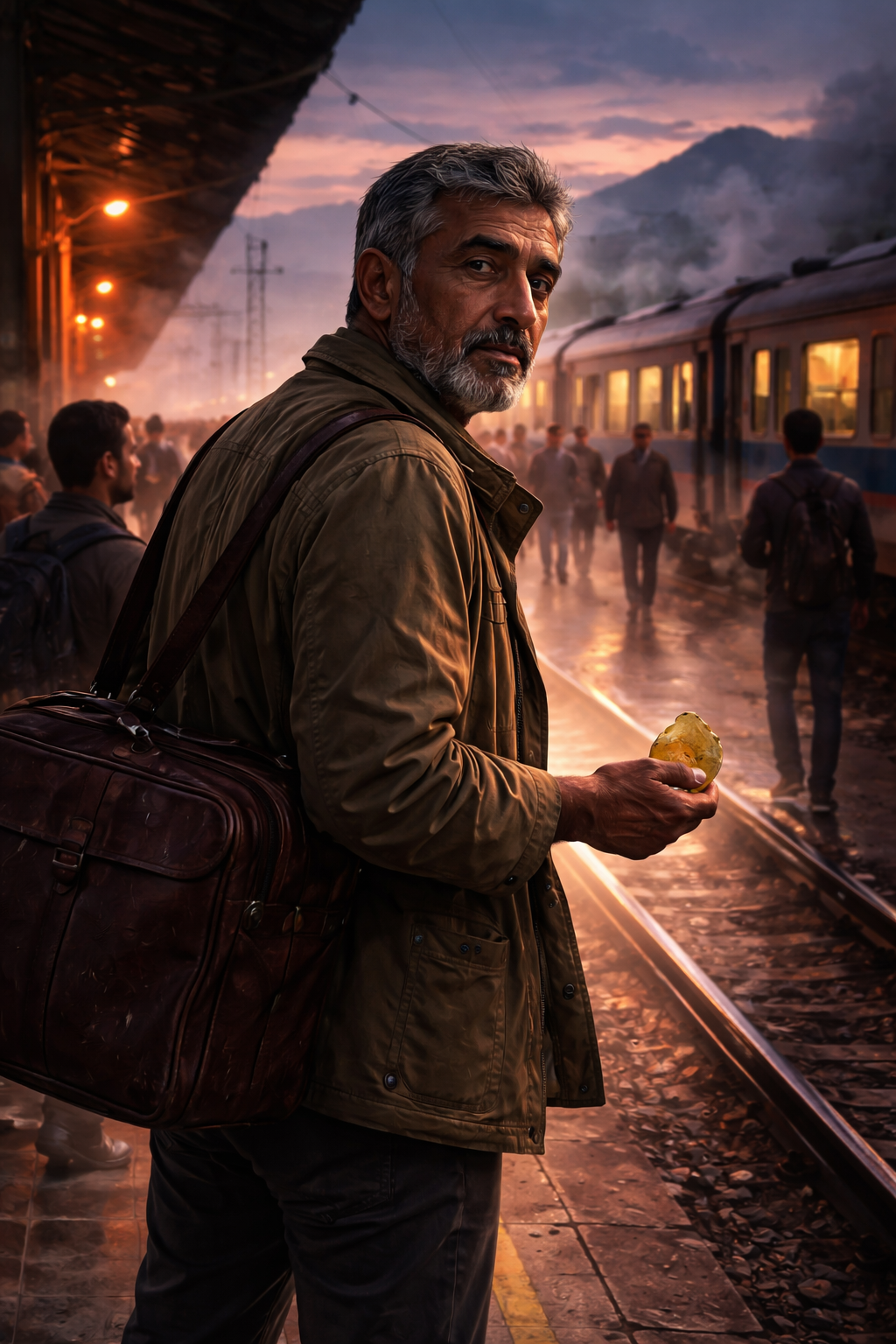
As the train pulled away from Isfahan, Amir slid his hand into his suitcase and found what he was looking for. The shard of yellow ceramic was still there. He lifted it gently, turning it in the dim light, its cracked glaze catching memories more vividly than any photograph.
That morning felt like a lifetime ago. The walls of his apartment had trembled, coughing up dust and fragments of plaster. The city itself seemed to shudder with fear. Amir hadn’t waited to think—only to act. He packed what he could, ready to leave everything else behind. Yet somehow, his eyes had fallen on that broken piece of tile lying on the floor. Seventeen years of his life, reduced to something that fit in his palm.
The bombings had been deafening—raw, merciless. But on the train, it wasn’t the distant thunder that unsettled him most. It was the quiet panic. Young men whispering. Eyes darting. Hands gripping bags as if they held the last scraps of certainty in a collapsing world.
Amir turned away from them. Fear, he had learned, was contagious.
He checked his belongings again. The silver pipe he had bought decades ago was still tucked away. In another place, another life, it might become currency. Survival had a way of reshaping value.
There was a time when none of this would have frightened him. As a young man, he and his friends would climb Soffeh Mountain, laughing at the absurdity of it all, watching the world from above as if it couldn’t touch them. Back then, wars were distant stories, and life felt too vast to be contained by borders or beliefs.
Now, the years weighed on him. The rhythm of the train felt heavier, each clank echoing through tired bones. He held his suitcase close, as if it were the last solid thing anchoring him to who he had been.
From its pocket, he pulled an old ticket stub—his first escape from Isfahan. He had been seventeen, furious, reckless. After one last argument with his father, he had stormed out, convinced he would never return.
Tehran had been harsh but freeing. Long hours, small wages, endless exhaustion—but no lectures about honor, no suffocating expectations. Even now, he wasn’t sure he understood what honor meant.
But duty—duty he understood.
He unfolded a photograph. Amineh smiled back at him, frozen in a moment beneath the arches of Golestan Palace. Their names had once felt like destiny. Their life together had been simple, hopeful. They had planned for children, for books, for quiet evenings.
Then illness came, indifferent and swift. Doctors spoke in soft reassurances, but hope slipped away all the same. By the time she was gone, the world felt smaller, emptier.
He had returned to Isfahan after that. Pride swallowed, past forgiven in fragments. His father, once so distant, slowly softened again. Life settled into routine.
Work became his refuge. He built a name for himself, buried in research, respected in quiet academic circles. For a time, it felt like control—like meaning.
Until he spoke too loudly.
One conversation, one opinion too many, and the door closed. Retirement was suggested, gently but firmly. He understood the message. In his country, some things didn’t need to be said aloud.
After that, the world lost its shape. Politics, titles, recognition—they all seemed hollow. Even friendships thinned into silence.

The train conductor’s voice broke through his thoughts: two hours to Tabriz. A ripple of relief passed through the carriage. For many, it was just another stop. For others, it was a doorway out.
A young man moved through the aisle, barely more than a boy. His hands trembled as he asked for help, his voice thin with desperation. No ticket. No plan. Just hope, fragile and fading.
Amir reached into his suitcase one last time. His fingers closed around a brass key.
His father had given it to him years ago—the key to the apartment that had become his world. A quiet gesture, heavy with unspoken reconciliation. Like father, like son.
Amir looked at the boy again. Something shifted inside him. Not sudden, not dramatic—just a quiet release, like a knot finally loosening.
He stood.
Without overthinking, without allowing doubt to take hold, he placed his onward ticket into the boy’s hand.
The boy resisted at first, confusion and gratitude spilling into tears. Amir simply shook his head. No explanations. No speeches.
When the train stopped at Tabriz, he guided the boy toward the next platform, pressing one final instruction into his mind—find his uncle in Turkey, say Amir sent you.
And then it was done.
Amir stepped back onto the platform alone, his suitcase lighter than it had any right to be. No ticket. No destination. Just the cool evening air and the faint glow of a café across the street.
For a moment, he stood still.
Then he began to walk.
There was no plan, no urgency—only a strange, unfamiliar calm.
For the first time in years, perhaps in his entire life, Amir felt something he had never quite understood before.
Freedom