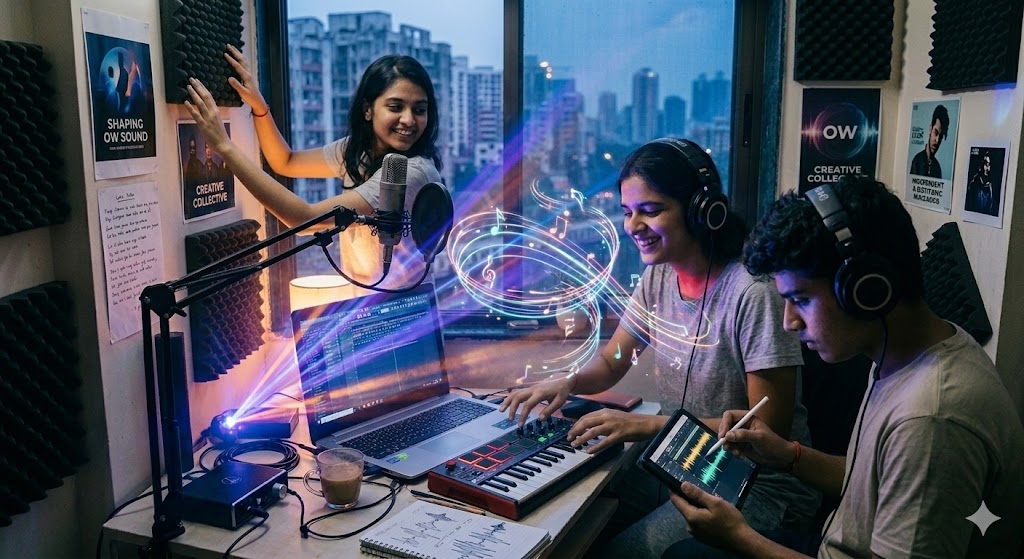
Mumbai: In the past, producing a professional-quality song required access to expensive recording studios, skilled sound engineers, and specialized equipment that few aspiring musicians could afford. Today, that landscape has been radically transformed. Rapid technological advances have dramatically lowered the barriers to music production, allowing young creators to produce, refine, and distribute their music from bedrooms, dorm rooms, and home studios. Laptops, smartphones, and affordable software have effectively replaced the traditional studio environment, empowering a new generation of musicians to explore their creativity with unprecedented freedom.
At the center of this revolution are Digital Audio Workstations, commonly known as DAWs. These powerful software platforms function as complete recording studios within a computer, enabling users to record vocals, compose melodies, edit audio, and mix entire songs. What once required racks of expensive analog equipment can now be achieved through a single program.
Several DAWs have become particularly popular among young producers because of their accessibility and affordability. GarageBand, which comes pre-installed on many Apple devices, offers an intuitive interface with built-in instruments, loops, and even music lessons, making it an ideal starting point for beginners. Similarly, BandLab provides a fully free, browser-based production environment that allows users to collaborate with others in real time. For those interested in electronic and hip-hop production, FL Studio has gained enormous popularity thanks to its pattern-based workflow and lifetime free updates in many versions. Other widely used platforms such as Ableton Live and Reaper also offer powerful tools at relatively low cost.
These platforms have effectively eliminated the need for traditional recording hardware such as mixing consoles, tape machines, and large studio spaces. With just a laptop and basic equipment, young producers can experiment with complex arrangements, layered vocals, and digital instruments that emulate everything from grand pianos to orchestras.
Hardware costs have also fallen dramatically. Affordable USB microphones, often priced under $50, allow musicians to record clear vocals at home. Headphones designed for studio monitoring are widely available at reasonable prices, while compact MIDI controllers enable producers to play and control virtual instruments directly through their computers. These small keyboards or pads act as bridges between physical performance and digital sound libraries.
Virtual plugins and sample libraries have further expanded creative possibilities. Instead of purchasing expensive synthesizers or drum machines, producers can download thousands of digital sounds—from cinematic orchestral strings to modern electronic beats. Many of these plugins faithfully replicate classic analog equipment that once cost thousands of dollars. As a result, young creators now have access to an almost limitless palette of sounds without needing a professional studio.
Perhaps the most transformative development in recent years has been the integration of artificial intelligence into music production. AI tools are increasingly capable of assisting with tasks that previously required technical expertise or significant time investment. Platforms such as Suno and Udio allow users to generate complete songs from simple text prompts. A creator can type a request such as “an upbeat pop song about summer love,” and the system can produce lyrics, melodies, instrumentation, and even vocals within seconds.
While these technologies have sparked debates about originality and artistic authenticity, many creators view them not as replacements for musicians but as tools for inspiration. AI-generated ideas often serve as starting points that artists refine, edit, and personalize to create their own distinctive sound.
Beyond full song generation, AI also assists with practical aspects of production. One example is stem separation, a technology that isolates individual components—such as vocals, drums, or bass—from an existing song. Applications like Moises enable producers to analyze tracks, remix songs, or study arrangements by separating elements that were once inseparable.

AI-driven mastering services have also simplified the final stage of music production. Traditionally, mastering required experienced audio engineers and specialized equipment to balance frequencies and optimize sound quality. Platforms such as LANDR now perform this process automatically, allowing independent musicians to achieve professional-level sound without the high cost of studio mastering.
Technology has also revolutionized the way music reaches audiences. Digital distribution services allow artists to release songs globally with just a few clicks. Platforms like SoundCloud and Bandcamp provide spaces where independent creators can share their work directly with listeners. Distribution services such as DistroKid and TuneCore help artists place their tracks on major streaming services including Spotify, Apple Music, and YouTube.
Social media has further accelerated this transformation. Short-form platforms like TikTok and Instagram allow snippets of songs to spread rapidly across global audiences. A catchy 15-second clip can propel a previously unknown artist into viral popularity overnight. For many young musicians, these platforms have become as important as traditional music charts.
The internet has also democratized music education. Aspiring producers can learn mixing techniques, songwriting strategies, and software tutorials through countless free videos on YouTube or through online communities on platforms like Reddit and Discord. Knowledge that once required formal training in music schools is now accessible to anyone with an internet connection.
This technological democratization has encouraged unprecedented diversity in music creation. Young producers are experimenting with genre-blending styles that merge hip-hop, electronic music, indie pop, and global influences. The do-it-yourself ethos embraced by younger generations promotes creativity without strict adherence to traditional industry rules.
However, this transformation also presents challenges. The ease of producing and releasing music means that streaming platforms are flooded with new tracks daily, making it harder for individual artists to stand out. Additionally, the use of AI in music production raises complex questions about copyright, training data, and the future role of human musicians.
Despite these concerns, many experts believe technology ultimately strengthens creativity rather than replacing it. By automating technical tasks and offering tools for experimentation, modern production technology allows artists to focus on storytelling, emotion, and originality.
In essence, music production has shifted from an elite, studio-driven process to an open and accessible creative field. Today’s young musicians can begin with little or no financial investment, collaborate across continents, and release music to global audiences instantly. The result is a dynamic and rapidly evolving musical landscape—one shaped not only by technology, but by the creativity and ambition of a new generation of artists.