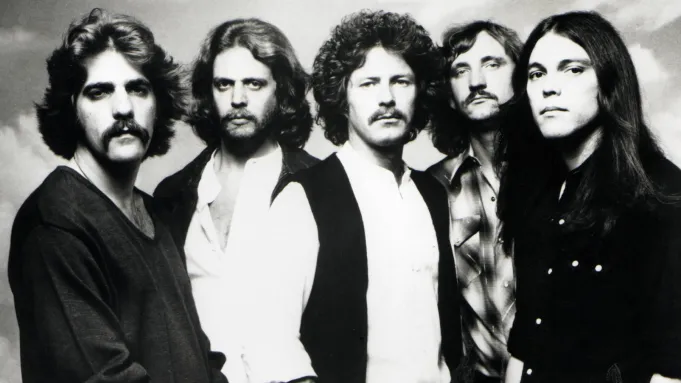
New Orleans: For more than five decades, the Eagles have embodied the sound, ambition, and contradictions of American rock music. They were meticulous craftsmen and reluctant road warriors, harmony singers with hard edges, a band that captured both the sunlit promise and the uneasy shadows of the California dream. Now, as 2026 unfolds, it appears that one of the most successful live acts in music history is approaching its final curtain call.
In early February 2026, Don Henley—co-founder, drummer, singer, and the sole remaining original member—offered the clearest signal yet that the end is near. Speaking to CBS Sunday Morning, the 78-year-old reflected candidly on the band’s future. “I think this will probably be it,” Henley said. “I feel like we’re getting toward the end, and that will be fine, too.”
Those words align neatly with the Eagles’ current calendar. Their official schedule lists only a series of extended weekend dates at the Sphere in Las Vegas through February and March, plus a final, symbolic appearance at the New Orleans Jazz & Heritage Festival on May 2, 2026. No further tours are planned. For a band that once vowed never to reunite, the road has stretched astonishingly far—but it now seems to be narrowing to its last mile.
From Canyon Harmonies to Arena Ambitions (1971–1975)
The Eagles’ story began in Los Angeles in 1971, at the heart of a fertile singer-songwriter scene where folk introspection met country twang and rock ambition. Glenn Frey, Don Henley, Bernie Leadon, and Randy Meisner had all served time backing Linda Ronstadt before being signed to Asylum Records by David Geffen.
Their self-titled debut in 1972 arrived with an ease that belied their discipline. “Take It Easy,” co-written with Jackson Browne, became an instant anthem, while “Witchy Woman” hinted at darker textures beneath the breezy harmonies. Albums like Desperado (1973) and On the Border (1974) expanded their thematic scope and sonic muscle, moving them steadily away from the coffeehouse and toward the arena.
The breakthrough came with One of These Nights (1975), which delivered chart-topping singles and confirmed the Eagles as major contenders. The subsequent release of Their Greatest Hits (1971–1975) would go on to become one of the best-selling albums in U.S. history, a rare artifact that turned a band’s early catalog into a cultural fixture.
Hotel California and the Cost of Perfection (1975–1980)
Creative evolution often demands sacrifice. In 1975, Bernie Leadon departed, and Joe Walsh joined, injecting grit, swagger, and a sharper rock sensibility. The result was Hotel California (1976), an album that transcended genre and era. Its title track, with its haunting metaphor of excess and entrapment, became one of the most analyzed and enduring songs in rock history.
The Eagles were now at their commercial and cultural peak—but internal tensions simmered. Personnel changes continued, with Timothy B. Schmit replacing Randy Meisner in 1977. The Long Run (1979) delivered more hits, yet the process was fraught. Exhaustion, ego, and conflict culminated in a notorious onstage confrontation between Frey and guitarist Don Felder, followed by the band’s breakup in 1980.
Henley’s bitter quip that they would reunite “when hell freezes over” sounded final.

Hell Freezes Over—and Over Again (1994–2016)
Time, however, has a way of softening absolutes. In 1994, the Eagles reunited for Hell Freezes Over, pairing new studio tracks with a lavishly produced tour that proved their appeal had only grown. What was once meant to be a one-off became a pattern: long gaps between albums, followed by meticulously staged tours that filled stadiums worldwide.
Their 2007 album Long Road Out of Eden debuted at No. 1, an extraordinary feat nearly three decades after their last studio release. The History of the Eagles documentary and accompanying tour (2013–2015) offered both celebration and reckoning, unflinchingly revisiting the band’s conflicts alongside its triumphs.
Then, in January 2016, the journey took a devastating turn. Glenn Frey died at 67, the loss of a founding voice and guiding force that seemed, at last, insurmountable.
Carrying the Torch, Saying Goodbye (2017–2026)
Yet the Eagles continued, reshaped but unbroken. In 2017, Vince Gill and Deacon Frey stepped in to cover Glenn Frey’s parts, honoring his legacy without attempting to replace him. The band pressed on as a tribute as much as an enterprise.
By July 2023, they acknowledged the inevitable with The Long Goodbye farewell tour, promising fans as many shows as demand required. That promise evolved into an ambitious residency at Las Vegas’ Sphere beginning in 2024, where immersive visuals and pristine sound turned the band’s greatest hits into a multi-sensory retrospective.
Loss followed again when Randy Meisner passed away in 2023. And now, with Henley’s recent remarks and a calendar that stops in 2026, the shape of the ending is clear.
An Enduring Legacy
The Eagles leave behind a staggering legacy: more than 200 million records sold, six Grammy Awards, and a catalog that continues to soundtrack road trips, late-night reflections, and collective nostalgia. They defined a version of California rock that balanced freedom and fatalism, harmony and friction, aspiration and regret.
Their songs will outlive their final encore. But for fans hoping to hear “Hotel California,” “Desperado,” or “Take It Easy” one last time, the window is closing. After more than 50 years, countless miles, and a journey as turbulent as it was triumphant, the Eagles’ long goodbye finally appears to be drawing to a close.