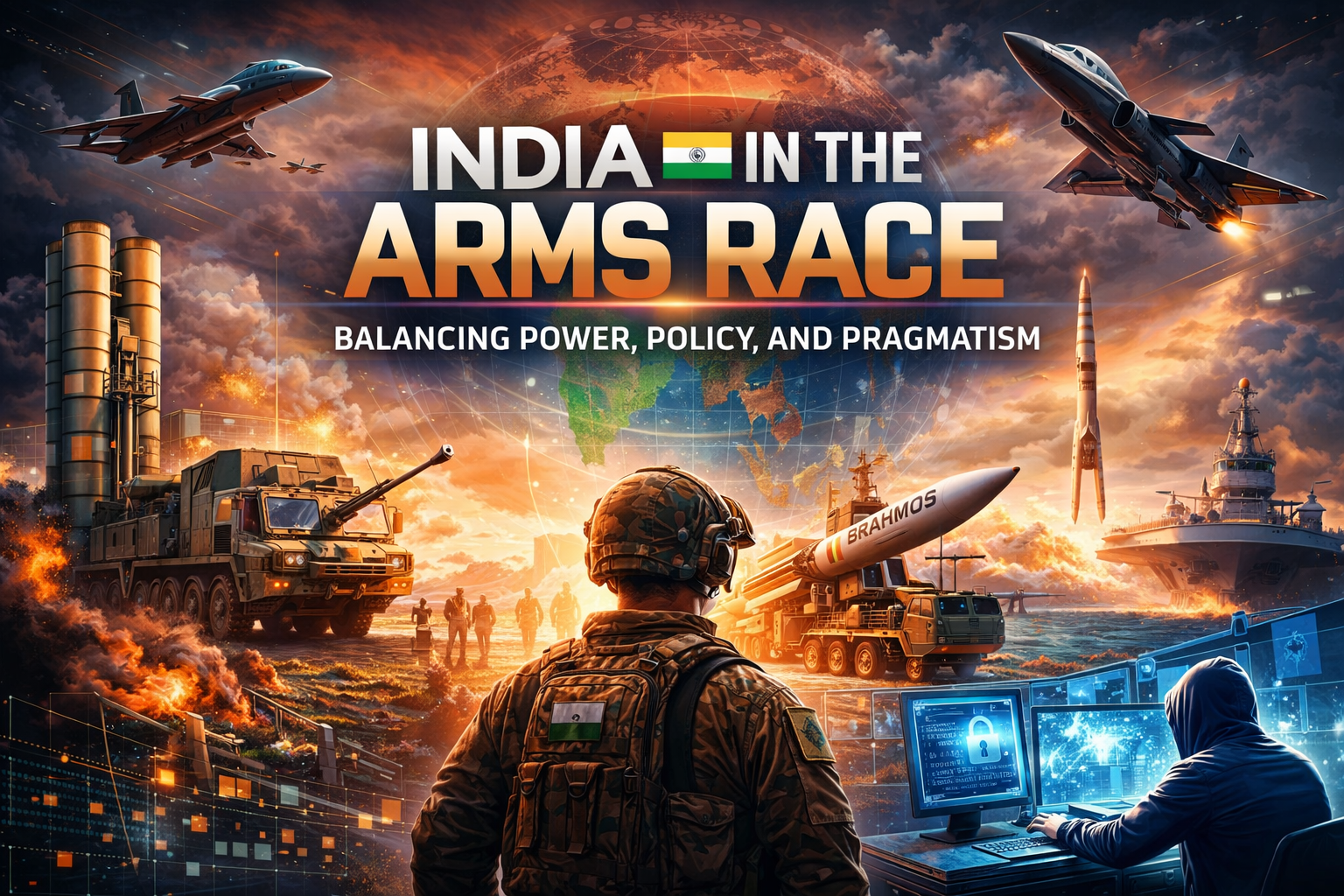
New Delhi: India’s position in the global arms race has evolved significantly over the past two decades, transforming from a largely import-dependent military power into an increasingly self-reliant and strategically assertive nation. As geopolitical tensions intensify and technological advancements redefine warfare, India finds itself navigating a complex landscape shaped by regional rivalries, global partnerships, and domestic imperatives. Its approach reflects a blend of deterrence, modernization, and indigenization, aimed at securing national interests while maintaining strategic autonomy.
At the heart of India’s defence posture lies its unique geopolitical environment. Bordered by two nuclear-armed neighbors—China and Pakistan—India faces a dual-front security challenge that heavily influences its military strategy. The long-standing tensions with Pakistan, coupled with periodic escalations along the Line of Control, demand constant vigilance. Meanwhile, the evolving dynamics along the Line of Actual Control with China, particularly after the 2020 Galwan Valley clash, have accelerated India’s focus on strengthening its northern borders. These realities compel India to maintain a robust military capable of responding to both conventional and unconventional threats.
India remains one of the world’s largest defence spenders, consistently ranking among the top countries in military expenditure. However, what distinguishes its current trajectory is a clear shift from procurement to production. The government’s push for “Atmanirbhar Bharat” (self-reliant India) in defence manufacturing aims to reduce dependence on foreign suppliers and build a strong domestic industrial base. Initiatives such as defence corridors, increased foreign direct investment limits, and the corporatization of ordnance factories are designed to encourage private sector participation and innovation. Indigenous projects like the Tejas light combat aircraft, Arjun main battle tank, and various missile systems highlight this transition, though challenges related to timelines, quality, and scalability persist.
Despite these efforts, imports continue to play a significant role in India’s military modernization. Historically reliant on Russian equipment, India has diversified its procurement sources to include the United States, France, Israel, and other countries. This diversification not only enhances operational capabilities but also reduces strategic vulnerability associated with overdependence on a single supplier. High-profile acquisitions such as Rafale fighter jets, S-400 air defence systems, and advanced naval platforms reflect India’s intent to maintain a technological edge in a rapidly evolving threat environment.
A critical dimension of India’s role in the global arms race is its nuclear doctrine. India adheres to a policy of “No First Use” and maintains a credible minimum deterrence posture. Its nuclear triad—comprising land-based missiles, aircraft, and submarine-launched ballistic missiles—ensures second-strike capability, a cornerstone of deterrence stability. The development of systems like the Agni series of missiles and nuclear-powered submarines underscores India’s commitment to maintaining strategic balance in the region. However, evolving doctrines in neighboring countries and advancements in missile defence systems continue to influence India’s nuclear strategy.
The emergence of new domains such as cyber and space has added further complexity to India’s defence strategy. Recognizing the importance of these areas, India has established dedicated agencies for cyber and space operations. Cybersecurity has become a national priority, given the increasing frequency of cyberattacks targeting critical infrastructure. In the space domain, India’s achievements—such as the successful anti-satellite (ASAT) test in 2019—demonstrate its growing capabilities. Space-based assets are now integral to communication, navigation, and surveillance, making their protection a key component of national security.
India’s naval expansion is another crucial aspect of its strategic outlook. With the Indian Ocean emerging as a critical theatre of geopolitical competition, India is enhancing its maritime capabilities to safeguard trade routes and counter the growing presence of external powers. The development of aircraft carriers, nuclear submarines, and advanced surveillance systems reflects a focus on blue-water capabilities. Initiatives like SAGAR (Security and Growth for All in the Region) and increased engagement with regional partners underscore India’s commitment to maintaining stability in the Indo-Pacific.
Strategic partnerships play a vital role in India’s approach to the global arms race. While maintaining its policy of non-alignment in a traditional sense, India has deepened ties with key players such as the United States, Japan, Australia, and European nations. The Quadrilateral Security Dialogue (Quad) exemplifies this trend, focusing on ensuring a free and open Indo-Pacific. Defence cooperation agreements, joint exercises, and technology transfers have enhanced interoperability and strengthened India’s position in the global security architecture.
At the same time, India continues to balance its relationships with traditional partners like Russia. Despite growing ties with the West, Russia remains a major supplier of defence equipment and a key collaborator in joint projects. This balancing act reflects India’s commitment to strategic autonomy, allowing it to engage with multiple partners without being drawn into rigid alliances.

The role of technology in shaping India’s defence strategy cannot be overstated. Emerging technologies such as artificial intelligence, robotics, hypersonic weapons, and quantum computing are redefining the nature of warfare. India is investing in research and development to keep pace with these advancements, though it still lags behind leading powers in certain areas. Public-private partnerships, increased funding for defence research organizations, and collaboration with global tech firms are seen as essential to bridging this gap.
However, India’s journey in the global arms race is not without challenges. Budget constraints, bureaucratic inefficiencies, and delays in procurement processes often hinder the pace of modernization. The need to balance defence spending with socio-economic priorities adds another layer of complexity. Additionally, the rapid pace of technological change requires continuous adaptation, making long-term planning increasingly difficult.
Another critical issue is the integration of new technologies into existing military structures. Modern warfare demands not only advanced equipment but also a shift in doctrine, training, and organizational culture. Ensuring seamless coordination between different branches of the armed forces and adopting a joint command structure are key priorities. The establishment of the Chief of Defence Staff (CDS) and the push for theatre commands represent steps in this direction.
India’s defence exports are also gaining traction, reflecting its growing capabilities and ambitions. The government has set ambitious targets for defence exports, aiming to position India as a global supplier of military equipment. Products such as missiles, patrol vessels, and surveillance systems are finding markets in Asia, Africa, and beyond. This not only boosts economic growth but also enhances India’s strategic influence.
In the broader context of the global arms race, India’s approach is characterized by pragmatism and restraint. Unlike some major powers, India does not seek to project military dominance on a global scale. Instead, its focus remains on securing its immediate neighborhood and contributing to regional stability. Its emphasis on defensive capabilities, coupled with a commitment to international norms, positions it as a responsible stakeholder in the global security order.
At the same time, the intensifying competition among major powers—particularly between the United States and China—creates both opportunities and challenges for India. While it can leverage partnerships to enhance its capabilities, it must also navigate the risks of being drawn into great power rivalries. Maintaining strategic autonomy while adapting to a rapidly changing geopolitical landscape will be crucial for India’s long-term security.
In conclusion, India’s role in the global arms race is defined by a careful balance between ambition and restraint, modernization and self-reliance, and partnership and autonomy. As warfare becomes increasingly complex and technology-driven, India is striving to build a military that is not only capable but also adaptable and resilient. While challenges remain, its evolving defence strategy reflects a clear recognition of the demands of the modern security environment. By continuing to invest in innovation, strengthen partnerships, and streamline its defence ecosystem, India is positioning itself as a significant and responsible player in the global arms race.