
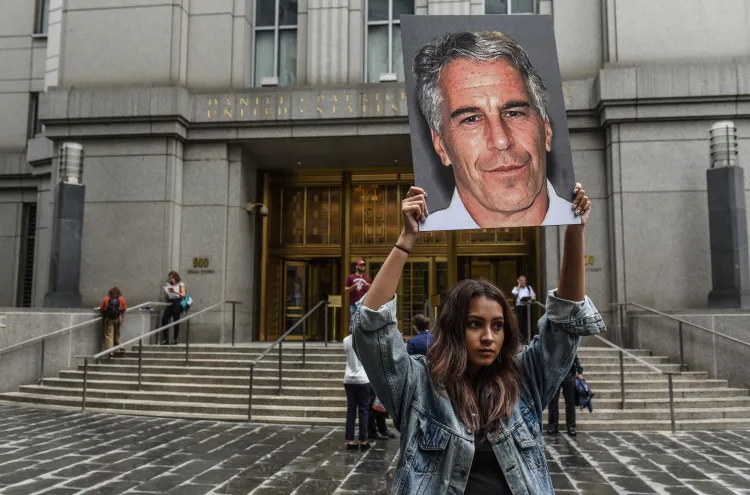
Washington: Few criminal cases have unsettled the public conscience as deeply as that of Jeffrey Epstein. The story combines extreme wealth, systemic sexual abuse, elite access, institutional failure, and a lingering sense that full justice was never achieved. Even years after Epstein’s death in federal custody in August 2019, the case continues to reverberate—less as a closed chapter and more as an open wound in the public imagination.
That fascination reached a new peak with the passage of the Epstein Files Transparency Act, signed into law by U.S. President Donald Trump on November 19, 2025. The legislation compelled the Department of Justice (DOJ) to release nearly all unclassified records connected to Epstein’s investigations, prosecutions, associates, and death. Over the following months, the DOJ published an unprecedented trove of material—millions of pages, images, and videos—transforming the Epstein case into one of the most documented criminal sagas in modern American history.
What these files ultimately reveal is not a neat conspiracy or a secret master list of abusers, but something more unsettling: how proximity to power, wealth, and prestige allowed a known predator to operate for years in plain sight.
The Crimes and the Central Figures
Jeffrey Epstein, a financier with opaque sources of wealth, orchestrated the systematic sexual exploitation of underage girls for decades. He recruited vulnerable teenagers—often from disadvantaged backgrounds—under the guise of offering paid “massages,” then abused them and, according to multiple accounts, trafficked some to others. His longtime associate Ghislaine Maxwell played a crucial role, grooming victims and facilitating access. In 2021, Maxwell was convicted on federal charges for sex trafficking and conspiracy, cementing her place as a central enabler of Epstein’s crimes.
Epstein’s 2019 arrest on federal sex-trafficking charges was widely seen as a belated reckoning, especially after his controversial 2008 Florida plea deal, which allowed him to avoid federal prosecution in exchange for a lenient state sentence. That reckoning never came. On August 10, 2019, Epstein was found dead in his jail cell at the Metropolitan Correctional Center in New York. Multiple investigations concluded he died by suicide, though the circumstances—guard failures, broken cameras, and institutional negligence—fueled widespread suspicion.
The Transparency Act and the Scale of Disclosure
The Epstein Files Transparency Act aimed to address years of mistrust by forcing sunlight onto the case. Between December 2025 and January 2026, the DOJ released massive batches of records, culminating on January 30, 2026, with the largest disclosure: over 3 million additional pages, 180,000 images, and more than 2,000 videos. In total, estimates suggest between 3.5 and 6 million pages are now publicly accessible through a dedicated DOJ repository.
The materials span decades and jurisdictions. They include court filings from Florida and New York, FBI investigative summaries, flight logs, depositions, emails, photos, tip-line submissions, psychological assessments, and records tied to the investigation into Epstein’s death. Heavy redactions were applied to protect victim identities, though some unredacted explicit images sparked criticism and concern over whether survivors’ privacy had been adequately safeguarded.
No “Client List,” No Hidden Conspiracy
One of the most important clarifications emerging from the files is also the least sensational: there is no formal “client list.” Despite years of speculation, the DOJ and FBI reiterated—most clearly in a July 2025 internal memo and again in the 2026 releases—that exhaustive reviews found no document cataloguing Epstein’s alleged clients and no credible evidence of a coordinated blackmail operation targeting global elites.
Similarly, the files reaffirm earlier conclusions about Epstein’s death: investigators found no basis to classify it as homicide. And while the documents contain countless references to prominent figures, the DOJ emphasized that mentions alone do not constitute evidence of criminal wrongdoing. Many entries stem from social interactions, business dealings, or unverified tips—some explicitly labeled “sensationalist” or “untrue.”
This absence of a smoking gun has disappointed those expecting dramatic revelations. Yet the lack of a conspiracy does not absolve the broader system that enabled Epstein’s access and longevity.
Mapping Epstein’s Elite Network
What the files do expose, in exhaustive detail, is the sheer breadth of Epstein’s social reach. Even after his 2008 conviction, he continued to cultivate relationships across politics, finance, technology, academia, entertainment, and royalty—often positioning himself as a wealthy connector or philanthropic facilitator.
Prince Andrew emerges as the most directly implicated high-profile figure. The files contain hundreds of references, including emails, photos, and scheduling records. Virginia Giuffre’s civil lawsuit—settled in 2022—alleged Epstein trafficked her to Andrew when she was 17. Although Andrew denies wrongdoing and was never criminally charged, the newly released material reinforces scrutiny of his continued association with Epstein after the latter’s conviction.

Donald Trump, now president again in 2026, appears frequently in the records, largely through 1990s and early 2000s social references, flight logs, and FBI tip-line allegations. Investigators found no evidence linking Trump to Epstein’s trafficking operation. The files also note that Trump barred Epstein from Mar-a-Lago after reports of inappropriate behavior.
Bill Clinton is referenced primarily through flight logs documenting post-presidency travel on Epstein’s plane. No allegations of sexual misconduct appear in the core evidence, and Clinton has long maintained that he cut ties after Epstein’s 2008 conviction.
Technology and business leaders also surface repeatedly. Elon Musk appears in email exchanges reflecting Epstein’s attempts to arrange meetings or travel, though Musk has stated the interactions were limited and unsuccessful. Bill Gates, whose association with Epstein has been widely reported, is mentioned in communications related to philanthropy networking; Gates has publicly acknowledged regretting those meetings.
Other names scattered throughout the files include Richard Branson, Sergey Brin, Leon Black, Les Wexner, Jes Staley, Lawrence Summers, and various cultural figures. An FBI PowerPoint summary lists allegations involving around 11 prominent men, but investigators stress that these range from unverified tips to contextual mentions and do not uniformly imply criminal conduct.
Inside Epstein’s Operations
Beyond famous names, the documents offer a granular look at Epstein’s methods. They detail how victims were recruited—often by Maxwell or other associates such as Jean-Luc Brunel—and moved between Epstein’s properties in New York, Palm Beach, New Mexico, Paris, and the U.S. Virgin Islands. Victim depositions describe grooming, coercion, and repeated abuse, painting a grim picture that stands in stark contrast to Epstein’s cultivated image as a patron of science and ideas.
Emails show Epstein continuing to organize dinners, conferences, and introductions even after his conviction, often framing himself as a benefactor or intellectual hub. Some interactions, such as scientists visiting his properties, appear innocuous on their face, underscoring how Epstein blurred lines between legitimacy and predation.
Institutional Failures and Lingering Questions
The files also lay bare the failures of institutions meant to stop Epstein sooner. His 2008 non-prosecution agreement, widely criticized as excessively lenient, looms large as a turning point where accountability was deferred. The delayed federal action until 2019 allowed years of continued abuse.
At the same time, the transparency dump exposes the limits of raw disclosure. Tip-line submissions include implausible or defamatory claims, illustrating how public records can amplify misinformation alongside facts. The accidental release of explicit images highlights the ethical challenges of transparency at scale.
What the Epstein Files Ultimately Reveal
The Epstein Files do not confirm a hidden global cabal, nor do they unlock a final list of perpetrators. Instead, they reveal something arguably more disturbing: how ordinary elite social dynamics—status, wealth, reputation, and silence—can shield extraordinary harm.
No wave of new indictments has followed the disclosures. For survivors, justice remains partial and delayed. For institutions, the case remains a test of whether lessons have truly been learned.
In the end, the most chilling revelation is not what was hidden, but what was tolerated. Epstein’s access was not mythical; it was facilitated by proximity to power and by a system slow to act. The files stand as a stark reminder that transparency alone cannot guarantee accountability—but without it, abuse thrives unchecked.