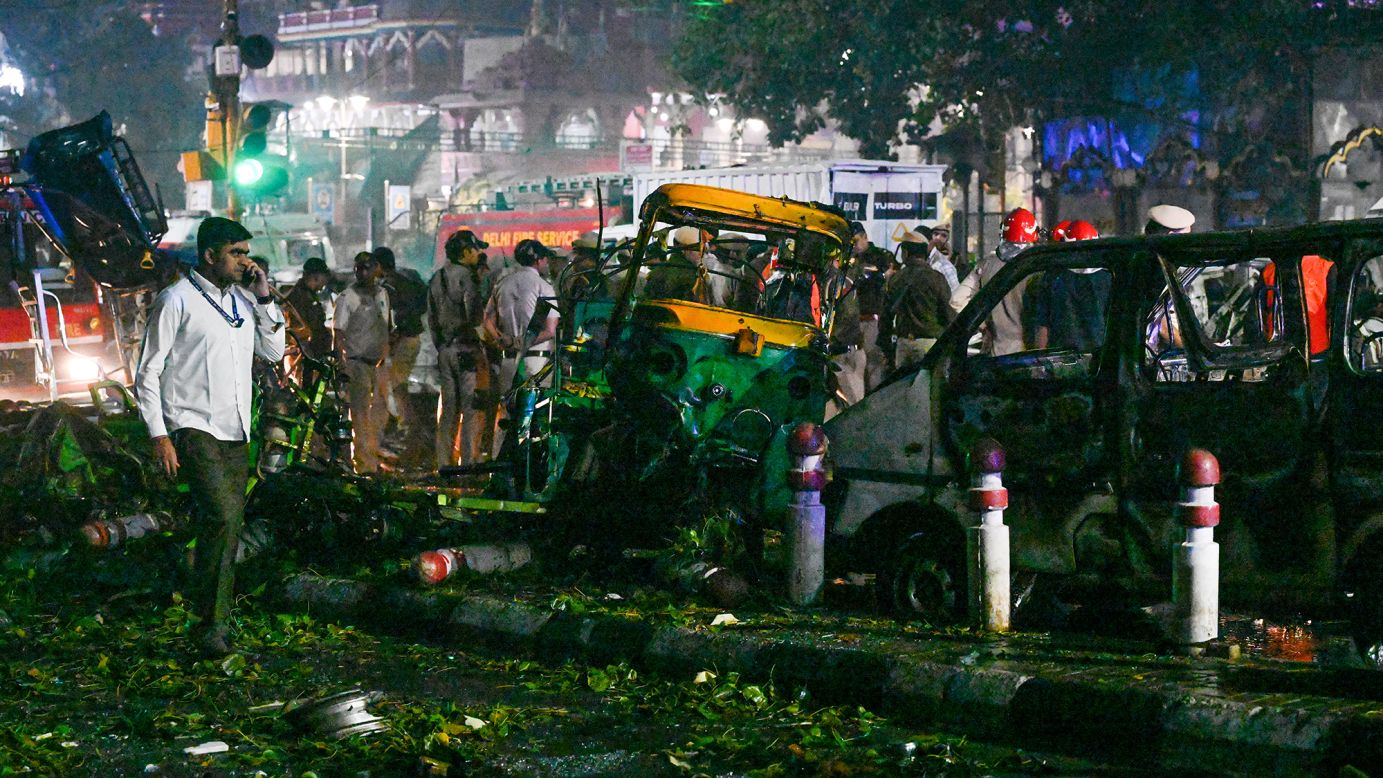
New Delhi: A massive explosion near Delhi’s historic Red Fort on November 10, 2025, has left the nation in shock, killing at least 13 people and injuring over 20. The blast, triggered inside a Hyundai i20 parked near Gate No. 1 of the Lal Qila Metro Station, tore through the evening bustle, setting ablaze 22 vehicles and sending shockwaves across India’s capital.
Preliminary investigations by the National Investigation Agency (NIA) suggest the use of ammonium nitrate fuel oil (ANFO) — a common industrial explosive. However, the case has taken a complex turn as agencies probe its suspected links to a dismantled terror module in Faridabad, allegedly operating under a fidayeen-style strategy. Sources identify the suspected perpetrator as Dr. Mohammad Umar from Pulwama, Jammu and Kashmir, believed to have detonated the device following the exposure of his network.
The Red Fort, a UNESCO World Heritage Site and the ceremonial seat of India’s Independence Day address, has once again been thrust into the center of a national security storm. The site’s dense human traffic and symbolic value make it a potent target — and experts warn that the latest tragedy underscores deeper vulnerabilities, especially from biological warfare (BW) threats.
Historical and Strategic Context
Built in 1648 by Emperor Shah Jahan, the Red Fort has witnessed the tides of empires, revolutions, and terrorist attacks — including the 2001 Lashkar-e-Taiba assault. Its proximity to the Yamuna River and surrounding markets creates a convergence of tourists, commuters, and traders, forming one of Delhi’s most crowded public zones.
Historically, fortifications like the Red Fort have seen rudimentary forms of BW. Ancient chronicles reference sieges involving poisoned wells and infected animals — early precursors to modern bioweapon tactics. Experts argue that the same geography that once made the fort defensible now renders it highly vulnerable to aerosol or vector-based attacks.
The Biological Warfare Angle
Biological warfare, the deliberate release of pathogens or toxins to cause harm, represents one of the most covert and devastating forms of asymmetric warfare. Globally, from the Mongol siege of Caffa in 1346 to the smallpox blankets of 18th-century America, the use of disease as a weapon has rewritten military history.
India’s own BW preparedness, while formally defensive under the 1972 Biological Weapons Convention, remains under scrutiny. During the 1965 Indo-Pak conflict, unexplained disease outbreaks in the northeast prompted fears of biological sabotage. In 1994, the Surat plague panic mirrored BW-like dynamics, costing over $1.5 billion in economic loss.
DRDO and the National Institute of Communicable Diseases (NICD) maintain NBC (nuclear, biological, chemical) defense programs, yet analysts like Lt. Gen. (Retd.) Vinod Bhatia caution that these remain “largely reactive” rather than preventive.
Recent arrests in Gujarat of individuals possessing ricin precursors — a deadly toxin derived from castor beans — highlight the risk of low-tech, easily assembled biological weapons. In the current case, the involvement of medically trained operatives has heightened concerns over dual-use knowledge being repurposed for terrorism.
A Hypothetical Hybrid Threat
While forensic evidence confirms a conventional explosion, counterterror experts are exploring whether the Red Fort attack could represent a “hybrid” strike model — combining kinetic impact with potential biological dispersal.
A blast in such a congested zone could theoretically serve as a carrier for pathogen-laced particles or ricin dust. In Delhi’s polluted environment, an aerosolized biotoxin could spread undetected before symptoms manifest, overwhelming health systems. Similar tactics were employed by Japan’s Unit 731 during World War II, which released plague-infested fleas across Chinese provinces.

Had a biocomponent been involved, the fallout could have crippled Delhi’s tourism-dependent economy (worth nearly $2 billion annually) and caused widespread panic, akin to the Surat episode.
Policy Implications and Strategic Response
The Red Fort blast serves as a grim reminder that India’s urban landmarks are not just targets of explosives, but potential epicenters for biological crises. Security experts argue that India’s counterterror framework must now integrate biosurveillance and epidemiological intelligence.
Key Recommendations:
-
Enhanced Biosurveillance: Deploy AI-assisted genomic monitoring systems at high-density sites like Red Fort, integrating DRDO and NICD databases for real-time pathogen alerts.
-
Training Overhaul: Update emergency response drills to simulate hybrid scenarios — combining blast, chemical, and biological contingencies.
-
International Collaboration: Strengthen coordination under the Biological Weapons Convention (BWC) through QUAD and G20 mechanisms, ensuring transparency in dual-use research.
-
Public Preparedness: Launch awareness programs positioning BW defense as a civic responsibility — akin to fire or disaster safety training.
The Red Fort, once the throne of emperors and today a symbol of democratic pride, now stands at the intersection of heritage and hazard. The November 10 explosion, though driven by conventional means, reveals deeper vulnerabilities — the kind that transcend visible destruction.
As investigators piece together the terror web behind the blast, policymakers must confront the silent specter of biological warfare. The ramparts that once defended Delhi from invading armies must now guard against an invisible enemy — one that moves not with gunpowder, but with microbes.