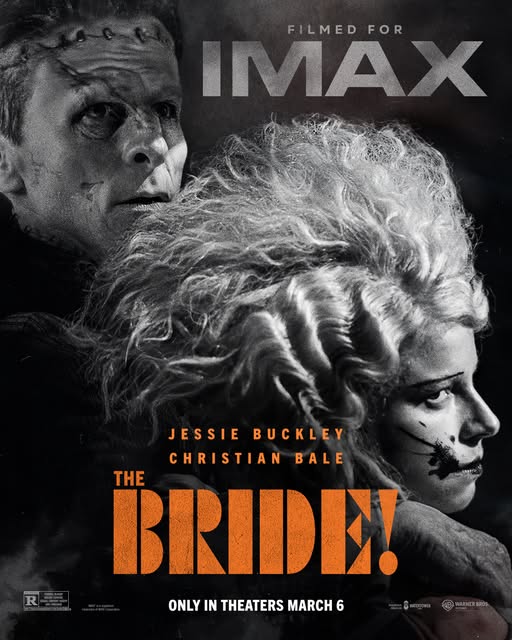
Los Angeles: When Maggie Gyllenhaal steps behind the camera, audiences expect something bold and emotionally layered. With The Bride! (2026), she delivers something far more explosive—a gothic, R-rated romance-horror spectacle that resurrects a classic monster tale and electrifies it with modern rage, style, and cinematic rebellion. Released on March 6, 2026 by Warner Bros., the film marks Gyllenhaal’s ambitious follow-up to her critically acclaimed directorial debut, The Lost Daughter (2021).
If her first film was a quiet psychological meditation, The Bride! is its chaotic opposite. Clocking in at around 126 minutes, the movie is a loud, flamboyant, and unapologetically maximalist reimagining of the iconic creature from Bride of Frankenstein (1935). But unlike the original film—where the Bride appeared briefly as a silent, terrified creation—Gyllenhaal’s version transforms her into a powerful, volatile figure bursting with personality, fury, and desire.
Reanimating a Classic Myth
The film transports Mary Shelley’s legendary monster mythos from its gothic European roots to the gritty urban landscape of 1930s Chicago, with occasional detours into New York. Set roughly a decade after the events of the 1935 Universal classic, the story follows a lonely creature named Frank, portrayed with wounded vulnerability by Christian Bale.
Frank longs not merely for survival but for companionship. In search of connection, he turns to the brilliant and unconventional scientist Dr. Cornelia Euphronious, played with quiet authority by Annette Bening. Together they attempt a radical experiment: resurrecting a recently murdered young woman named Ida.
The result is the Bride.
Portrayed by Jessie Buckley, the character emerges not as a meek creation but as a force of nature—feral, volatile, and fiercely alive. Buckley, reuniting with Gyllenhaal after The Lost Daughter, delivers a performance that critics are already calling career-defining. Her Bride is wild-eyed, sharp-tongued, and gloriously unrestrained, striding through scenes with the energy of a gothic punk icon.
A Monster Love Story Turned Anarchy
While the premise begins as a classic horror tale, the narrative quickly mutates into something far stranger and more anarchic. The Bride and Frank form an intense and unpredictable bond—one that is equal parts romance, rebellion, and chaos.
Together, they embark on a violent, passionate rampage across Chicago, pursued relentlessly by a determined detective played by Peter Sarsgaard. Their journey resembles a twisted monster-movie version of Bonnie and Clyde: a crime spree punctuated by emotional outbursts, bursts of music, and surreal moments of tenderness.
The ensemble cast includes notable appearances from Jake Gyllenhaal and Penélope Cruz, among others. While these supporting roles add texture and unpredictability to the narrative, the film clearly belongs to Buckley and Bale, whose strange yet touching chemistry anchors the chaos.
Maximalist Vision and Visual Excess
Stylistically, The Bride! embraces bold visual experimentation. Cinematographer Lawrence Sher crafts a striking visual palette that oscillates between lush black-and-white imagery reminiscent of classic Universal monster films and bursts of saturated color that evoke film noir, glam-punk aesthetics, and surreal fantasy.
Costume designer Sandy Powell delivers one of the film’s most memorable elements. Characters appear in elaborate ensembles ranging from fox-fur shrugs and towering top hats to couture dresses that blur the line between period authenticity and modern rebellion.
The musical dimension of the film is equally dramatic. Composer Hildur Guðnadóttir, known for her haunting work on Joker, provides a sweeping orchestral score filled with operatic strings and emotional intensity. At times, the music erupts into theatrical crescendos that blur the line between horror, melodrama, and musical spectacle.
Even the production design indulges in playful historical liberties. One surreal sequence depicts a 1936 theater screening White Zombie in 3D to an audience wearing red-and-blue glasses—an anachronistic but visually delightful flourish that captures the film’s gleeful disregard for strict historical accuracy.
Feminine Rage and Reclamation
Beyond its stylistic fireworks, The Bride! is deeply invested in reclaiming the narrative agency of its titular character. In the original 1935 film, the Bride—played by Elsa Lanchester—appeared only briefly and never spoke, existing largely as an object created for the monster’s companionship.
Gyllenhaal’s reinterpretation radically flips that dynamic.

Buckley’s Bride is loud, demanding, and impossible to ignore. She refuses passivity and challenges the very premise of her creation. Through this lens, the film becomes a proto-feminist reimagining of the Frankenstein myth—exploring themes of bodily autonomy, female rage, societal control, and the commodification of women’s stories.
Adding another meta layer, Buckley also portrays Mary Shelley in a framing narrative that connects the author’s own struggles with the Bride’s quest for identity and freedom.
Yet the film’s thematic ambition sometimes becomes overwhelming. Gyllenhaal’s script juggles multiple ideas simultaneously—feminist allegory, gangster romance, horror spectacle, and musical theatrics—occasionally producing tonal whiplash. Moments of raw emotional intimacy can suddenly collide with exaggerated violence or stylized song sequences.
Divisive but Impossible to Ignore
Unsurprisingly, the film has sparked sharply divided reactions since its release. Some critics celebrate it as a wildly imaginative triumph—an exhilarating example of a major studio film embracing creative risk in an era dominated by safe franchise storytelling.
Others argue that the film’s excess becomes exhausting. Its sprawling narrative and constant tonal shifts can feel overwhelming, leaving some viewers wishing for more restraint.
But even detractors often concede one thing: The Bride! is never dull.
The movie surges forward with relentless energy, powered largely by Jessie Buckley’s fearless performance. She inhabits the Bride with ferocity, humor, and unpredictability, transforming what might have been a gimmick into a complex, magnetic character.
Opposite her, Christian Bale gives Frank an unexpected vulnerability. Beneath the scars and monstrous exterior lies a deeply lonely soul, making their bizarre romance surprisingly touching amid the film’s carnage.
A Strange, Glorious Monster
Interestingly, The Bride! arrives in a year already buzzing with anticipation for another Frankenstein-inspired project from Guillermo del Toro. Yet Gyllenhaal’s film stands apart as the louder, more rebellious interpretation—less concerned with gothic elegance than with chaotic creative expression.
It may not possess the classic restraint of Bride of Frankenstein, nor the intimate precision of Gyllenhaal’s debut film. But what it lacks in cohesion, it compensates for with sheer vitality.
Ultimately, The Bride! is a cinematic experience meant to be felt as much as analyzed. It is messy, extravagant, occasionally bewildering—but always alive.
In a cinematic landscape dominated by carefully engineered blockbusters, Maggie Gyllenhaal’s audacious monster opera feels refreshingly strange. Whether audiences find themselves exhilarated or exhausted, the film leaves an unmistakable impression.
And perhaps that is the most fitting tribute to a story about reanimation: The Bride! doesn’t merely revive a classic myth—it shocks it back to life with a thunderous, rebellious heartbeat.