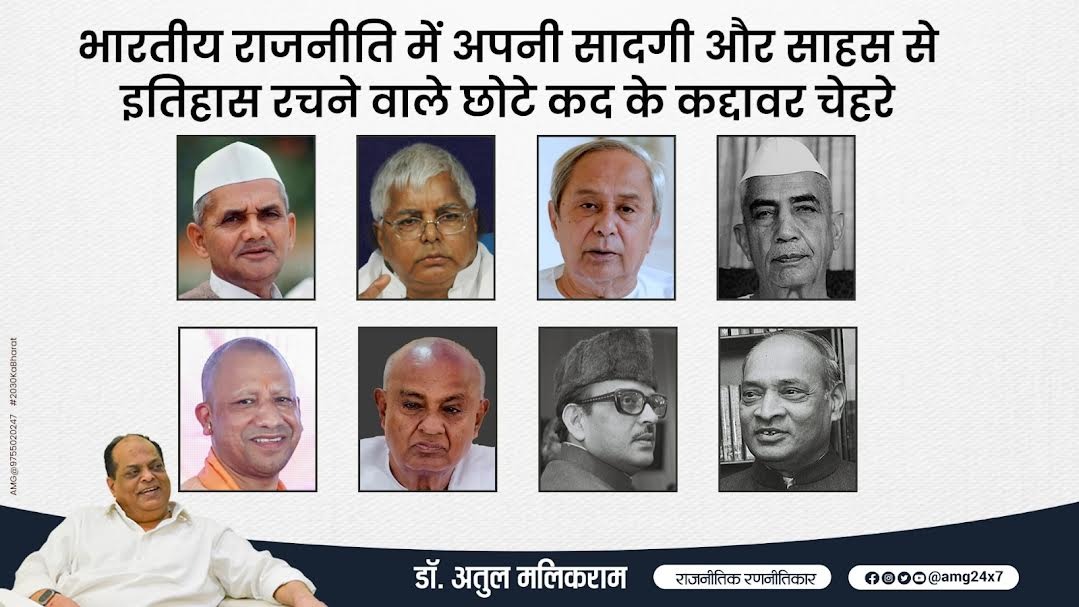
New Delhi: One of the most distinctive strengths of Indian democracy is that leadership is never measured in inches or feet, but in the depth of public trust, moral courage and clarity of vision. In an age dominated by social media optics—where stage presence, body language and physical height often attract undue attention—Indian political history offers powerful reminders that some of the most influential leaders were modest in stature but monumental in impact.
Former Prime Minister Lal Bahadur Shastri remains the finest example of simplicity and moral strength. Known for walking shoulder to shoulder with Mahatma Gandhi during the freedom struggle, Shastri set rare ethical benchmarks by resigning as Railway Minister after a train accident, accepting moral responsibility. As Prime Minister, he unified the nation during the 1965 India–Pakistan war and coined the immortal slogan “Jai Jawan, Jai Kisan,” honouring soldiers and farmers alike. During a food crisis, he even observed personal fasts to inspire public discipline—proving that leadership is rooted in integrity, not appearance.
Another towering figure was Lalu Prasad Yadav, who emerged as a mass leader from Bihar. As Chief Minister, he brought backward classes, Dalits and minorities into the political mainstream, triggering a major social transformation. As Railway Minister, he surprised critics by turning Indian Railways from loss to profit and launching people-centric initiatives like the Garib Rath trains, making travel affordable for millions.
From the spiritual corridors of Gorakhpur’s Gorakshpeeth to the political centre stage, Yogi Adityanath carved a distinct path. After founding the Hindu Yuva Vahini and serving as a Member of Parliament, he rose to become Chief Minister of Uttar Pradesh. His tenure has been marked by a strong law-and-order framework, action against organised crime, and large-scale infrastructure development including expressways, airports and investment summits—blending Hindutva with development-driven governance.
H. D. Deve Gowda, who rose from a farmer’s family to become Karnataka’s Chief Minister and later India’s Prime Minister, demonstrated mastery in coalition politics. His governance focused strongly on irrigation, rural development and farmers’ welfare, leaving a lasting imprint on grassroots governance.
A defining moment in Indian political ethics came with V. P. Singh, who challenged corruption head-on by taking on the Bofors scandal. As Prime Minister, he implemented the Mandal Commission, granting 27 per cent reservation to Other Backward Classes—one of the most significant social justice reforms in India’s history.

Similarly, Odisha’s long-serving Chief Minister Naveen Patnaik provided calm, consistent leadership, steering the state towards stability and development. His focus on disaster management, women empowerment, healthcare and education helped Odisha gain national recognition for effective governance.
Farmer leader Chaudhary Charan Singh dedicated his life to rural India. Through land reforms and the abolition of the zamindari system, he empowered farmers and gave them political voice. His legacy lives on through National Farmers’ Day, observed in his honour.
Completing this lineage of understated yet transformative leaders is P. V. Narasimha Rao, the intellectual architect of India’s economic liberalisation. A multilingual scholar and India’s first Prime Minister from the South, Rao steered the nation through the 1991 economic crisis alongside Dr Manmohan Singh. The reforms of liberalisation, privatisation and globalisation permanently altered India’s economic trajectory and integrated it with the global economy.
At a time when political discourse is increasingly driven by spectacle and surface-level appeal, these leaders stand as enduring reminders that true leadership is defined by service, honesty, courage and the ability to bring lasting change—proving that in Indian politics, stature has never been a measure of greatness.