Lucknow: The Crafts Bazaar emerged as a vibrant site of exchange—where tradition met contemporary practice, and age-old skills found new relevance. At Safed Baradari, visitors were drawn into the visual language of eastern India through a live Pattachitra demonstration by Suhana. An initiative of Rupsona Chitrakar, Suhana Pattachitra carries forward a family legacy of Kalighat painting from West Bengal, nurtured since childhood. Rooted in Hindu mythology, Pattachitra—an ancient cloth-based scroll painting tradition of Odisha and West Bengal—was presented not merely as visual art, but as a performative storytelling practice, unfolding narratives through line, colour, and rhythm.
Adding to the tactile richness of the Bazaar, Kadam Haat Basketry Barn Private Limited, a Kolkata-based initiative, showcased handcrafted grass and bamboo products ranging from functional tableware to elegant decorative basketry. Working closely with artisan communities across West Bengal, Kashmir, Odisha, and Uttar Pradesh, the initiative highlighted sustainable craft ecosystems rooted in regional knowledge.
Meanwhile, Shawlstory, led by Lubna Mirza from Dehradun and drawing from the traditions of Najibabad, presented exquisite works in pure pashmina, antique jamawar shawls, Kalamkari, and Kashidakari, celebrating textile heritage through meticulous craftsmanship and storytelling.
Keynote Lecture | Lucknow University
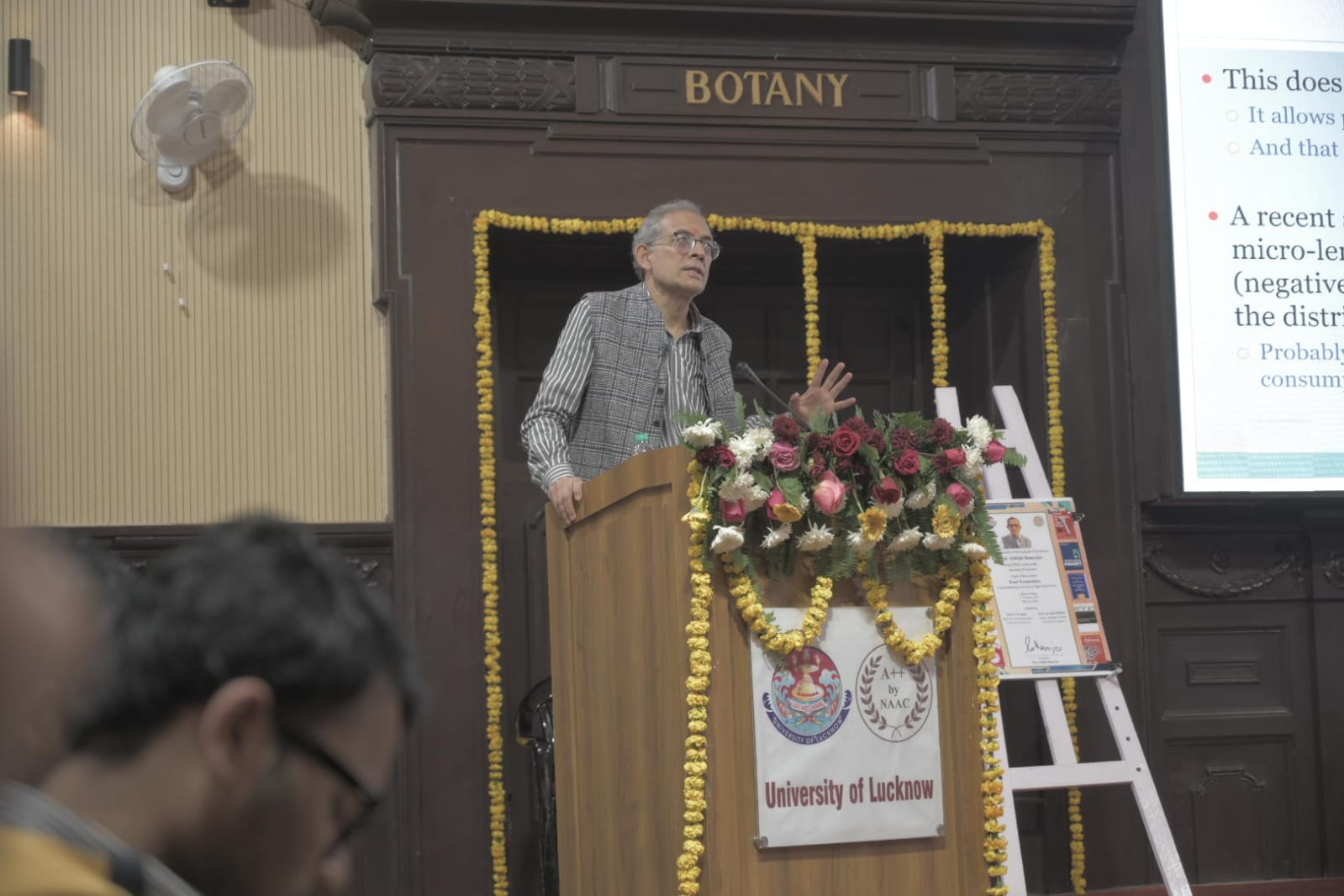
A major intellectual highlight of the day unfolded at Lucknow University, where Nobel Laureate and MIT economist Prof. Abhijit Banerjee delivered a keynote lecture—his second collaboration with MSLF this season. Reflecting on ideas from his seminal work Poor Economics: A Radical Rethinking of the Way to Fight Global Poverty, Prof. Banerjee challenged deeply ingrained assumptions about poverty and human behaviour.
“There is a belief that if you give people money they become lazy,” he observed, “but studies show that when people are paid well, they actually work harder.” Linking poverty in India closely to nutrition, he added, “The poor are low on nutrition, while the rich can afford it better.”
Emphasising human potential, Prof. Banerjee remarked, “The poorest are very, very willing to put in all their effort if they are really given a chance.” On education, he offered a sharp critique: “If your child can’t read, don’t teach them history—teach them how to read. School systems often break confidence; they teach algorithms, not how to solve problems.”
Reflecting on governance and systemic reform, he concluded with a metaphor central to his work: “A lot of problems happen because something goes wrong with the plumbing—and we’ve been working on the plumbing for a long time now,” reinforcing his belief that small, well-designed interventions can create transformative impact.
Heritage Experiences
A curated series of heritage walks offered immersive encounters with Lucknow’s layered past.
War Chronicles – Residency Walk, conducted by Deep Dive India, traced the 148-day siege of the British Residency during the Revolt of 1857, blending anecdotal storytelling with broader military histories of Hindustan. Deep Dive India continued its experiential approach rooted in history, archaeology, culture, and landscapes across Awadh, Bundelkhand, and the Kumaon Himalayas.
The Umrao Jaan Car Tour, led by Eshan Sharma, used cinema as a historical lens to explore 19th-century Awadh. Traversing Qaiser Bagh, the British Residency, Chowk, and Aminabad, the tour unpacked the world of tawaifs, courtly patronage under Wajid Ali Shah, the impact of 1857, and the transformation of Lucknow’s economy and crafts, including chikankari and itr-making.
The Maqbara Road Photo Walk, guided by Basil Hashmi, revealed a lesser-known heritage corridor in Hazratganj, culminating at the Sibtainabad Imambada, an architectural and spiritual landmark steeped in history.
An audience favourite, Husn-e-Karigari-e-Awadh, led by Noor Khan and Neera Kathuria, filled up immediately upon announcement. The walk took participants through the lanes of Chowk, introducing them to master artisans and live craft processes—from zardozi addas and chikankari blocks to chhapai colours and workshops. Initiated in 2019, the walk highlighted Lucknow’s enduring craft ecosystems and the people who sustain them.

Cultural Evenings | Amrit Lal Nagar Takht, Raja Ram Pal Singh Park
The evening unfolded with Bengali Golpo, a free-flowing qissagoi session by Mukta Chatterjee, Deepali Banerjee, Monalisa Chaudhary, and Divya Bhattacharya. Dressed in traditional laal paar sarees, the storytellers opened with the classic Bengali ulu and shank naad, weaving personal narratives, songs, and memories of Bengali life in Lucknow.
“Wherever Bengalis go, they carry a little Bengal with them and create the home they long for,” reflected Divya Bhattacharya.
“My family came from the 24 Parganas… I’ve sung Chandi Paath for almost 50 years,” shared Mukta Chatterjee.
“I’m deeply grateful to MSLF for giving us a platform—I can’t remember the last time I sat for a golpo,” said Deepali Banerjee.
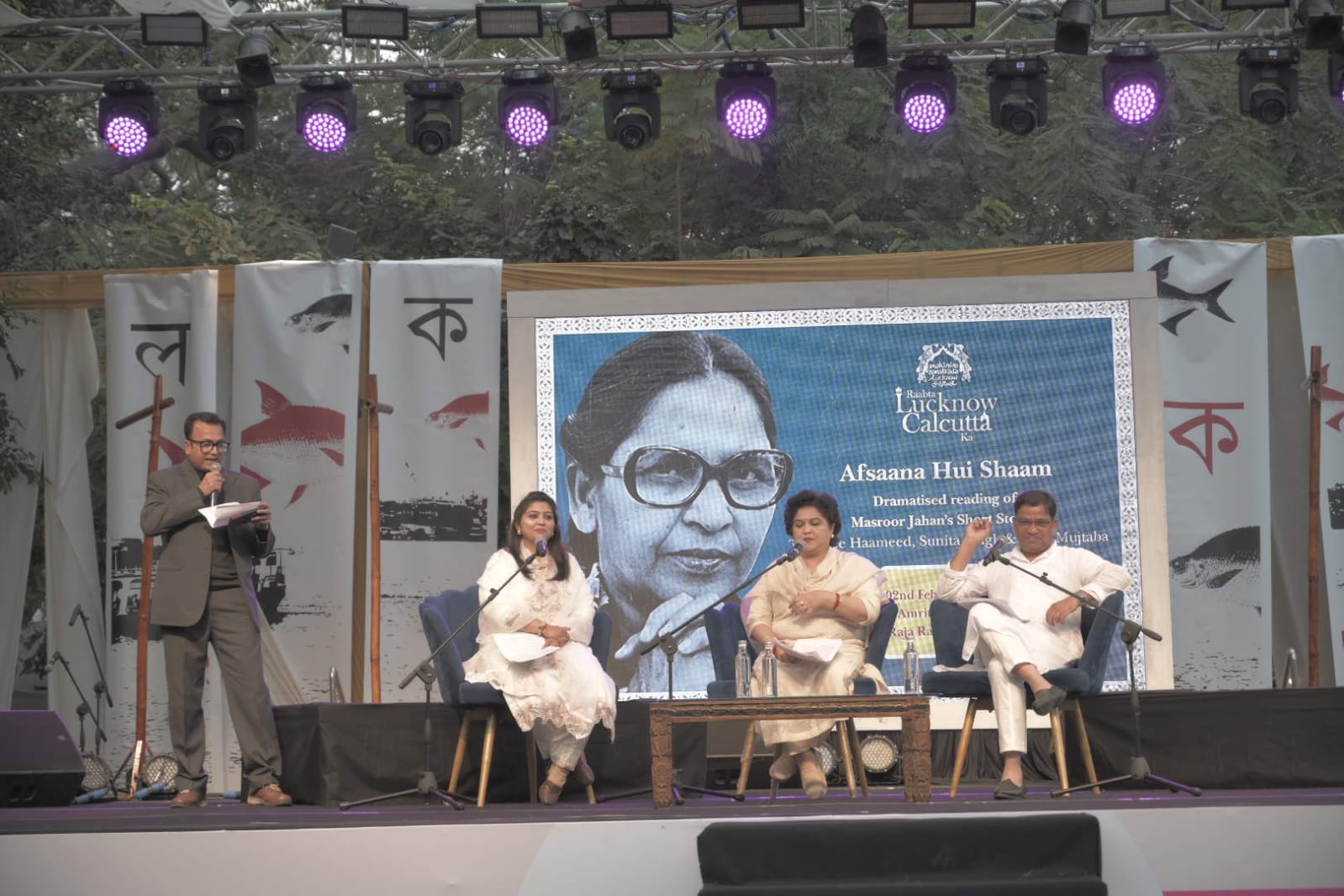
Afsaana Hui Shaam followed with a dramatised reading of short stories by Begum Masroor Jahan, performed by Tariquee Haameed, Sunita Singh, and Saira Mujtaba. Through layered voice and emotion, the performance explored love, loss, longing, and resilience within the Ganga-Jamuni cultural ethos.
The evening continued with Dastan-e-Simurgh, a Dastangoi adaptation of Fariduddin Attar’s Mantiq-ut-Taair, performed by Kafeel Jafri. The allegorical Sufi narrative traced the birds’ journey across seven valleys in search of the Simurgh, engaging deeply with themes of self-realisation and spiritual truth.
“This is the first time I’m performing The Conference of Birds, and there couldn’t be a better platform than MSLF,” Jafri shared.
The day concluded with Sur Sarita: A Musical Odyssey by Rageshri Das, blending Purav Ang and Bengali soundscapes. Combining semi-classical Hindustani traditions with Bangla folk forms, the performance created a melodic journey across the Indo-Gangetic plains, accompanied by vocals, guitar, tabla, and sarangi.
About Mahindra
Founded in 1945, the Mahindra Group is one of the world’s most admired multinational federations, with 324,000 employees across over 100 countries. A global leader in farm equipment, utility SUVs, IT, and financial services, Mahindra is also the world’s largest tractor company by volume. Its diverse presence spans renewable energy, agriculture, logistics, hospitality, and real estate.
With a strong commitment to ESG leadership, Mahindra focuses on enabling rural prosperity and enhancing urban living, driving positive change to help communities and stakeholders Rise.