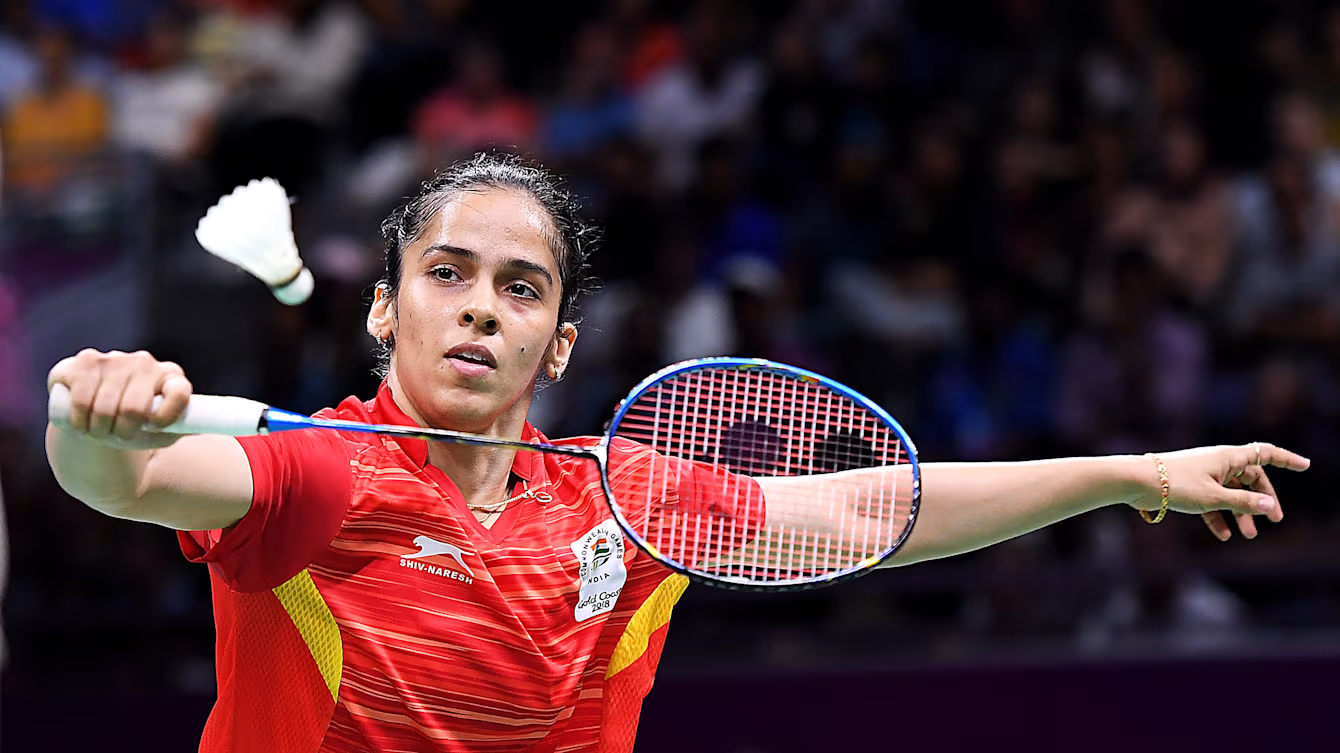
Mumbai: Saina Nehwal quietly drew the curtain on one of the most influential careers in Indian sport. Appearing on a podcast, the 35-year-old confirmed what many had sensed for some time—that her journey as a professional badminton player had already ended. Chronic knee issues, including severe cartilage degeneration and arthritis, had forced her away from competitive play nearly two years earlier. There was no grand farewell, no final lap of honor. True to her fiercely independent spirit, Saina chose to enter and exit the sport on her own terms.
Her final appearance on the international circuit came at the Singapore Open in 2023. By then, her body was no longer able to match her ambition. Even brief training sessions caused swelling and pain, making elite-level badminton impossible. “I can’t push it anymore… I thought it’s enough,” she said, capturing the quiet resolve with which she accepted the end of a remarkable chapter.
From Hisar to the World Stage
Born on March 17, 1990, in Hisar, Haryana, Saina Nehwal grew up in a household that valued education and sport. Her father, Harvir Singh Nehwal, is a Ph.D. holder in agricultural science, while her mother, Usha Rani Nehwal, was a former state-level badminton player. A move to Hyderabad during her childhood proved decisive. At just eight years old, Saina picked up a racquet—initially to overcome language barriers in a new city and to fulfill her mother’s unfulfilled sporting aspirations.
Under the guidance of coaches such as Nani Prasad and S. M. Arif, and later at Pullela Gopichand’s academy, her talent flourished rapidly. In 2005, she announced herself internationally by winning the Asian Satellite Badminton Tournament, signaling the arrival of a prodigy with uncommon grit and focus.
Breaking Barriers, Setting Benchmarks
Saina’s rise was swift and historic. In 2008, she became the first Indian to win gold at the BWF World Junior Championships. A year later, she shattered another ceiling by clinching the Indonesia Open, becoming the first Indian to win a BWF Super Series title. These victories did more than fill trophy cabinets—they redefined what was possible for Indian badminton.
Her career, spanning nearly two decades, is studded with milestones. At the London Olympics in 2012, Saina won bronze in women’s singles, securing India’s first-ever Olympic medal in badminton. In 2015, she reached the final of the BWF World Championships, earning silver and becoming the first Indian to do so. She added a world championship bronze in 2017, Commonwealth Games gold medals in 2010 and 2018, and multiple Asian Games podium finishes across singles and team events.
That same year, 2015, marked another historic peak as Saina rose to World No. 1—becoming the first Indian woman and only the second Indian overall, after Prakash Padukone, to top the BWF rankings.

With 24 international titles, including a record 10 Super Series crowns for an Indian shuttler, Saina remains the only Indian athlete to have medaled at the Olympics, World Championships, and World Junior Championships, while also earning honors at the Commonwealth Games, Asian Championships, and Asian Games.
Honors Beyond the Court
Saina’s achievements earned her the nation’s highest accolades: the Rajiv Gandhi Khel Ratna in 2009, the Padma Shri in 2010, and the Padma Bhushan in 2016, alongside the Arjuna Award. Her influence extended beyond sport—she was ranked among the world’s most charitable athletes in 2015, and an agricultural institute at Chaudhary Charan Singh Haryana Agricultural University bears her name, reflecting her wider social impact.
A Legacy That Transcends Medals
Perhaps Saina Nehwal’s greatest achievement cannot be quantified. Before her, badminton in India lived largely in the shadows. After her, it became a national obsession. She opened doors for women in Indian sport, inspired a generation of players—including Olympic champion PV Sindhu—and firmly placed India on the global badminton map.
As news of her retirement spread, tributes poured in from across the sporting world. Icons such as Sachin Tendulkar, Virat Kohli, and fellow shuttlers hailed her as a trailblazer who changed the game forever.
Saina Nehwal steps away with dignity, resilience, and a legacy that will long outlive her final match. Her era may have ended, but the path she carved will guide Indian badminton for generations to come.