- CU UP and Sahitya Akademi Host Two-Day Seminar to Explore the Impact of Storytelling in English and Translations: Visions, Revisions, and Innovations
- Two-Day Special Seminar at CU UP on “Storytelling in English and Translations: Visions, Revisions and Innovations” to Guide Young Writers of 21st Century
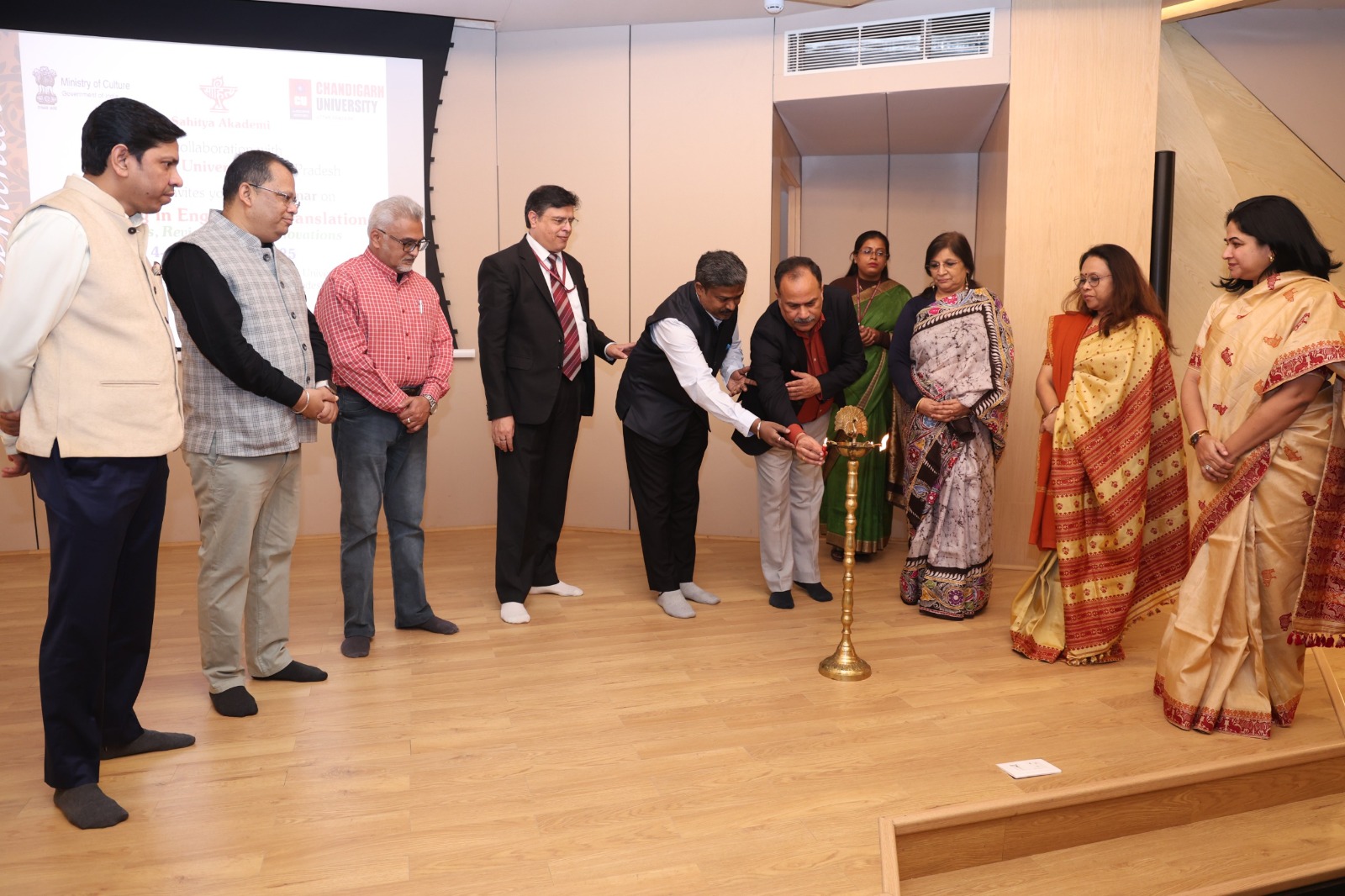
Unnao: The Sahitya Akademi, India’s premier literary institution under the Ministry of Culture, Government of India, in collaboration with Chandigarh University Uttar Pradesh, commenced a two-day national seminar that brought together scholars for in-depth discussions on “Storytelling in English and Translations: Visions, Revisions and Innovations.” The seminar opened with extensive deliberations on contemporary literary trends, creative perspectives and evolving narrative practices.
The central objective of this two-day seminar is to examine the shifting modes of storytelling, emerging directions in translation, and the new expressions shaping literary creativity. The event also facilitated reflections on the influence of English and translation on writing in the 21st century.
The seminar witnessed participation from scholars, academicians, researchers and writers from across the country. Speakers at the inaugural session observed that storytelling is not merely a form of entertainment but a conduit that preserves cultural heritage, connects languages and inspires new thought. Among those present were Shanamukhananda, Deputy Secretary, Sahitya Akademi, Ministry of Culture, Government of India; Prof. Anita Singh, Head, Department of English, BHU; Prof. Sunita Murmu, Head, Department of English, Gorakhpur; Pratyusha Pramanik, Chandigarh University Uttar Pradesh; Saumya Sharma, IFLU Lucknow; Sunita Murmu, DDU Gorakhpur; Prof. Onkar Nath Upadhyay, HoD, English Department, Lucknow University; Prof. Debjyoti Biswas, Bodoland University; Prof. Gourhari Behera, DDU Gorakhpur; Prof. Prakash Joshi, Director, Human Resource Development Centre, Allahabad University; Prof. Thipendra P. Singh, Pro Vice-Chancellor, Chandigarh University UP; and Dr Ajay Kumar Yadav, Registrar, Chandigarh University UP.
During the initial discussions, experts emphasized that even in changing times, stories remain a vital medium to understand society, share experiences and convey emotions and ideas to the next generation. The seminar features four theme-based sessions focusing on emerging narrative forms, reinterpretations for contemporary readers, new creative techniques and modern poetic adaptations of mythological narratives. Research paper presentations, poetry recitations and interactive sessions are also part of the programme, aiming to explore the evolving relationship between tradition and modernity.

Addressing the gathering, Shanamukhananda, Deputy Secretary, Sahitya Akademi, Ministry of Culture, Government of India, said that India’s storytelling tradition is deeply rooted—from the tales of grandmothers to epics such as the Mahabharata, Ramayana and Panchatantra. He noted that while stories transitioned from oral to written forms over time, today they reach the world through global mediums like English. He highlighted how writers such as Tagore, R.K. Narayan and Raja Rao infused Indian experiences into English literature, while translators helped present India’s diverse languages, folk narratives and traditions to the global stage. The purpose of this seminar, he added, is to understand the power of stories, translation and India’s cultural heritage—forces that connect, inspire and strengthen collective identity.
Prof. Dr T.P. Singh, Pro Vice-Chancellor, Chandigarh University Uttar Pradesh, said that the two-day national seminar jointly organised by Sahitya Akademi and Chandigarh University UP is a matter of pride. He added that bringing together scholars, academicians and researchers from across the country on a contemporary theme like “Storytelling in English and Translations” enriches literary dialogue and fosters new bridges of understanding between languages and cultures. He expressed confidence that the seminar would advance meaningful conversations between tradition and modernity and offer fresh perspectives in the evolving world of literature.