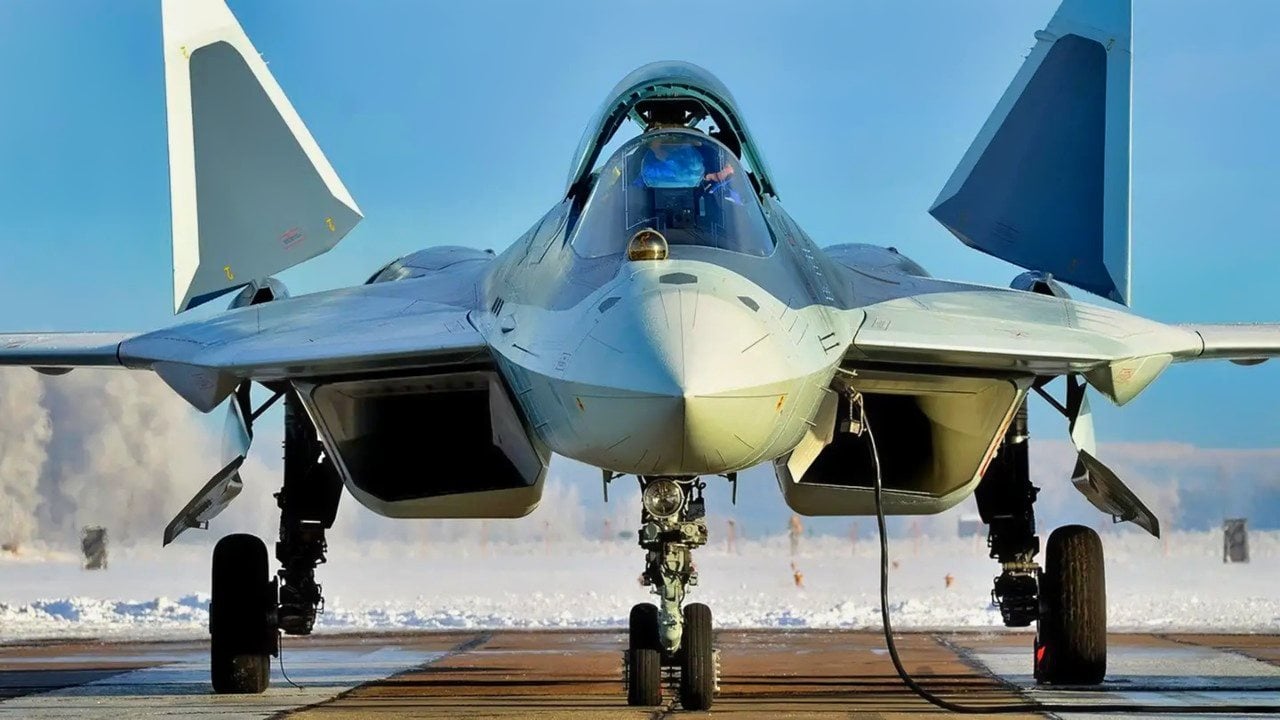
New Delhi: Russia is stepping up efforts to position its Su-57 stealth fighter as a contender for the Indian Air Force (IAF), reshaping its export proposal to align closely with India’s “Make in India” and localisation priorities, according to international defence media reports.
The revised offer focuses on a customised Su-57E variant that would incorporate significant participation from Indian industry and integrate indigenous subsystems. This represents a notable departure from Russia’s earlier export approach, under which the aircraft was marketed largely in a standard, non-customisable configuration.
Nearly ten years ago, India walked away from a Russian proposal for joint development of the fifth-generation fighter, citing technical challenges, design concerns, and the scale of modifications required. However, renewed diplomatic and industrial engagement has brought the Su-57 back into discussions surrounding the IAF’s long-term force structure.
In December 2025, Russian President Vladimir Putin personally highlighted the aircraft during talks with Prime Minister Narendra Modi, signalling high-level political backing for the renewed pitch. Senior leadership from Russia’s United Aircraft Corporation (UAC) has since reinforced that any Indian Su-57E would prioritise local manufacturing and Indian-made systems.
UAC officials have stated that the revised concept is designed to meet India’s long-standing insistence on localisation, technology access, and data sovereignty. Earlier export models for the Su-57 were characterised by strict controls and limited flexibility, comparable to highly standardised Western stealth aircraft programmes.
Defence sources indicate that technical discussions have advanced, with major Indian public-sector defence companies participating in configuration and integration planning. The aircraft is reportedly being assessed as a potential successor to certain Su-30MKI squadrons for specialised, high-end combat roles.
Three broad procurement pathways are understood to be under consideration. The first involves a limited number of aircraft acquired directly from Russian production lines. While this approach could enable faster induction, past experience—such as India’s Rafale purchase—has shown that small, fully imported fleets come at a significant cost.

The second option would see licensed production in India with relatively modest modifications, including integration of Indian weapons, communications systems, and tailored mission software. This route would balance localisation with cost control, without fundamentally altering the aircraft’s core design.
The third and most expansive approach envisages a joint development model. Under this scenario, numerous IAF-specific design changes would be incorporated, with Indian industry responsible for integrating a wide range of indigenous avionics, sensors, and electronic systems. Early squadrons could retain a largely standard configuration, while later batches would evolve into heavily customised Indian variants—similar to how the Su-30MKI diverged significantly from its Russian counterpart.
Proposed Indian-specific enhancements reportedly include domestic mission computers, secure software-defined radios, encrypted data links, and indigenous identification-friend-or-foe systems. These additions would support network-centric operations, protect sensitive data, and ensure operational independence.
However, defence analysts caution that extensive localisation carries substantial cost implications. The Su-30MKI, for instance, is significantly more expensive than Russia’s Su-30SM due to customisation and local integration. A similarly tailored Su-57E could limit the number of aircraft the IAF is able to procure.
For Russia, India is viewed as a critical potential export customer for the Su-57, which has so far seen limited international uptake. The evolving proposal reflects Moscow’s willingness to adapt to India’s strategic and industrial priorities. Whether cost, timelines, and competing indigenous programmes will allow the Su-57E to secure a major role in India’s future fighter fleet remains an open question.