
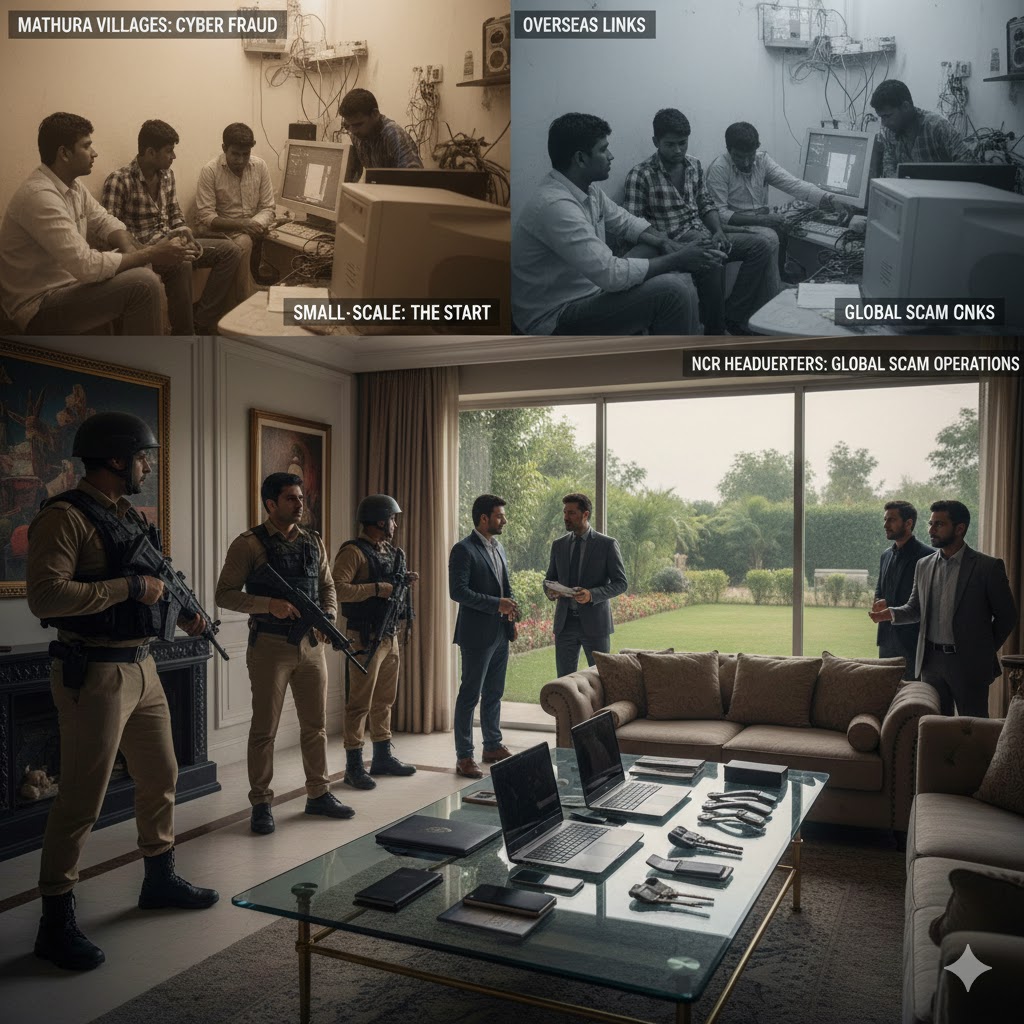
Lucknow | What began as small-scale cyber fraud operations in the border villages of Uttar Pradesh’s Mathura district has now been uncovered as a well-organised international cybercrime network, operating from luxury properties in Delhi and the National Capital Region (NCR). A recent police crackdown has exposed how fraudsters used rural pockets as their base before expanding into global digital scam operations, funding a lifestyle marked by premium vehicles, farmhouses, and overseas links.
In a coordinated multi-day operation, the Mathura Police arrested 37 accused and dismantled a syndicate that had once functioned quietly from villages such as Devsaras, an area locally dubbed ‘Mini Jamtara’ due to its long association with cyber fraud. Investigators revealed that increased police vigilance in rural areas forced the accused to shift operations to urban centres, enabling them to scale up activities while blending into elite neighbourhoods.
From Fields to Farmhouses
Senior police officials said the gang initially carried out fraudulent calls from makeshift locations such as fields, cowsheds, and temporary shelters near Govardhan. The proximity to the Uttar Pradesh–Rajasthan border offered a tactical advantage, allowing suspects to evade arrest by quickly crossing state lines at the first sign of police action.
As profits grew, the accused invested in large residential properties and agricultural land across Rajasthan’s Deeg and Kaman regions. The difficult terrain and limited inter-state coordination helped them remain undetected for years.
Wedding Display Raises Suspicion
The scale of illegal earnings surfaced publicly during a lavish wedding in Devsaras village. The groom’s procession featured nearly 40 Mahindra Thar SUVs, a Land Rover Defender, and several other high-end vehicles—an unprecedented spectacle in the rural belt.
While villagers were left astonished, the event raised serious red flags for investigators. Police are now examining vehicle ownership records, funding sources, and banking trails, suspecting the display was a deliberate projection of wealth generated through cybercrime.
Luxury Homes as Cyber Command Centres
Investigations revealed that the syndicate’s actual control rooms were located in upscale Delhi-NCR residences. These luxury homes operated like professional call centres, equipped with fake SIM cards, VoIP calling systems, and layered digital payment networks to obscure money trails.

Victims included not only Indian citizens but also foreign nationals from countries such as Thailand, Saudi Arabia, Nigeria, and others. The accused often posed as businessmen, consultants, or property dealers, allowing them to function unnoticed in premium residential colonies.
Multi-State Coordination Intensified
Mathura Police have sought formal cooperation from Deeg Kotwali Police in Rajasthan, with Bhilamka village emerging as a major hideout and transit point. Joint patrolling, property verification drives, and financial scrutiny have been launched to prevent further escapes and dismantle remaining links.
Organised Crime and Money Laundering Charges
Police officials confirmed that cases have been registered under the Information Technology Act, along with sections related to organised crime, criminal conspiracy, and money laundering. Forensic analysis of seized mobile phones, laptops, and bank accounts is underway, with authorities expecting further arrests and exposure of international connections.
Senior officers said the case highlights how rural cybercrime hubs have evolved into transnational criminal enterprises, demanding sustained coordination across states and borders.
“This is no longer just a local cybercrime case,” a senior officer said. “It shows how digital fraud can transform villages into gateways of global criminal networks.”