
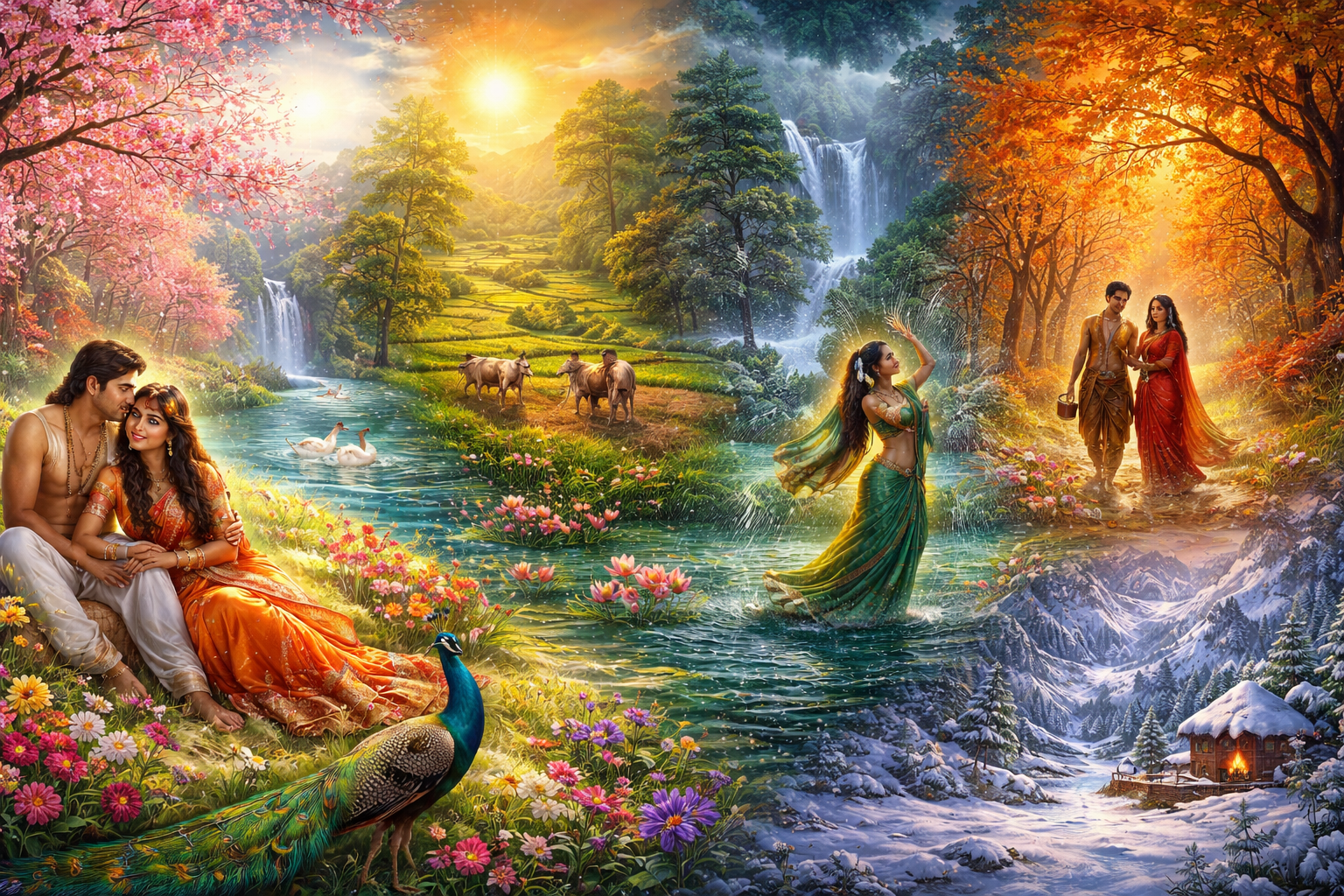
Lucknow: The beautiful Indian climate has six seasons regarded traditionally since ancient times. The year starts in sunny summer, typically in the second week of April, when the Chitra month as per Indian solar calendar begins. That is why the financial year in India is taken to end on March 31. The traditional New Year is called Baisakhi, Poila Baisakh, and celebrated all over the country in different ways. The solar and lunar calendars are similar, with some variations; the lunar calendar has Yugādi as the start of a new year and celebrated a few days apart.
Chitra and Vaiśākha months form summer, known as Grīshma ritu. The next two months, namely Jyestha and Āshādha which coincide with mid-June to mid-August, form Varshā or the monsoon season that brings heavy showers. The next two months, Śrāvana and Bhādrapada which coincide from mid-August to mid-October approximately, form Sharad ritu, the autumn. We then have Hemanta, the cool season during the months of Āśvina and Kārtika, i.e., from October to mid-December. Towards the end of the year falls the cold season, Shishira, which lasts from mid-December to February, in the months known as Mārgashīrsha and Pausha. Then comes the glorious spring season, Vasanta ritu, in Phālguni and Māgha. We can see the similarity of these Sanskrit names with the vernacular versions such as Baisakh, Sāwan etc. The Tamil names of the months – Māsi, Panguni, Cittirai, Vaigāsi, Āni, Ādi, Āvani, Purattāsi, Aippasi, Kārtikai, Mārgazhi and Tai also bear close resemblance to them.
Kalidasa’s lyrical poem on the cycle of seasons is famous, the Ritusamhāra, that has inspired many poets over the centuries. On summer he says —
प्रचण्डसूर्यः स्पृहणीयचन्द्रमाः, सदावगाहक्षमवारिसंचयः।
दिनान्तरम्योऽभ्युपशान्तमन्मथो, निदाघकालोऽयमुपागतः प्रिये॥ 1.1 ॥
“Now has the summer approached, my dear, when the sun is fierce, the moon is sought and one wants to continually immerse in water pools; when the evenings are pleasing and the feeling of love is allayed (due to discomfort of heat).”
मृगाः प्रचण्डातपतापिता भृशं तृषा महत्या परिशुष्कतालवः।
वनान्तरे तोयमिति प्रधाविता निरीक्ष्य भिन्नाञ्जनसंनिभं नभः॥ 1.11 ॥
“Severely scorched by the harsh sun, their palates dried up with thirst, the beasts try to start off to a different forest, seeing the sky appear like collyrium (kajal) and mistaking it to be water.”
तृषा महत्या हतविक्रमोद्यमः श्वसन्मुहुर्दूरविदारिताननः।
न हन्त्यदूरेऽपि गजान्मृगेश्वरो विलोलजिह्वश्चलिताग्रकेसरः॥ 1.14 ॥
“Leaving off his mighty efforts on account of great thirst, panting with jaws wide open, the lord of beasts – the lion – with tongue lolling and mane quivering, does not attack the elephants close by.”
विशुष्ककण्ठोद्गतशीकराम्भसो गभस्तिभिर्भानुमतोऽभितापिताः।
प्रवृद्धतृष्णोपहता जलार्थिनो न दन्तिनः केसरिणोऽपि बिभ्यति॥ 1.15 ॥
“And the elephants, parched by the sun and their mouths dry with thirst, do not fear the lion while seeking water.”
On the rainy season he writes —
सशीकराम्भोधरमत्तकुञ्जर-स्तडित्पताकोऽशनिशब्दमर्दलः।
समागतो राजवदुद्धतद्युति-र्घनागमः कामिजनप्रियः प्रिये॥ 2.1 ॥

“With the clouds squirting water like lordly elephants spraying ichor, with lightning as their banners, thunder like the sounding of drums, the Monsoon has arrived like a king radiant with glory.”
नितान्तनीलोत्पलपत्रकान्तिभिः क्वचित्प्रभिन्नाञ्जनराशिसंनिभैः।
क्वचित्सगर्भप्रमदास्तनप्रभैः समाचितं व्योम घनैः समन्ततः॥ 2.2 ॥
“With thick clouds in places dark as the petals of blue lotuses, in places as dark as collyrium and in places as lofty as a young woman’s bosom, is the sky overcast all around.”
On Autumn when the skies are clear of dust and the moon is etched bright —
काशैर्मही शिशिरदीधितिना रजन्यो हंसैर्जलानि सरितां कुमुदैः सरांसि।
सप्तच्छदैः कुसुमभारनतैर्वनान्ताः शुक्लीकृतान्युपवनानि च मालतीभिः॥ २ ॥
“The earth is whitened by the kāśa flowers; the nights by the moon; the river waters by swans the lakes by lotuses and the forest regions by the fragrant saptacchada trees laden with flowers and the ground by mālatī creepers.”
व्योम क्वचिद्रजतशङ्खमृणालगौरै-स्त्यक्ताम्बुभिर्लभुतया शतशः प्रयातैः।
संलक्ष्यते पवनवेगचलैः पयोदै राजेव चामरशतैरुपवीज्यमानः॥ ४ ॥
“The clouds as white as silver, conch shells and lotus roots, blown about in hundreds by the wind, lightened as they are by shedding all their water, fan the sky like a king with the chowris as it were.”
Kalidasa describes the winter as the time when people take resort indoors to the warmth of the fire and animals go into hiding. As for beloved spring, the king of seasons celebrated in poetry, we must devote another study to it!
Team Siddhanta Knowledge Foundation