
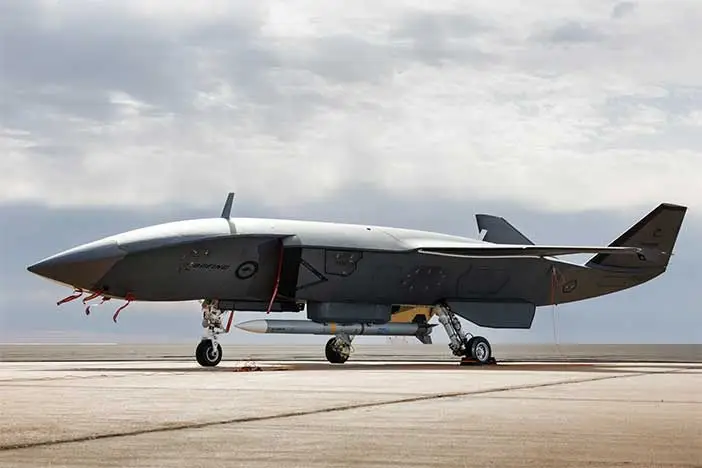
Berlin: German defense giant Rheinmetall AG has entered into a strategic partnership with Boeing Defence Australia to introduce the advanced MQ-28 Ghost Bat autonomous combat aircraft to Germany, with deployment targeted by 2029.
The collaboration aims to equip the Bundeswehr with a next-generation Collaborative Combat Aircraft (CCA), marking a major step in Europe’s push to modernize its air combat capabilities.
Advancing Autonomous Air Combat
Developed by Boeing in Australia, the MQ-28 Ghost Bat is among the most sophisticated autonomous military aircraft currently available. With over 150 successful test flights, the platform has already demonstrated operational potential with the Royal Australian Air Force.
Unlike traditional fighter jets, the aircraft is designed to operate alongside piloted systems, acting as a “loyal wingman.” It can support missions such as intelligence gathering, electronic warfare, and precision targeting—roles that are increasingly critical in modern warfare environments.
Rheinmetall to Drive German Integration
As part of the agreement, Rheinmetall will act as the primary system integrator in Germany. The company will adapt the aircraft to meet national defense requirements and ensure compatibility with existing command, control, and weapons systems.
Rheinmetall leadership highlighted that the partnership will not only enhance Germany’s defense capabilities but also strengthen domestic industry through the creation of a European production and technology hub. The project is expected to generate significant economic value and boost supply chain resilience.
Strengthening Global Defence Collaboration
The agreement also reflects deepening defense ties between Germany and Australia. By leveraging Australia’s years of research and development on the MQ-28 program, Germany aims to fast-track deployment while minimizing development risks.

Engineers from both countries are expected to collaborate closely using advanced digital environments to accelerate testing, integration, and future upgrades.
Fast-Track Deployment by 2029
One of the key advantages of the partnership is speed. Since the MQ-28 is already a mature platform, Germany can significantly reduce the time required to operationalize a CCA capability. Plans include phased localization, with an increasing share of components to be produced domestically over time.
Built for Future Warfare
The MQ-28 Ghost Bat has been under development for nearly a decade and represents a major leap in unmanned combat aviation. Its open and modular architecture allows for continuous upgrades and integration of new technologies, ensuring long-term adaptability.
Recent demonstrations have showcased its ability to autonomously detect and engage airborne targets, underlining its potential as a force multiplier in complex combat scenarios.
A Strategic Shift in Air Power
As European nations accelerate investments in next-generation military technologies, the Rheinmetall–Boeing partnership signals a broader transition toward autonomous and collaborative air combat systems. Analysts believe such platforms could play a defining role in shaping the future of aerial warfare.