Comprehensive brainstorming on Policy, Technology, Finance, and Public Participation for the rejuvenation of the Gomti River.
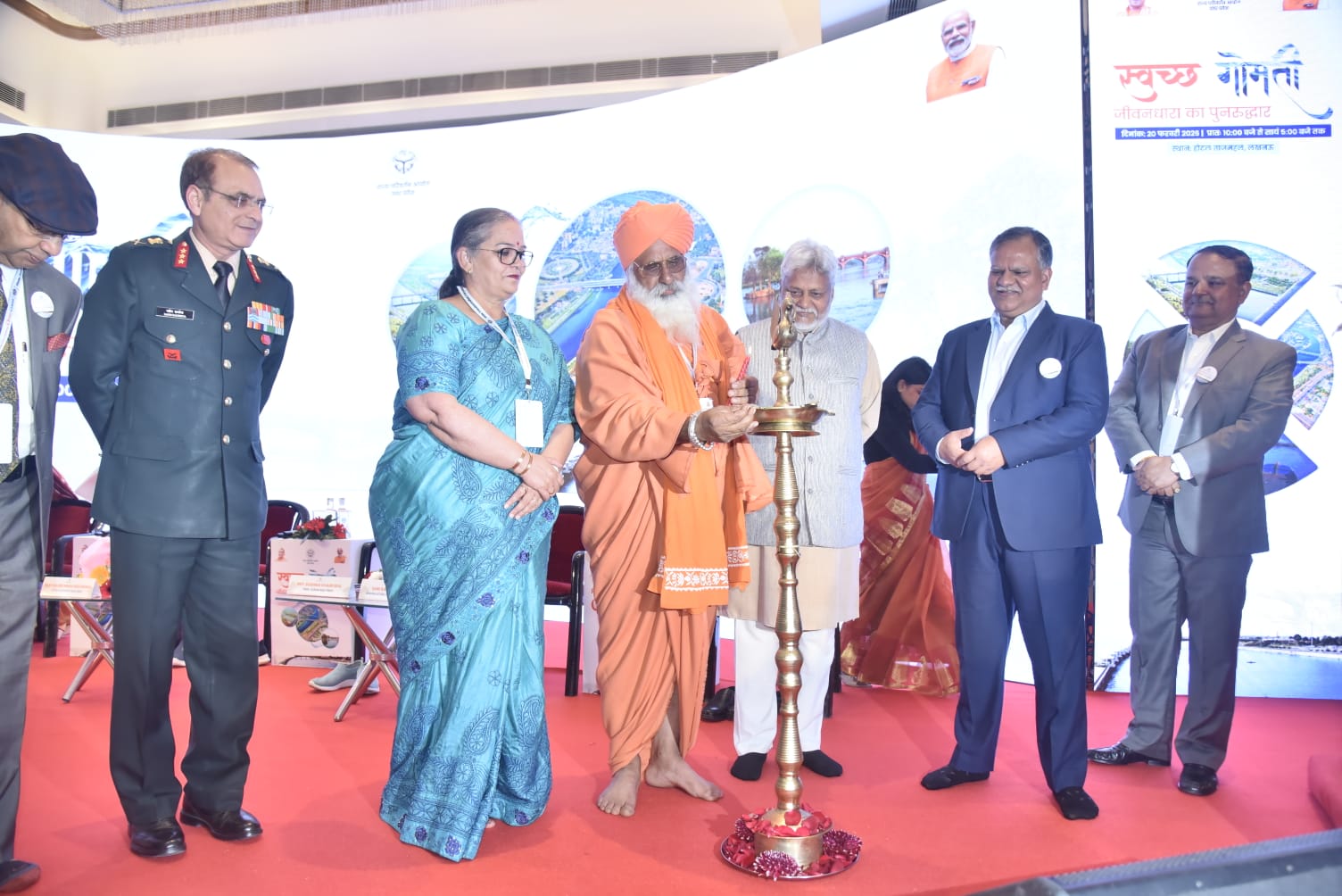
LUCKNOW | Under the visionary guidance of Chief Minister Yogi Adityanath and the leadership of the State Transformation Commission (STC) CEO Manoj Kumar Singh, a state-level workshop titled “Revitalizing the Lifeline: Clean Gomti 2026” was organized today. This landmark initiative aims to establish a scientific and sustainable roadmap to restore the Gomti River—a major tributary of the Ganga—to its pristine and perennial glory.
A Scientific and Strategic Deep-Dive
The workshop brought together senior government officials, environmentalists, technical experts, and industry leaders to discuss a multi-dimensional strategy. The primary focus areas included:
-
Scientific Analysis: Experts pointed out that the unregulated flow of domestic sewage through storm-water drains in the Lucknow metropolitan area is the biggest contributor to pollution.
-
Infrastructure & Technology: Leading firms like VA TECH WABAG and SUEZ India presented the “One City, One Operator” model. The consensus was to treat wastewater not as a liability, but as an economic resource through advanced recycling.
-
Finance+ Model: Discussion centered on a hybrid financial strategy involving state budgets, Central schemes, CSR funds, and Public-Private Partnerships (PPP) to ensure long-term project viability.
Voices of Leadership
“The rejuvenation of the Gomti is not just an environmental project; it is linked to public health, livelihoods, and biodiversity. Our goal is to transform this campaign into a mass movement (Jan-Andolan).” — Shri Manoj Kumar Singh, CEO, State Transformation Commission
Renowned environmentalist and ‘Waterman of India’ Shri Rajendra Singh, along with Rajya Sabha MP Sant Balbir Singh Seechewal, emphasized the importance of traditional knowledge and community-led conservation. Representing the Indian Army’s Central Command, Lt. Gen. Anindya Sengupta highlighted the intrinsic link between environmental security and national security.
Key Sessions & Outcomes
-
Institutional Framework: A proposal was made to form a dedicated centralized agency to monitor and coordinate efforts between departments like Urban Development, Panchayati Raj, and the Pollution Control Board.

-
Behavioral Change: Experts stressed Social and Behavior Change Communication (SBCC) to instill a sense of ownership among citizens, ensuring the riverfront remains clean post-restoration.
-
Smart Monitoring: Emphasis was placed on installing smart sensors and rigorous monitoring of industrial effluent and sewage discharge points.
Distinguished Participants
The workshop saw participation from a global and national panel of experts, including:
-
Sushma Kharkwal (Mayor, Lucknow)
-
Lt. Gen. Naveen Sachdeva (Chief of Staff, Central Command)
-
World Bank Representatives: Smt. Sumila Gulyani and Mr. David Malcolm Lord.
-
GIZ (Germany): Ms. Laura Sustersic.
The “Clean Gomti 2026” initiative serves as a robust foundation for ecological restoration. By integrating technical efficiency with public participation, Uttar Pradesh aims to set a global benchmark for sustainable river management.