
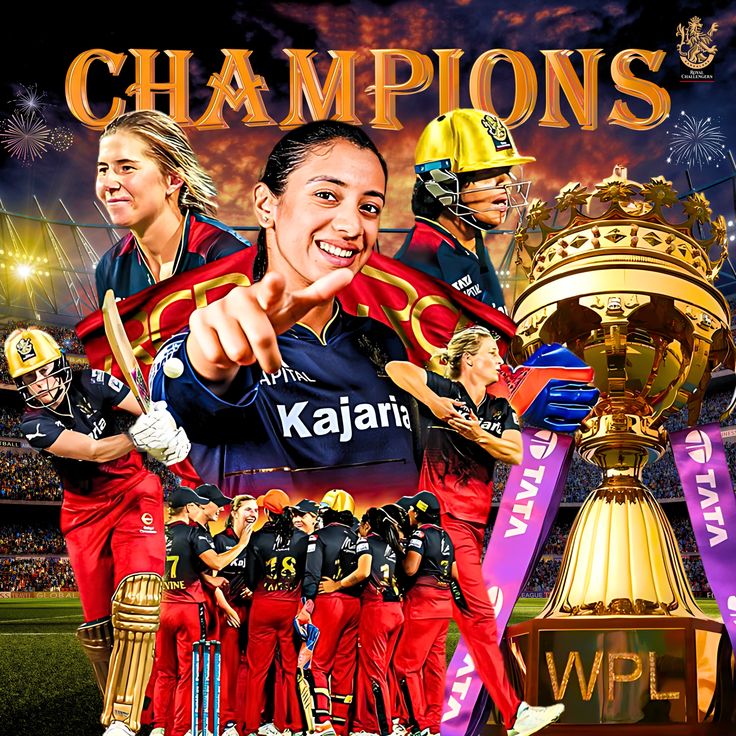
Vadodara: History doesn’t always announce itself politely. Sometimes it arrives with a roar, a blur of boundaries, a stadium holding its breath — and a captain who refuses to blink. On February 5, 2026, at a floodlit BCA Stadium in Vadodara, Royal Challengers Bengaluru Women didn’t just win the Women’s Premier League title. They claimed an era.
Chasing a daunting 204 in a final — a number that had never been hunted down before on this stage — RCB tore up every script, beat Delhi Capitals by six wickets, and lifted their second WPL crown, drawing level with Mumbai Indians as the league’s only multiple-time champions. For Delhi, the heartbreak deepened: four finals, four losses, a cruel statistic that underlines how unforgiving elite sport can be.
For RCB, this was validation. Redemption. And domination — all rolled into one unforgettable night.
A Season Built Like a Champion
WPL 2026 was the toughest edition yet. Batters hit harder, bowlers bowled smarter, and captains played chess at sprinting speed. The margins were razor-thin. The noise was louder. The pressure heavier.
Through it all, RCB stood tallest.
They finished top of the league table with six wins from eight matches and a muscular net run rate of +1.247, earning a direct entry into the final. No eliminators. No second chances. Just quiet confidence born of consistency.
RCB’s league campaign was a masterclass in balance. Explosive starts up top. Depth in the middle. Finishers who didn’t panic. Bowlers who adapted. Fielders who hunted in packs.
They stormed out of the blocks with five straight wins, putting daylight between themselves and the rest. There were mid-season stumbles — inevitable in a long campaign — but the bounce-back was instant, emphatic, and ruthless.
One result stood out: a last-ball heist against defending champions Mumbai Indians, where Nadine de Klerk delivered a reminder that RCB don’t fold under pressure — they feast on it.
Head-to-head with Delhi Capitals in the league phase was split. But RCB carried something DC didn’t: the memory of winning a final against them in 2024. Confidence can’t be quantified. But it can be felt.
Mandhana: The Calm at the Centre of the Storm
If this RCB side has a heartbeat, it’s Smriti Mandhana.
Her captaincy throughout the season was marked by clarity and calm. She trusted her players. She read conditions sharply. Her field placements were proactive, not reactive. And when the moment demanded leadership, she didn’t point — she performed.
Mandhana’s batting was both statement and shield. She absorbed pressure so others could play freely. She attacked when needed, paced when required, and set the tone in almost every big game.
RCB’s squad depth allowed for rotation without loss of quality — a sign of smart auction strategy and clear roles. But Mandhana was the axis. Everything revolved around her poise.
And in the final, she delivered the performance of her career.
The Final: When Records Were Meant to Break
Delhi Capitals arrived in the final hungry, wounded by history, desperate to change the narrative. Losing the toss, they were sent in — a decision shaped by tournament trends favouring chases under lights.
DC responded with intent.
Jemimah Rodrigues anchored the innings with a composed 57 off 37, holding the middle together as wickets threatened. Laura Wolvaardt brought elegance and urgency, her 44 off 25 keeping the tempo high. And when Chinelle Henry walked in at the death, she turned the game incandescent — 35 not out off 15 balls, pure muscle and timing.
The final tally: 203/4.
It was the first 200+ score in a WPL final. A mountain. A statement. A challenge thrown straight at RCB’s feet.
The pressure was instant. Finals don’t forgive timid starts. One early wobble, and the chase could collapse.
Then Smriti Mandhana stepped in — and lit the fuse.
Mandhana Unleashed, Voll Unafraid
From ball one, Mandhana’s intent was unmistakable. No sighters. No caution. Just authority.
She pierced gaps. Cleared ropes. Danced down the track. The fifty came up in 23 balls — the fastest half-century in WPL final history. The stadium buzzed. DC scrambled. Momentum swung violently.
At the other end stood Georgia Voll, fearless and fluid. Where Mandhana blazed, Voll flowed — picking lengths early, punishing anything marginal, rotating strike like a veteran.

Together, they built a partnership that didn’t just chase a target — it dismantled belief. The stand became the highest partnership in a WPL final, rewriting records with every over.
The required rate dropped. The noise rose. DC’s bowlers searched for answers and found none.
This was controlled aggression at its finest — power married to precision.
Nerves, Twists and Steel
Finals rarely allow a smooth ending.
Mandhana’s dismissal in the penultimate over — a moment that would have shattered lesser teams — injected sudden tension. The crowd inhaled sharply. DC sensed a crack.
But this RCB side doesn’t unravel.
Nadine de Klerk walked in with intent clear and mind settled. Radha Yadav joined her with the calm of someone who had been here before. Singles were taken. Pressure was shared.
Final over. 10 needed off 6 balls.
No drama. No panic.
Radha Yadav stepped across, opened the face, and found the boundary. Two balls later, it was done.
204/4 in 19.4 overs.
The highest successful chase in WPL history.
A final that will be replayed, debated, and revered.
The Supporting Cast That Made It Possible
Championships aren’t won by moments alone. They’re built on seasons of contributions.
- Georgia Voll emerged as a revelation — her maturity in big moments belying her years.
- Nadine de Klerk delivered clutch contributions all season: late runs, timely wickets, relentless energy.
- Radha Yadav and Shreyanka Patil controlled the middle overs with intelligence and variation.
- Lauren Bell brought discipline and bounce when it mattered.
- Richa Ghosh provided explosive cameos that tilted games in a handful of balls.
- Pooja Vastrakar and Arundhati Reddy added depth, flexibility, and steel.
This was a squad without passengers.
Why RCB Won: The Championship Blueprint
RCB’s triumph wasn’t accidental. It was engineered.
Batting Depth: Firepower up top meant the middle order played without fear.
Chasing Excellence: They mastered conditions under lights, using dew and momentum ruthlessly.
Balanced Attack: Spin variety complemented pace options perfectly on Vadodara’s surface.
Mental Fortitude: Big totals didn’t scare them. Big moments didn’t freeze them.
Delhi Capitals were outstanding all season — reaching a fourth final is no fluke. But finals demand execution without hesitation. That remains their unfinished business.
Beyond the Trophy: What This Win Means
This title does more than add silverware.
It buries the old narratives that once followed the RCB name in franchise cricket. It mirrors the ambition long held by their men’s IPL side. It proves that belief, once established, becomes habit.
For women’s cricket in India, the WPL continues to soar — higher scores, fuller stadiums, deeper global talent pools, and genuine rivalries.
RCB’s journey — champions in 2024, contenders in 2025, champions again in 2026 — reflects sustainable excellence, not a flash of fortune.
As fireworks lit up the Vadodara sky and Mandhana lifted the trophy, it wasn’t just celebration. It was confirmation.
RCB Women are no longer chasing history.
They’re writing it.
And if this final was any indication, the red empire isn’t done yet.