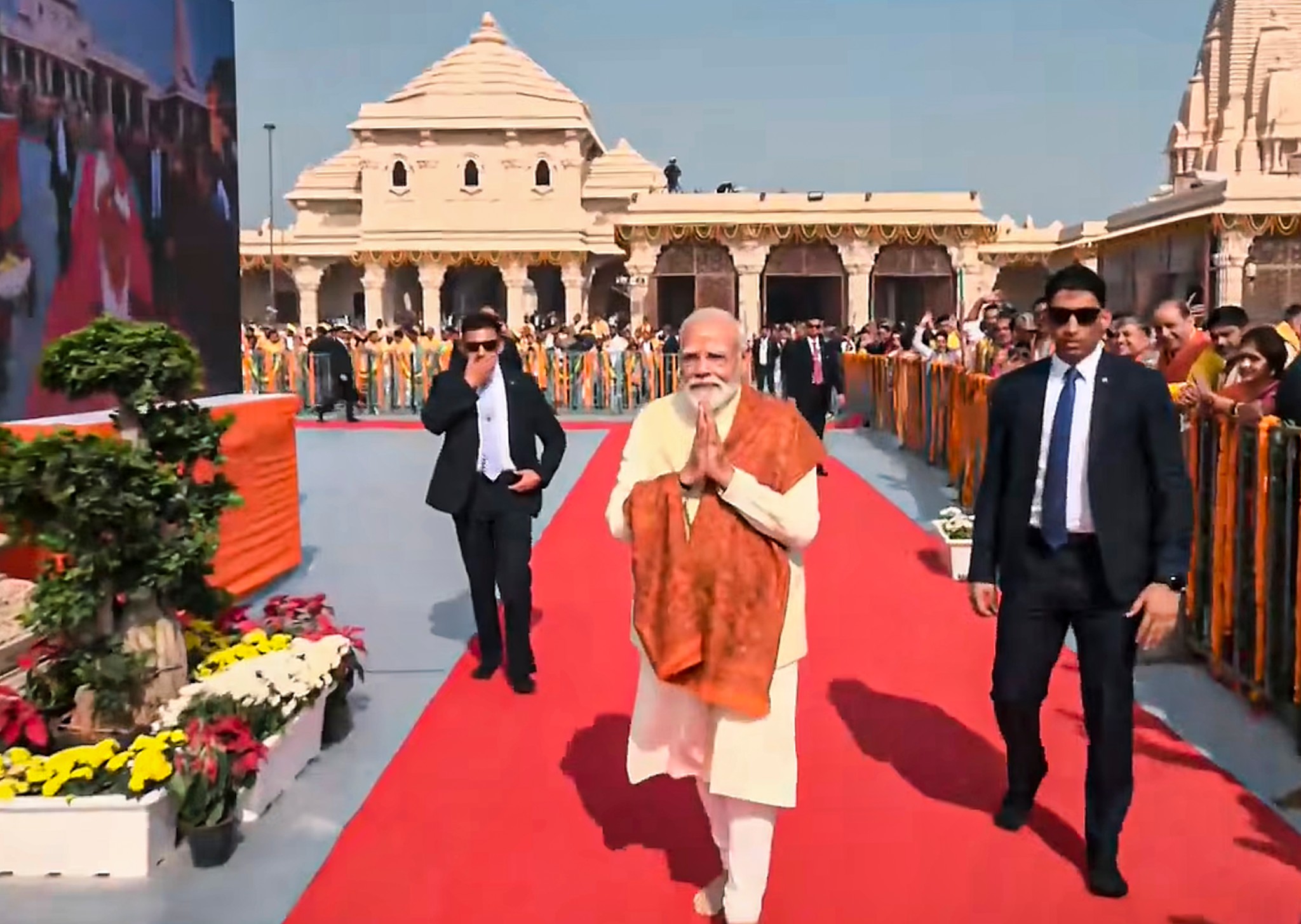
Ayodhya: Marking a momentous occasion in the nation’s socio-cultural and spiritual landscape, Prime Minister Narendra Modi ceremonially hoisted a saffron flag on the Shikhar of the sacred Ram Janmbhoomi Temple in Ayodhya, Uttar Pradesh today. The Dhwajarohan Utsav symbolises the completion of the temple’s construction and the beginning of a new chapter of cultural celebration and national unity.
Addressing a gathering, the Prime Minister said that Ayodhya is witnessing yet another pinnacle of India’s cultural consciousness. “Today the entire India and the entire world is filled with the spirit of Lord Ram,” Modi remarked, adding that every devotee is experiencing unique satisfaction, boundless gratitude, and immense transcendental joy. He noted that centuries-old wounds are healing, centuries of pain are ending, and centuries of resolve are being fulfilled. He called it the culmination of a 500-year-long yajna whose flame never wavered in faith. He underlined that the divine glory of Ram’s sanctum has now been enshrined in the form of this Dharma Dhwaja in the grand temple.
“This Dharma Dhwaja is not merely a flag, but the flag of the renaissance of Indian civilization,” Modi said. He explained that its saffron colour, the glory of the Solar dynasty inscribed upon it, the sacred Om, and the engraved Kovidar tree together symbolise the greatness of Ram Rajya. He described the flag as resolve, success, and the saga of perseverance—an embodiment of centuries-old dreams and the culmination of the penance of saints and the contribution of society.
Modi emphasized that this Dharma Dhwaja will, for centuries to come, proclaim the ideals and principles of Ram, asserting that truth alone prevails. It will inspire duty, commitment, equality, and the aspiration for a society free from discrimination, sorrow, and poverty.
He said the scriptures note that those who cannot visit the temple but bow before its flag also attain equal merit. Calling the flag a symbol of purpose, he added that it will offer devotees from afar a vision of Ram Lalla’s birthplace while carrying His message to humanity for ages. Modi extended his greetings to crores of devotees worldwide and expressed gratitude to donors, workers, artisans, and planners associated with the temple’s construction.
“Ayodhya is the land where ideals become conduct,” the Prime Minister said, noting that this is where Ram began His life’s journey. He recalled how Ram returned from exile as ‘Maryada Purushottam’, shaped by sages, friends, devotees, and society at large. He urged every citizen visiting the Ram Mandir to also visit the seven temples built in the complex, each representing friendship, duty, devotion, and social harmony.
Modi stated that “our Ram connects not through differences but through emotions.” He added that over the last 11 years, the government has focused on empowering women, Dalits, backward classes, tribals, farmers, workers and youth. He said that when every section of society is strengthened, every effort contributes to the resolve of building a developed India by 2047.
Reflecting on Ram Lalla’s Pran Pratishtha, he said the nation must think beyond the present and prepare for the next thousand years. Ram, he said, represents ideals, discipline, truth, valor, patience, devotion, knowledge, humility, and unwavering resolve—qualities that must guide India’s journey.
“Ram is not merely a person but a value, a discipline, and a direction,” Modi said, urging citizens to awaken Ram within themselves. He noted that the Kovidar tree imprinted on the Dharma Dhwaja is a reminder that disconnecting from roots leads to lost glory.
He referenced the ancient description by Valmiki of Ayodhya’s flag marked with the Kovidar symbol, saying its consecration today signifies the resurgence of identity and cultural confidence.
Emphasizing freedom from the mentality of slavery, Modi recalled Macaulay’s impact on India’s mindset and said the next decade must be dedicated to removing this inferiority. He stressed that India is the mother of democracy, citing the thousand-year-old democratic inscriptions of Uttiramerur and the Anubhava Mantapa tradition.

He noted how symbols of colonial legacy were replaced in the Indian Navy’s flag—a transformation of mindset that defines India’s strength through its own heritage. The same transformation, he said, is visible in Ayodhya today, where Ramatva was once denied but has now been reaffirmed.
Modi emphasized that freeing ourselves from mental slavery in the next decade will ignite a confidence that will make the dream of Viksit Bharat by 2047 unstoppable. He added that the Ram temple complex is becoming increasingly magnificent as Ayodhya transforms into a global example. Once lagging in development, the city is now among Uttar Pradesh’s leading destinations.
He highlighted Ayodhya’s new model of development—grand roads like Ram Path and Janmabhoomi Path, a world-class airport and railway station, and a surge of 45 crore devotees since Pran Pratishtha boosting the region’s economy. He said the 21st century is crucial, noting that India has risen from the 11th to the world’s 5th largest economy in just 11 years and is poised to become the 3rd.
Modi invoked Ram’s chariot in the battle against Ravan, likening its virtues to the qualities needed for a developed India—valor and patience as wheels, truth as the flag, strength and wisdom as the horses, and forgiveness, compassion, and equality as reins. He said national interest must remain supreme over self-interest to build a Bharat inspired by Ram Rajya.
Uttar Pradesh Governor Anandiben Patel, Chief Minister Yogi Adityanath, and RSS Sarsanghchalak Dr. Mohan Bhagwat were present at the event.
Background
The programme coincides with Margashirsha Shukla Panchami, the Abhijit Muhurat associated with Ram and Sita’s Vivah Panchami, and also marks the martyrdom day of Guru Tegh Bahadur, who meditated in Ayodhya for 48 hours in the 17th century.
The triangular flag—ten feet high and twenty feet long—bears the radiant Sun symbolizing Ram’s valor, an Om, and the Kovidara tree. It rises atop a Nagara-style Shikhar, while the 800-metre Parkota draws from South Indian architectural design.
The temple complex also features 87 carved stone episodes from the Valmiki Ramayana and 79 bronze episodes from Indian culture, offering devotees an enriching spiritual and cultural experience.