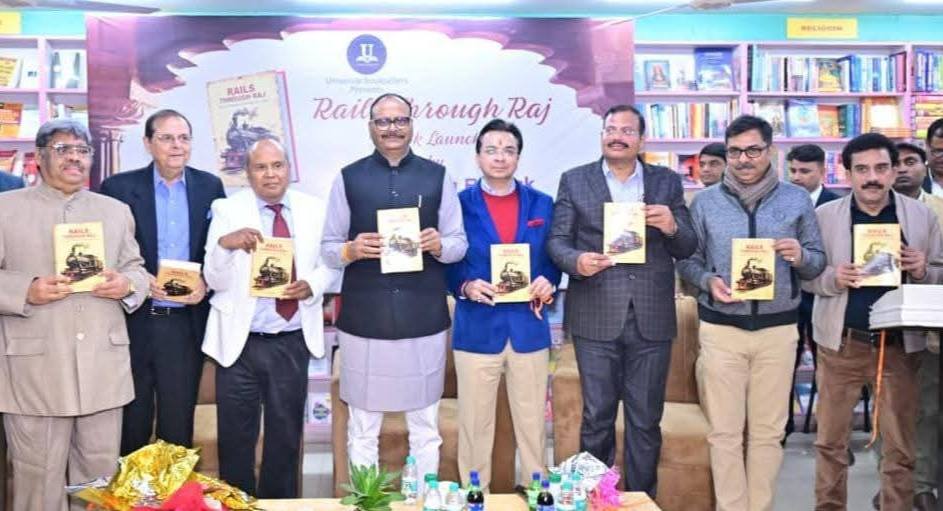
New Delhi: Rails Through Raj – The East Indian Railway (1841–1861), authored by P. K. Mishra (IRSME, 1986 Batch), currently serving as General Manager of Modern Coach Factory, Raebareli, and also associated with RCF Kapurthala, has emerged as a landmark contribution to Indian railway historiography. Published by Heritage Publishers (ISBN: 9788170267461), the 358-page book is being widely hailed as the most comprehensive and authoritative study of the formative years of the East Indian Railway (EIR)—India’s first major railway system under British rule.
The East Indian Railway, conceived in the early 1840s and operational by the 1850s, laid the foundations of what would eventually become one of the world’s largest railway networks. Stretching from Calcutta (now Kolkata) into the hinterland and later towards Delhi, the EIR was often described as the “Highway of Hindostan.” Mishra’s work focuses on the critical two-decade period between 1841 and 1861, when the idea of railways in India moved from vision to reality.

What sets the book apart is its deep reliance on primary archival material, including company records, government correspondence, engineering reports, and contemporary documents rarely explored in such detail. Unlike broader histories of Indian Railways, Rails Through Raj concentrates on the pre-operational planning, political negotiations, financial structures, and early engineering challenges that shaped the East Indian Railway before its large-scale expansion.
The book traces the origins of the railway idea in the 1840s, highlighting debates in Britain and India, the role of railway visionaries such as Rowland Macdonald Stephenson, and the East India Company’s insistence on guaranteed returns to attract private British capital. A detailed examination of the controversial guarantee system explains how assured interest payments encouraged investment while placing a heavy burden on Indian revenues, a policy that defined colonial railway development.
Mishra also documents the formidable engineering challenges faced by early railway builders, from surveying difficult terrain and battling monsoons to constructing bridges over major rivers like the Ganges. The narrative covers early construction milestones, including the opening of the Howrah–Hooghly line in 1854, and the gradual push along the Grand Trunk route.

Beyond engineering and finance, the book explores the socio-economic and administrative impact of the railways, examining how they transformed trade, troop movement, postal services, and governance, while also serving as tools of imperial control. Attention is also given to the human dimension—the lives of Indian labourers and British engineers, early accidents, and contemporary cultural reactions to the arrival of the “iron horse.”
As a senior IRSME officer with decades of experience in railway operations, manufacturing, and heritage preservation, Mishra brings rare insider insight to the subject. His professional background lends both credibility and clarity, making the book rigorous yet accessible. Recent book launches and promotions in late 2025 have further highlighted its contemporary relevance as Indian Railways reflects on its long and complex legacy.
Early readers and historians have described Rails Through Raj as a monumental work of scholarship that fills a long-standing gap in primary-source-based studies of early railway history. The book is expected to appeal to railway professionals, historians, civil services aspirants, heritage enthusiasts, and general readers interested in how 19th-century infrastructure helped shape modern India.
Available on platforms such as Amazon, Flipkart, and select heritage bookstores, Rails Through Raj – The East Indian Railway (1841–1861) is widely regarded as essential reading for anyone seeking to understand the roots of Indian Railways and their enduring impact on the subcontinent.