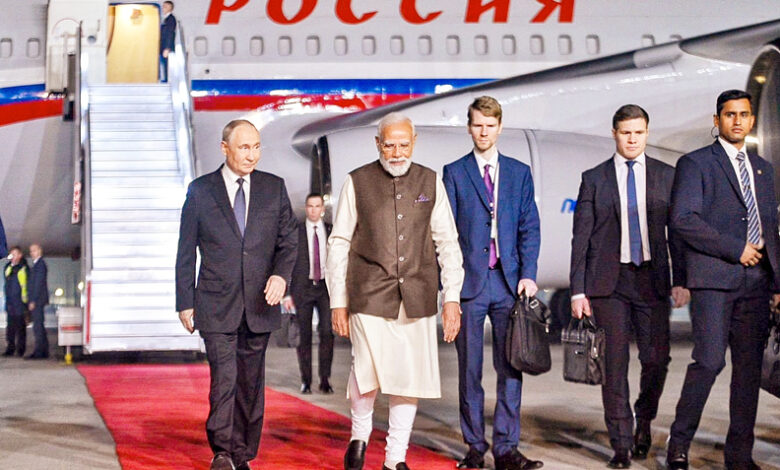
Delhi | Russian President Vladimir Putin’s two-day visit to India concluded with a series of strategic developments that reaffirmed the depth and resilience of India-Russia relations. On the second day of the visit, President Putin received a ceremonial welcome at Rashtrapati Bhavan, paid homage to Mahatma Gandhi at Rajghat, and later engaged in extensive bilateral talks with Prime Minister Narendra Modi at Hyderabad House.
The two leaders finalised major agreements in defence, energy, nuclear cooperation, trade, counter-terrorism, and mobility. A landmark outcome of the dialogue was the shared commitment to achieving USD 100 billion in bilateral trade by 2030, signalling a renewed push toward economic expansion.
Energy, Defence, and U.S. Pressure
In a pointed message to the United States, President Putin said Russia would continue uninterrupted energy supplies to India despite external pressure. His remarks come against the backdrop of Washington’s concerns that India’s increased imports of Russian crude strengthen Moscow economically amid the prolonged Ukraine conflict.
India has maintained that its energy policy is shaped purely by national interest and affordability for its citizens.
Prime Minister Modi also announced 30-day visa-free travel for Russian citizens, aimed at boosting tourism, education and business exchanges.
Putin revealed that Russia will provide portable nuclear technology to India to expand clean energy capacity. Multiple agreements were signed in health, education, food security, transport, shipping, fertilizers, customs and postal services.
A Partnership That Stays Steady Through Global Turbulence
PM Modi described India-Russia ties as a “North Star — steady amid global fluctuations,” recalling the eight-decade-old strategic trust between the two nations. The leaders also discussed the Ukraine conflict and stressed the need for dialogue and diplomacy.
India reiterated that it supports neither side in global conflicts but stands firmly for long-term peace and negotiation. Counter-terrorism emerged as another strong point of convergence, with both countries committing to coordinated efforts against global terrorism.

Geopolitical Message Beyond Bilateralism
Putin’s visit after four years holds strong geopolitical significance. With the world unsettled by the Russia-Ukraine war, the Israel-Gaza conflict and the U.S.’s new tariff regime, the visit underscores that Moscow remains keen on consolidating its Asian partnerships.
For India, the visit reflects a careful balancing act between Washington and Moscow. Analysts view the warm optics between Putin and Modi as a signal that Indo-Russian friendship continues to stand firm despite shifting global alignments.
Russia is already a key partner in India’s nuclear program, especially the Kudankulam Nuclear Power Plant. Negotiations also progressed on a proposed free-trade arrangement, expected to accelerate investments aimed at achieving USD 50 billion in mutual investment by 2025.
A Relationship Rooted in Trust
Putin emphasised that India has maintained strong ties with Russia despite external pressures — a message closely observed by global powers. For India, the engagement reflects a long-standing diplomatic principle of strategic autonomy, shaped by the philosophy of ‘Vasudhaiva Kutumbakam’ — the world is one family.
As global power equations shift, Putin’s presence in New Delhi sends an unmistakable message:
India and Russia continue to see each other as dependable partners capable of navigating geopolitical turbulence together. The visit not only reinforced historical ties but also paved the way for deeper cooperation in the decade ahead.