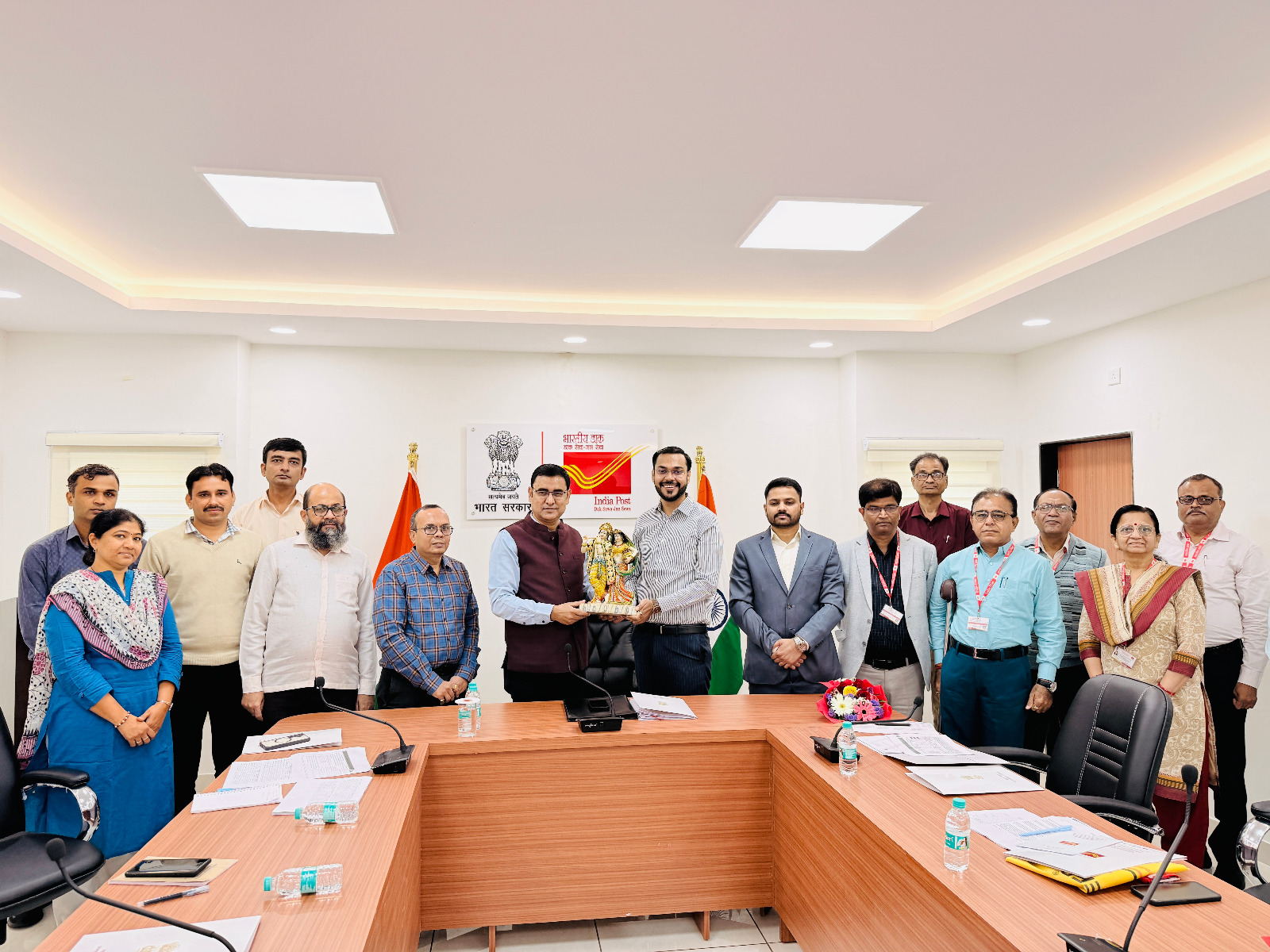
Ahmedabad – In a major initiative to expand postal services and strengthen last-mile connectivity, the Postmaster General of the North Gujarat Region, Krishna Kumar Yadav, has launched the innovative “Postal Warrior Campaign.” The campaign aims to ensure that postal and financial services reach every corner of society under the guiding principle of “Dak Seva, Jan Seva” (Postal Service, Public Service).
The Department of Posts has been actively modernizing its operations by adopting the latest technologies and digital initiatives. Today, beyond traditional mail delivery, India Post has emerged as a trusted institution in areas such as financial inclusion, logistics, e-commerce support, and digital services. These advancements have significantly improved the speed and efficiency of transactions at post office counters and branch post offices.
The “Postal Warrior Campaign,” which began in September 2025 at the branch post office level, was expanded in February 2026 to include sub post offices and head post offices across the region. The primary objective of the campaign is to connect more citizens with the postal network while increasing financial inclusion and business opportunities through the extensive postal infrastructure.
Under the campaign, post offices are categorized into four achievement levels—Silver Warrior, Gold Warrior, Diamond Warrior, and Platinum Warrior—based on business performance. Branch post offices achieving 100 points are recognized as Silver Warriors, those with 250 points as Gold Warriors, 500 points as Diamond Warriors, and 1,000 points as Platinum Warriors. Points are awarded for activities such as opening savings accounts, collecting initial premiums for Postal Life Insurance and Rural Postal Life Insurance, booking Speed Post or parcels, and generating business through the India Post Payments Bank (IPPB).
The North Gujarat Region currently has 2,258 post offices, including 9 head post offices, 344 sub post offices, and 1,905 branch post offices, spread across six postal divisions—Ahmedabad, Gandhinagar, Sabarkantha, Mehsana, Patan, and Banaskantha—along with one Railway Mail Service division.
According to Postmaster General Krishna Kumar Yadav, all 1,905 branch post offices in the region have successfully achieved at least 100 business points and have been declared Silver Postal Warriors. Additionally, more than 1,000 branch post offices have attained the Gold Warrior status, 125 have been recognized as Diamond Warriors, and 20 branch post offices have achieved the prestigious Platinum Warrior category. Among the divisions, Ahmedabad and Patan have reached the Gold Warrior level.
The campaign has also contributed to significant growth in the region’s postal business. By February of the 2025–26 financial year, the North Gujarat Region generated ₹206 crore in total revenue, marking a 21 percent increase compared to the previous year. Notably, revenue from Post Office Savings Bank services crossed ₹100 crore for the first time.

Currently, the region manages around 4.3 million post office savings accounts and 8.9 lakh IPPB accounts. During the current financial year alone, 8.25 lakh new savings accounts and 1.5 lakh IPPB accounts have been opened. Postal Life Insurance and Rural Postal Life Insurance together recorded ₹272 crore in premium collections, while 18.5 million Speed Post and parcel bookings were processed.
Postal facilities have also supported various citizen services. Around 3.15 lakh people accessed Aadhaar-related services through post offices, while over 96,000 individuals used IPPB for Aadhaar services. Nearly 56,000 passport applications were processed through Post Office Passport Seva Kendras.
The region has also taken steps toward social development by declaring 1,100 villages as “Sampoorna Sukanya Samriddhi Gram,” 713 villages as “Sampoorna Bima Gram,” and 350 villages as “Sampoorna Bachat Gram.”
Speaking about the initiative, Postmaster General Krishna Kumar Yadav said India Post plays a vital role in achieving the vision of a Developed India by supporting key national initiatives such as Digital India, financial inclusion, and a cashless economy. He added that the implementation of Advanced Postal Technology (APT) 2.0 is further strengthening transparency, efficiency, and last-mile service delivery across the postal network.
He also highlighted initiatives like “Dak Chaupal,” which aim to take government and citizen-centric services directly to communities at the grassroots level.