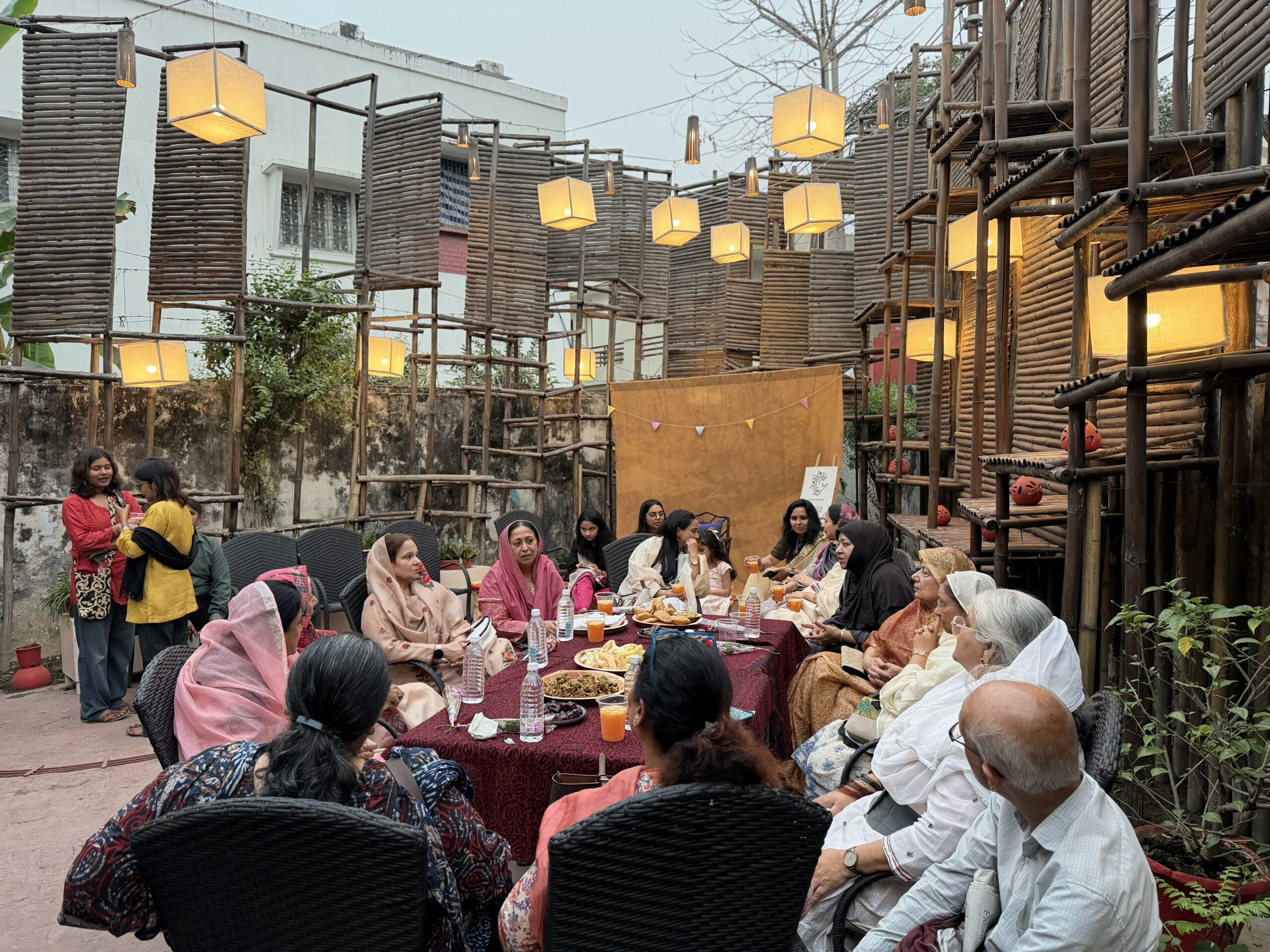
Lucknow: An evening of poetry, reflection and shared community marked a special celebration of Women’s Day during the sacred month of Ramzan, as Lucknow Bioscope, Sanatkada and Naimatkhana jointly hosted a poetry session followed by a potluck Iftar in Lucknow.
The gathering took place at 130, J.C. Bose Road in Qaiser Bagh and brought together artists, writers, activists and members of the local community for an evening that blended literature with collective celebration.
Poetry as Voice and Resistance
The event opened with a powerful poetry session by poet, lawyer and movement organiser Sabika Abbas Naqvi, whose work engages deeply with themes of gender, justice and the lived experiences of women.
Introducing her work, she reflected on the everyday feminism she witnessed growing up, saying that much of what she understands about feminism comes from the resilience and labour of working women, mothers and the women within our homes.
One of the highlights of the evening was her poem “Pinjra Tod,” written in 2013 when she was just 19. The poem begins with the striking line: “Aaj hum apni besharmi ki baatein karenge” (“Today, we will speak about our shamelessness”). Naqvi explained that the poem was inspired by the gender-based restrictions women often face in universities, particularly hostel rules that limit women students’ mobility and access to public spaces such as libraries.
She also shared the inspiration behind another poem, “Mera Kajal,” reflecting on the pressures women face to conform to expectations about their bodies and appearances. She observed that such expectations often silence women’s voices, making it essential to reclaim that voice through expression.
Another moving recitation, “Maadri Jabane,” explored the idea of mother tongue and language as a powerful carrier of identity, memory and belonging.

A Voice Beyond Poetry
Sabika Abbas Naqvi is widely known for her multifaceted work as a poet, lawyer, educator and cultural organiser. She currently leads global movement and campaigns work at Noor and previously served as Editor-in-Chief of South Asian Avant-Garde (SAAG).
She is also the co-editor of the Bystander Anthology, a Rockefeller and CARE Fellow for Arts for Gender Equality, and an INK Fellow. Her poems are taught in universities worldwide. Beyond her literary work, she founded community initiatives such as Baab-e-Ilm, a community education programme, and Sar-e-Rahguzar: Poetry on the Streets.
Community Iftar and Shared Table
Following the poetry session, the evening transitioned into a warm community Iftar potluck, reflecting the spirit of Ramzan and collective sharing. Guests contributed a wide variety of dishes, turning the gathering into a vibrant culinary spread.
The menu included traditional favourites such as nahari-kulcha, haleem and biryani, alongside cakes, fruit chaat and badaam halwa, creating a festive table that brought together diverse flavours and traditions.
An Evening of Connection
As the evening progressed, conversations flowed freely over shared meals, poetry and memories. The event became more than a cultural gathering—it was a space where literature, activism and community intersected.
By bringing together poetry, the observance of Ramzan and the celebration of Women’s Day, the organisers created a meaningful platform for reflection and solidarity—reminding participants that art and dialogue remain powerful tools for building empathy, understanding and collective belonging.