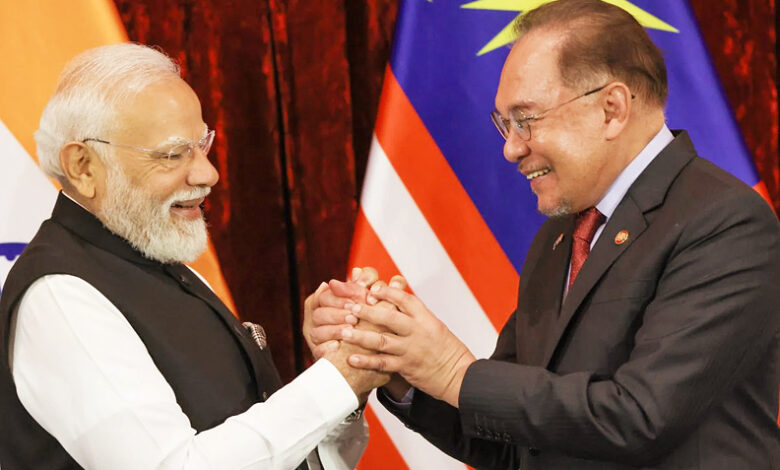
Kuala Lumpur: Prime Minister Narendra Modi’s recent visit to Malaysia has marked a significant turning point in relations between the two countries, setting the stage for deeper strategic, economic, and technological cooperation.
The visit — his first foreign trip of 2026 and the first to Kuala Lumpur in seven years — carried strong symbolic and diplomatic weight. Malaysian Prime Minister Anwar Ibrahim personally received Modi at the airport, a gesture widely viewed as a sign of political priority and renewed warmth in ties.
Repairing and Elevating Ties
The visit comes after a period of mild diplomatic unease, including India’s absence at the October 2025 ASEAN Summit and differences that emerged following the Pahalgam terror attack. Although Malaysia condemned the attack, its earlier offer to mediate between India and Pakistan had caused discomfort in New Delhi.
Observers say the visit was not merely about repairing relations but about elevating them to a new strategic level.
A key diplomatic outcome was the explicit mention of “cross-border terrorism” in the joint statement — a first in India–Malaysia declarations. While terrorism had been condemned in previous joint statements (2015, 2017, and 2024), the specific terminology is being viewed as a diplomatic gain for India, which has consistently raised concerns about Pakistan-sponsored terrorism on global platforms.
India and Malaysia are also set to co-chair ASEAN’s counter-terrorism sub-committee until 2027, potentially giving New Delhi greater scope to institutionalize discussions on cross-border terrorism within regional forums.
Comprehensive Strategic Partnership in Action
In August 2024, both nations upgraded their ties to a Comprehensive Strategic Partnership. The current visit aimed to operationalize that framework. Eleven agreements and Memoranda of Understanding (MoUs) were signed, covering defence, energy, digital technology, healthcare, security cooperation, and semiconductors.
Notably, sensitive issues such as the extradition of controversial preacher Zakir Naik were absent from the public joint statement — a move seen as mature diplomacy, focusing on convergences rather than differences.
Semiconductor Cooperation at the Core
Semiconductor collaboration emerged as a central economic pillar of the visit. Malaysia is among the world’s leading semiconductor exporters, while India is in the early stages of building domestic manufacturing capacity.
The joint statement acknowledged the strategic importance of semiconductor supply chains and outlined plans for technology cooperation. With global efforts underway to diversify production networks and reduce overdependence on specific geographies, India–Malaysia collaboration could create new regional manufacturing ecosystems.
Experts believe this partnership may significantly accelerate India’s semiconductor ambitions while strengthening Malaysia’s position within diversified Indo-Pacific supply chains.

Expanding Trade and Local Currency Settlement
Bilateral trade between the two countries stands at approximately $8.5 billion, with commitments made to expand and diversify the trade basket. A notable development was the push for trade settlement in local currencies — the Indian Rupee and Malaysian Ringgit — reflecting a broader global trend toward reducing dollar dependence.
India imports palm oil and electronics from Malaysia, while exporting aluminum and petroleum products. Both sides acknowledged the need for a more balanced and diversified trade structure, particularly through high-technology sectors.
Malaysia’s interest in BRICS membership was also referenced in discussions, a diplomatic signal given India’s presidency of the grouping this year.
Geopolitical Balancing in the Indo-Pacific
The visit unfolded amid broader Indo-Pacific strategic shifts. With intensifying competition between major global powers, Malaysia is pursuing a multipolar balancing strategy. India, seen as a rising economic and strategic power, fits naturally into this calculus.
The visit coincided with a trip to Malaysia by Pakistan’s naval chief, underscoring Kuala Lumpur’s longstanding defence ties with Islamabad. However, analysts suggest Malaysia is seeking strategic diversification rather than alignment with any single axis.
For India, expanding engagement with ASEAN nations aligns with its “Act East” policy — now evolving beyond economic outreach into a comprehensive strategic framework.
A Pragmatic Strategic Reset
The joint statement’s emphasis on counter-terrorism, economic cooperation, semiconductors, digital technology, and defence reflects a relationship grounded in strategic realism rather than episodic reactions.
PM Modi’s Malaysia visit must be viewed within the larger context of Indo-Pacific power dynamics, ASEAN centrality, evolving global supply chains, and competitive regional narratives. The explicit reference to cross-border terrorism is diplomatically significant, but its real test will lie in sustained regional policy coordination.
If momentum continues, the India–Malaysia partnership could become a key pillar in Southeast Asia’s evolving strategic architecture — influencing regional alignments and reshaping diplomatic equations in the years ahead.