Lucknow: Lucknow, the City of Nawabs, has long been a cradle of learning—an elegant blend of Mughal-era intellectualism and contemporary educational ambition. Primary education in the region dates back to the 18th century, when celebrated institutions such as Farangi Mahall shaped holistic learning among the elite, laying early foundations for structured pedagogy.
Post-independence, the landscape began to shift dramatically. The 1950s ushered in a new era with the rise of institutions like City Montessori School (CMS). What began in 1959 as a modest nursery school soon evolved into the world’s largest school chain, enrolling over 61,000 students across 20 campuses by 2023. This period marked a decisive move away from rote instruction toward child-centric teaching, supported by Uttar Pradesh’s drive for universal primary education. By the 1980s, government initiatives such as halkabandi schools brought indigenous learning systems into the mainstream, even as private chains helped democratize access to quality education.
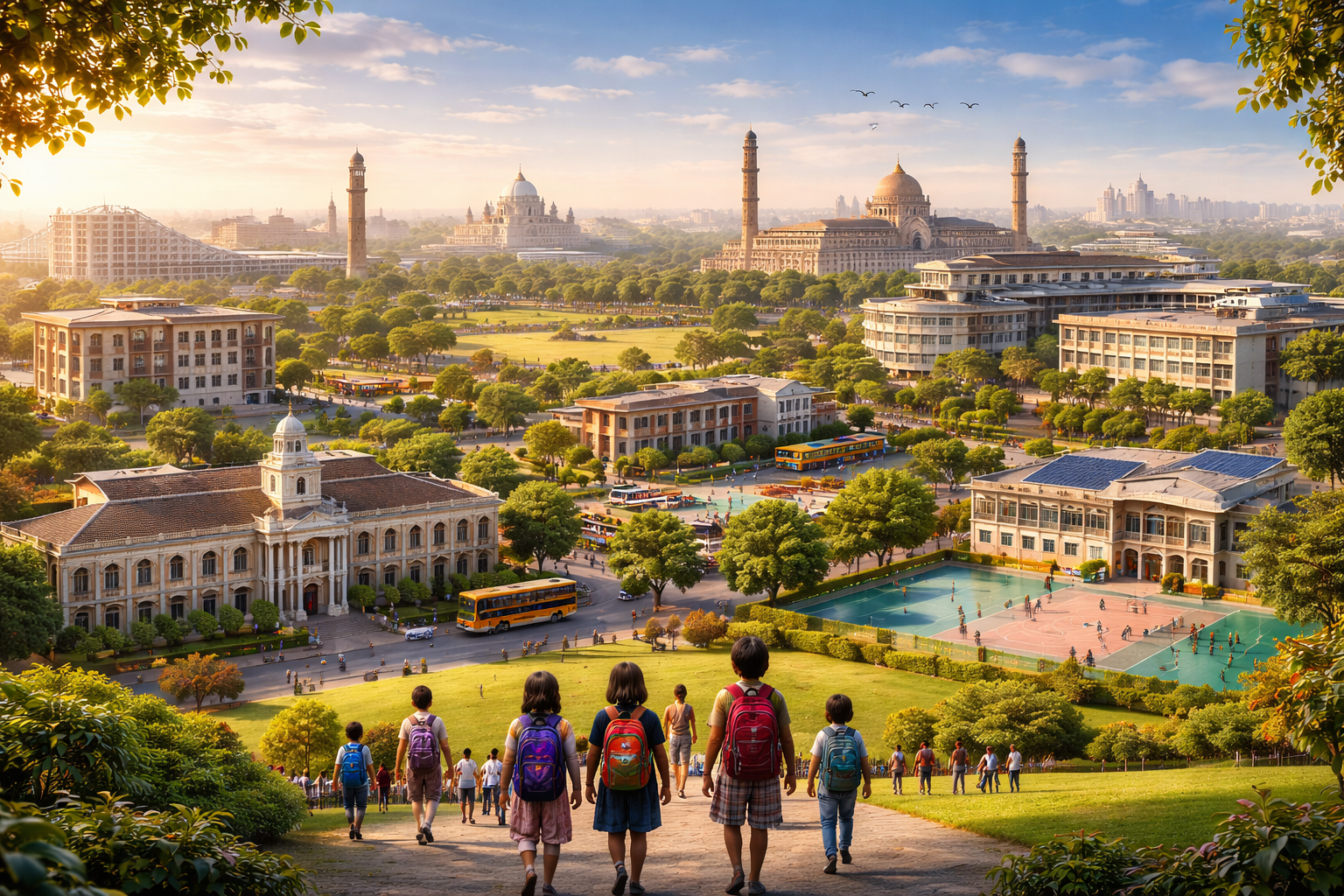
Today, Lucknow is home to more than 700 primary schools, offering CBSE, ICSE, and UP Board curricula enriched with STEM, the arts, sports, and multidisciplinary learning models.
The 1990s and 2000s saw the rapid expansion of branded school networks, with early childhood education emerging as a priority for urban families. Pride and Joy Preschool, stands as a defining example of this shift. Operating across seven centres in Aliganj, Gomti Nagar, Aminabad, and surrounding areas, it caters to children aged 2–6 through play-based learning, nurturing creativity, values, and emotional intelligence. With a parent rating of 4.8/5 and a mission of “empowering confident learners,” it has become a trusted starting point for Lucknow’s young learners.
Similarly, Ekana International Academy—set within the elite sporting ecosystem of Gomti Nagar Extension’s Sportz City—offers a distinctive fusion of academics and athletics. Established as a boarding school with limited annual intake, its modern infrastructure includes professional cricket academies and sustainability-driven architectural design. For primary students, Ekana provides a holistic CBSE-aligned framework that integrates life skills and sports, drawing inspiration from Lucknow’s athletic heritage anchored in the nearby Ekana Cricket Stadium.
Among emerging institutions, Akhilesh Das Gupta School (ADGS) represents a fresh wave of innovation. Established by the three-decade-old BBD Group, this 7-acre CBSE-affiliated campus in New Gomti Nagar serves students from early years to Grade 8. With a 10:1 student-teacher ratio, state-of-the-art laboratories, expansive green areas, and the backing of an alumni network exceeding 100,000, the school champions fearless imagination and experiential learning. Admissions for 2026–27 are already generating significant interest, underscoring the city’s appetite for progressive, value-driven education.
The Gyan Group’s upcoming venture further reflects the sector’s momentum. Building on the legacy of the CP Group (est. 1991), Gyan Heritage Schools—known for their commitment to equitable access through initiatives such as Gyan Shala for children from underprivileged communities—plan to launch a new primary campus in Lucknow by mid-2026. Targeting underserved neighbourhoods, the school promises tech-enabled classrooms and a curriculum on par with top-tier private institutions, aligning with Uttar Pradesh’s renewed emphasis on Sanskrit and cultural learning.

This expansion builds on the foundation laid by established chains like Lucknow Public School (LPS), founded in 1988, which now operates 11 branches with a focus on affordable excellence.
Other prominent institutions add depth to the city’s educational fabric. Seth M.R. Jaipuria School, known for its inquiry-based approach and CBSE curriculum from nursery to Class 12, maintains a 30:1 ratio across several city campuses. GD Goenka Public School complements this with pre-nursery programs emphasizing personalised attention through an 18:1 ratio and global exposure. VIBGYOR High’s 10:1 structure integrates arts and technology for Classes 1–12, while Delhi Public School (DPS) offers an even more focused 8:1 ratio for foundational learning.
Heritage pillars such as La Martiniere College (ICSE, 25:1) and Loreto Convent continue to preserve their historic ethos while adapting to contemporary needs, serving diverse primary cohorts. Schools like Springdale and Amity International add distinctive character-driven educational philosophies, often praised on community forums for fostering well-rounded development. Siddhant World School completes the city’s top-tier offerings with blended curricula designed for holistic growth.
As Lucknow prepares for the addition of 16 new specialised schools by 2026, the trajectory of primary education points toward greater inclusivity, innovation, and diversification.
From its nawabi heritage to its embrace of digital-age learning, Lucknow’s school ecosystem has evolved into a vibrant mosaic. These institutions are more than centres of instruction—they are launchpads for the leaders of tomorrow, ensuring every child in the heart of Awadh has the opportunity to shine.