– Team Siddhanta Knowledge Foundation
Lucknow: It is language that tells the story of mankind’s journey, speaking across the centuries along with archaeology. Understanding the Sanskrit origins of many words helps us understand our own history better.
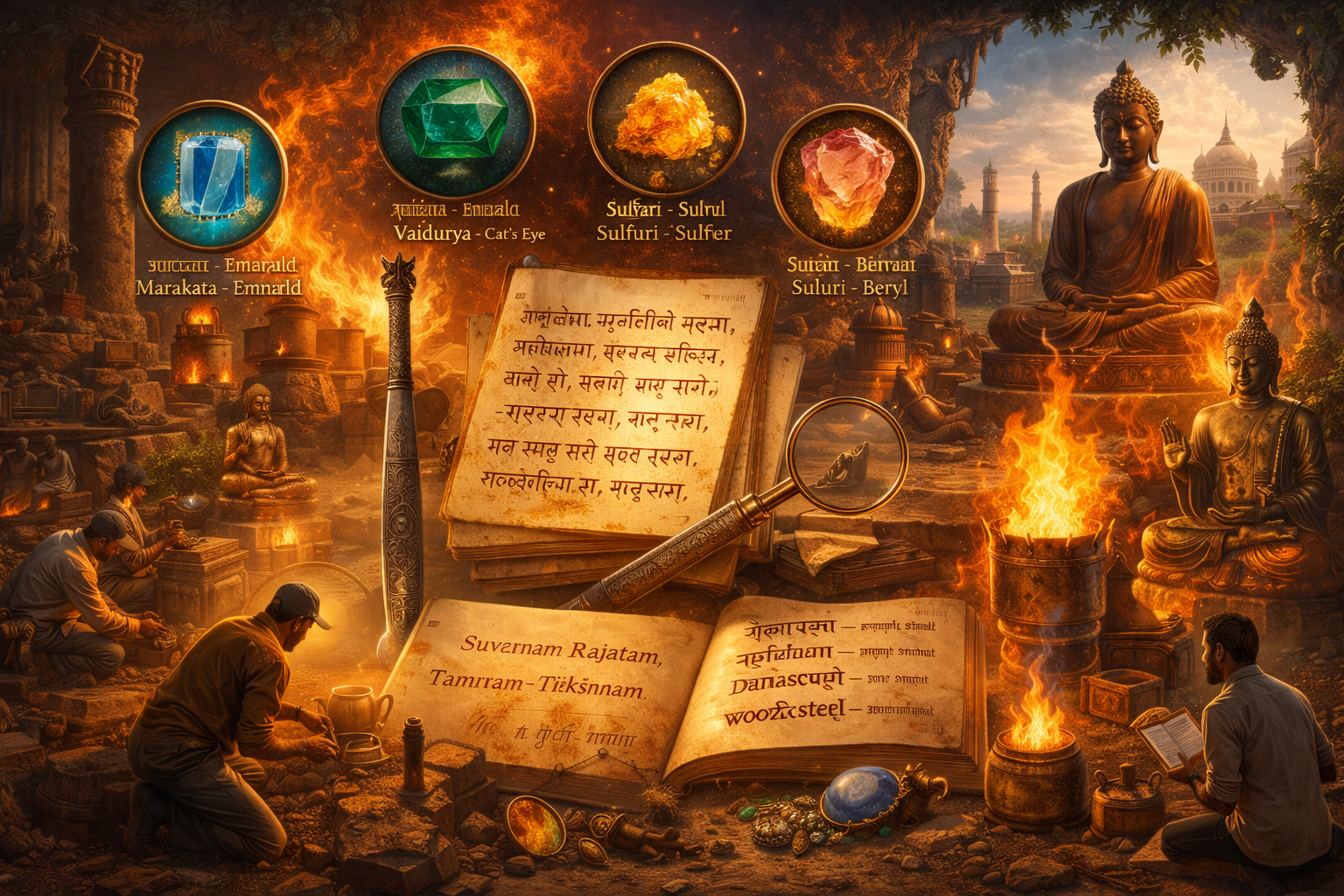
Many scientific terms in current chemistry have roots in Sanskrit, demonstrating ancient India’s influence on material sciences. The word ‘beryl,’ is derived from the Sanskrit veluri, a term Panini used, linked to vidūra (far). This was a mineral source of the element beryllium, mined in Tamil Nadu,far south from Panini’s region. Cat’s eye gemstones are known as vaidurya. The term emerald is also said to come from the Sanskrit marakata through its Greek version of ‘smaragdos’. The term ‘sulfur’ is thought to come from śulvāri in Sanskrit, reflecting ancient knowledge of sulfur compounds and their properties. Sulfur was widely used in early Indian metallurgy and chemical applications. The mineral corundum, known for its hardness and use in abrasives, derives from the Sanskrit word kuruvinda.
Western historians usually speak of worldwide civilizational evolution from Stone to Bronze to Iron Ages. This however overlooks India’s distinct timeline, where advanced metallurgy was present much earlier than in other regions. Vedic texts, for example, demonstrate knowledge of various metals without fitting neatly into the epochs of Western study.
In the Krishna Yajur Veda’s Taittiriya Samhita (4.5, 4.7), six metals — gold, silver, copper, iron, lead, and tin are explicitly mentioned, showing an awareness of these metals in their pure forms rather than as ores or alloys and archaeological artefacts affirm that metallurgical practices were indeed well-known. Even today, experts are quite amazed at the metallurgical skill that built the rust-free iron pillar of Delhi.
Always rare and precious, gold was utilized by almost every ancient civilization, including India, where it features prominently in early Tamil Sangam literature with various local names like Īgai, Seizhai, Ponpol, and Kilicirai. Interestingly, similar Sanskrit terms, as noted in Arthaśāstra, point to a shared cultural and philosophical influence across these regions.
Archaeological findings reveal a uniformity in iron artefacts across India, suggesting either centralized knowledge dissemination or a widespread shared knowledge of iron processing. We also understand that various metal items were exported from India to Europe many millennia ago.
The Damascus sword, famed for its resilient wootz steel, originated from Indian metallurgy. ‘Wootz’ stems from the Tamil word ‘Urukku’ (later ‘Ukku’ in Telugu and Kannada), emphasizing India’s metallurgical influence extending as far as Damascus.
Steel, combining iron and carbon, was highly valued for weapons, especially swords that needed to be both strong and durable. The alloying process of creating brass by combining copper with zinc is also described, revealing ancient Indians’ skills in creating metals that mimicked gold and had superior stability, as seen in terms like Svarṇakakṛta.
Indian expertise in zinc production using the unique closed-furnace method, developed to capture volatile zinc, was the envy of the ancient world.
Copper artefacts, like the massive standing Buddha statue from Sultan Ganj, testify to the significant role of copper. The art of creating bronze (copper-tin alloy) goes back to the Harappan civilization and persists today, particularly in Swamimalai, where artisans still use traditional lost-wax techniques (Madhu UcchisṭhaVidhānam).
The famous Aranmula metal mirrors from Kerala, made with a specific type of bronze, highlight the intricate understanding of alloying for particular uses, especially reflective surfaces.

We have texts such as Rasārnava and Rasaratnasamuccaya that provide remarkable glimpses into knowledge of ancient India. Dating back as early as 300 BCE and extending to 1200 CE, they laid foundational principles that resonate with modern scientific practices. In Rasārnava, we find detailed references to the types of copper ores. For example, a verse states:
Mākṣikodvividhastatra, pītaśuklavibhāgataḥ,
vimalastrividho devi, śuklapītaścalohita.
This verse, which differentiates between types of copper ore such as makshika and vimala, reveals a sophisticated awareness of ore characteristics based on their specific forms connected with extraction procedures for metals.
Notably, these ores named makshika and vimala are believed to refer to copper pyrites, while sasyakadenotes copper sulphate. Ancient Indian chemists, or rasavādins, were skilled in processes similar to those in modern laboratories, mentioning processes such as Svedana (steaming), Mardana (grinding or digesting), Mūrcana(rendering inactive), Utthāpana (sublimating), Patana (distilling). Siddha literature in Tamil employs similar terms, indicating a shared cultural lexicon for chemical procedures across regions.
In the Rasārnava, we also see what may be the world’s earliest documentation of flame tests. The text reveals that flame color changes when certain metals are introduced and can be used for material identification. Gold produces a yellow flame, silver a white one, copper a blue one, and iron a black one. They understood sulfur’s interaction with copper to produce distinctive colors, as reflected in the term śulva, meaning copper-sulfur compounds.
One of the most impressive achievements in Rasārnava, is the ordering of metals by reactivity suggesting a rudimentary reactivity series:
suvarṇam, rajatam, tāmram, tīkṣṇam, vangam, bhujangamam, lohantu, ṣaḍvidam, taccha, yathāpūrvam, tadakṣayam.
This ancient sequence demonstrates understanding based on practical observation with furnaces or puṭas and characterized by furnace dimensions and the amount of fuel required for specific metals.
https://siddhantaknowledge.org/